EDITOR’S NOTE: Seattle’s Child publishes health alerts from Public Health — Seattle & King County as a service to our readers. The alert below was written by the health department and have not been edited by our staff.
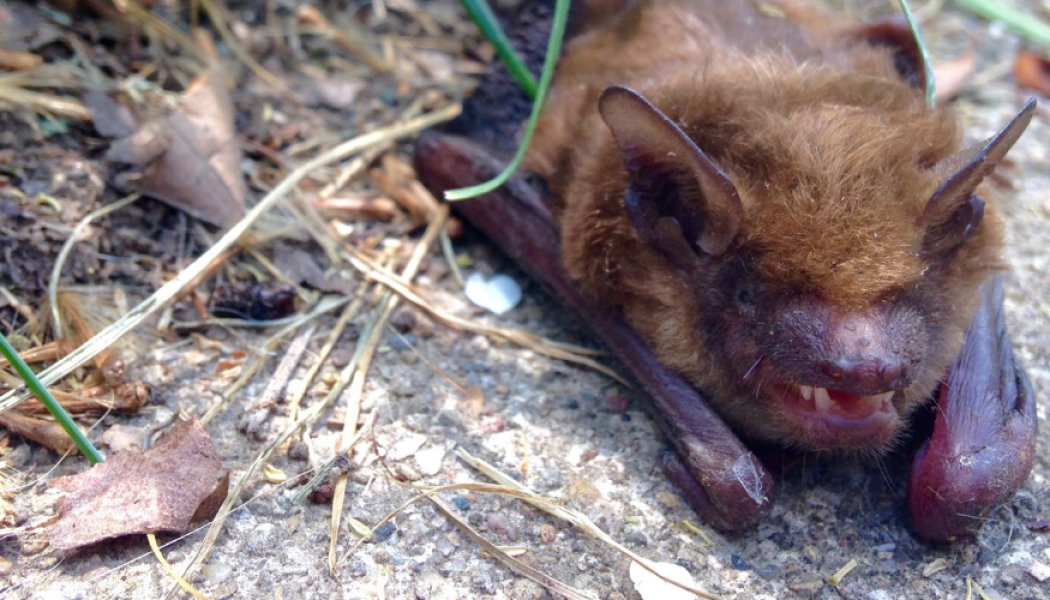
A rabid bat was found in Renton on July 28 at Gene Coulon Park. The bat was found on the sidewalk at the south end of the park, in the area near the park playground, south shelter and park restrooms. Anyone who might have had physical contact with this bat (even if not bitten) could be at risk and should seek medical evaluation immediately or call Public Health at 206-296-4774 to determine if rabies preventative treatment is necessary.
The bat was reported to park staff by members of the public who then notified Public Health. It was euthanized by an animal control and Public Health tested the it for rabies and received a positive test on July 29, 2026.
To date, no people are known to have had direct contact with this bat. If you had any contact with this bat, please call Public Health or seek medical evaluation immediately.
The bat was found in the circle marked on the map below.
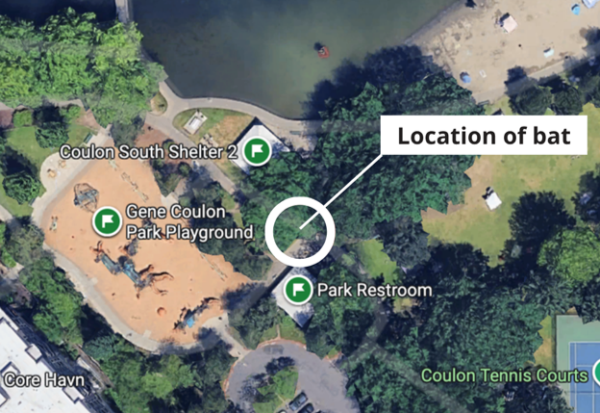
(Photo courtesy Public Health — Seattle & King County)
Second rabid bat identified in less than two weeks
It’s the second rabid bat warning sent out by the county public health department in the last two weeks. A bat was found in Seattle on July 15 on the sidewalk on University Way Northeast, between NE 41st and NE 42nd streets. This is near Parrington Lawn, on the University of Washington campus, and is a busy area with many businesses.
Anyone who might have had physical contact with this bat (even if not bitten) could be at risk and should seek medical evaluation immediately or call Public Health at 206-296-4774 to determine if rabies preventative treatment is necessary.
Rabies is a life-threatening disease but can be prevented if treatment is given before symptoms appear.
The bat was first identified on July 15, 2026. Public Health – Seattle & King County received multiple public calls about the bat and directed people to contact animal control. The bat was euthanized by an animal control agency on July 16, 2026. Public Health tested the bat for rabies and received a positive test on July 17, 2026.
Public Health confirmed the callers reporting the bat did not have physical contact with the bat. To date, no other people are known to have been exposed to this bat. If you had any contact with this bat, please call Public Health or seek medical evaluation immediately.
Who is at risk
Any person or animal that touched or had contact with the bat or its saliva could be at risk of getting rabies, which is almost always fatal once symptoms begin. Fortunately, rabies can be prevented if treatment is given before symptoms appear.
“Rabies is treatable if caught before symptoms appear, so identifying anyone who has had contact with the bat as soon as possible is important,” said Jocelyn Mullins, Public Health Veterinarian at Public Health – Seattle & King County. “Contact includes touching a bat, being bitten or scratched, or having any other bare skin contact with a bat or its saliva.”
If you see a bat, do not touch it!
It is estimated that less than 1% of bats are infected with rabies. Bats with unusual behaviors, including inability to fly, flying during the daytime, making a lot of noise or otherwise acting sick, are more likely to have rabies. Healthy bats rarely approach humans.
But since you cannot tell if a bat has rabies by looking at it, it’s safest to assume that any bat could have it. Never touch a bat!
Touching a bat or its saliva–including being scratched or bitten–could put you at risk for rabies exposure. You are also at risk if you wake up with a bat in your room because people don’t always wake up if touched or bitten. Teach your kids not to touch bats and be sure to keep your pets away from bats.
If you think you or your children or pets may have touched or had contact with a bat, take immediate action:
- Wash the area that came into contact with the bat thoroughly with soap and water.
- Contact your medical provider as soon as possible.
- Call Public Health: 206-296-4774 to report the exposure and assess whether you might have been exposed to rabies and whether the bat should be tested for rabies
If you find a bat inside your house
- If the bat hasn’t not come into contact with a person or pets: Close doors to other parts of your home and secure pets away from the location of the bat. Open windows and allow bats to leave your home.
- If you think you had contact with a bat, or if someone wakes up from sleeping with a bat in the room: try to trap it safely so it can be tested for rabies. Wear thick gloves and never handle a bat with bare hands. More information on how to safely catch a bat and have it tested for rabies can be found on Public Health’s bats and rabies webpage.
Pets are at-risk for getting rabies from bats, too
In Washington State, all dogs, cats and ferrets are required to be up-to-date on their rabies vaccinations. Vaccinate your pets for prevention. Talk to your veterinarian to see if your pet needs to update their rabies vaccine.
If you suspect your pet has come into contact with a bat, call your veterinarian, even if your pet is up to date on its vaccinations. Your veterinarian may need to give it a booster shot to protect it!
Never touch or feed wild animals
In Washington state, bats are the main animal known to be carry rabies. Rabies is extremely rare in other animals in Washington. Still, it’s important to avoid contact with unfamiliar animals.
- Do not handle, feed, or unintentionally attract wild animals with open garbage cans, uncovered compost bins, or pet food left outside.
- Never adopt wild animals or bring them into your home. Call animal control, an animal rescue agency or wildlife rehabilitator like PAWS Wildlife Center for assistance with sick wild animals.
- Teach children never to handle unfamiliar animals, wild or domestic, even if they appear friendly.
- Call your local animal control agency to remove any stray animals from your neighborhood.
Keep bats out of your home
If you have problems with bats getting inside your house, you can do a lot to make your home more bat-proof. Putting screens on windows can prevent bats from accidentally flying into your home. Sometimes, bats are attracted to nesting in attics or inside a wall. The Washington State Department of Fish and Wildlife has excellent tips on easy things you can do to your home or building to prevent bats from getting inside.
Bats also help us
Bats are a vital part of our local ecosystem. Bats eat large amounts of night-flying insects like mosquitos, termites, and agricultural pests, reducing the risk of mosquito-related diseases and the need for pesticides in our community. We need bats to fill this important role.
It’s best to keep your distance from bats as a precaution, both for their sake and for yours.
Rabies and pets
If your pet might have had contact with this bat, contact your veterinarian immediately. Dogs, cats, ferrets, and horses should be current on their rabies vaccine but will need to be revaccinated if they had contact with a bat. The best way to prevent rabies in pets is to ensure they are up-to-date on rabies vaccinations.
More about rabies
Rabies is dangerous, but it can be prevented if treatment is given before symptoms develop.
- If someone has had contact with a bat, treatment can prevent infection. This treatment should be given as soon as possible.
- Rabies is a viral disease of the central nervous system that is almost always fatal once symptoms begin.
- The virus is found in the saliva of an animal with rabies and is usually transmitted by a bite or scratch. Because rabies is a life-threatening disease, medical advice must be sought promptly if a bat comes into contact with humans or animals.
For more information about how to safely capture a bat in your home and how to safely avoid bats, visit: kingcounty.gov/bats .
This article is published with permission from Public Health Insider, the official blog of Public Health – Seattle & King County.