|
Courtesy of Tomash Devenishek |
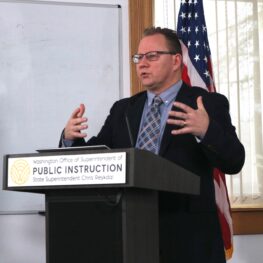
It's not the easiest way to start a new position, but Dr. Susan Enfield, Seattle Schools new interim superintendent, took the dive this week and personally answered several of the questions posted by parents during a special Ask the Superintendent event on the Seattle's Child Family & Kids section of the popular Seattle ask and answer site Questionland.com.
More than 60 questions were posted on the site in early April. On April 13, Enfield signed on and answered 11 of them. Here are those questions and her responses:
How many "academic coaches" does the district employ that don't directly teach students?
ENFIELD: We have 86 academic coaches from multiple departments who support math, literacy, science, special education, English Language Learners, data analysis and new teachers. Given current budget reductions and our commitment to prioritize funding in the classroom, we have cut 40 academic coaching positions in the last two years. But it is a balancing act, because coaches play a key role in teachers' professional development, and research shows that coaching can be very effective in improving teachers' instructional practice and raising student achievement. There are 12 coaches based in schools, and the rest support schools from the central office. Most of these positions are funded through grants.
What is your plan for dealing with the large maintenance backlog at our schools?
ENFIELD: We recognize there is a backlog of maintenance work at our schools. Our buildings are aging and it's important to create safe, clean buildings for our students, teachers and staff. A key priority for our Facilities Department is to make repairs to the District's 110 sites, and reduce that backlog.
In 2009, the department conducted an analysis of the facilities to prioritize the work that needs to be done. For the 2010-2011 school year, a Maintenance Zone Crew was implemented to focus specifically on the complete list of work orders at each school that add to our Maintenance backlog, if not completed. Concentrating resources at a single school to complete the entire backlog of work orders enables us to reduce the backlog at a faster rate. To date, our Zone Crews have visited 54 schools completing 2,291 work orders.
For the 2010-2011 school year we implemented a new work order and preventative maintenance system to increase efficiency. Our custodial teams now complete preventative maintenance on our existing building systems on a regular basis. By performing preventative maintenance we essentially slow the backlog. To date we have completed 3,577 preventative maintenance work orders, a 40 percent increase over last year.
We will continue to look at maintenance of our buildings, and how to best respond to repair needs. Our core mission is to educate students, and to do that, they need a clean, safe and well functioning school. Our capital staff work together with our custodial and maintenance staff to design and construct new buildings and remodeled schools that will last longer, operate more efficiently, and be easier to maintain in the long run.
ENFIELD: Our core mission is to ensure all students receive a quality education. When it comes to making budget decisions, it is our priority to protect funding that directly impacts classrooms and schools.
Central Administration is not just administrators. It also includes certificated and classified support staff found in major departments including Human Resources, the office of the Superintendent, Board of Directors, Legal Services, Business & Finance, Payroll, Accounting, Grants, Technology, Communications, and all of Teaching & Learning. It also includes administrative support for Food Services, Transportation, Maintenance, Operations, and Community Service. In addition to the costs of personnel in all of these areas, Central Administration also includes non–personnel costs related to administrative functions including, but not limited to, elections, audits, printing, mailing, supplies, contractual services and equipment.
Our District has made significant cuts to Central Administration over the past three years, primarily in personnel. During the 2008-09 school year – as currently shown on the state Office of Superintendent of Instruction (OSPI) website – Seattle's Central Administration percent of budget was slightly above 9%. Over the last several years since central office budget reductions have occurred, that figure has dropped. For the current 2010-11 school year, Seattle Public Schools budget submitted to OSPI shows a total Central Administration figure below 7%. We believe that level will be maintained or decreased next year too.
Seattle Public Schools will continue to look at efficiencies in our administration. It is also important to remember that cuts to Central Administration can create unintended consequences not only to these various departments, but can cause ripple effects to our schools. We are mindful of the delicate balance that must be maintained in order to also make sure our schools still get the support they need and that essential services are completed at an acceptable level.
Will you work to get rid of the MAP test?
ENFIELD: The MAP (Measures of Academic Progress) test gives teachers, principals, district leaders, community members and families an additional data point in determining student progress. The MAP test has been shown to be highly informative in assessing student progress toward passing the state tests like MSP (Measure of Student Progress) and HSPE (High School Proficiency Examination). Because MAP provides valuable information in monitoring student and school progress, we will retain MAP in our schools.
As a system, we have an obligation to ensure all students are progressing in their learning – including those needing added support to reach proficiency on state standards, and those who need to be challenged to go beyond those standards. We recognize, however, that we have had challenges with implementing this assessment in all our schools. I have directed our technology, research and planning departments to review implementation school by school and ensure we have provided the highest levels of service and support possible.
We also recognize that there is room for review and improvement. District and school leaders are currently engaged in a process of determining how policy and practices associated with MAP (such as administering two tests vs. three tests per year) could or should be altered. We hope our review and changes will improve our ability to use MAP data as a tool to tailor teachers' instruction to students' needs and allocate resources and supports to schools where necessary.
Is the district still planning on bringing in Teach for America teachers even if the costs are not currently fully funded? ENFIELD: Under our agreement with Teach for America (TFA), TFA corps members could apply for teaching positions during the District's open hiring process. The agreement does not guarantee that any TFA corps members would receive either an interview or a position. If any TFA corps members are hired by SPS, they automatically become full union members, just like any other new teacher, and are subject to the same hiring, evaluation, discipline and seniority rules as all teachers. In partnership with a local university, corps members obtain their full state teaching certification and many also obtain a Master of Arts degree in education during their two years. 10th grade OSPI Math test scores=> Black Pass rates: SPS=12.5%, Cleveland=5.7%, RBHS=3.9%. Why is "Discovery still tolerated"?
ENFIELD: We are in our second year of implementing the Discovering Math series and it generally takes at least three years of full implementation of any program to see results. It is important to remember that the quality of classroom instruction is the most important factor in student learning. A key part of our core work has been, and will continue to be, providing teachers and support staff with the tools they need to support student learning. We are also committed to connecting students and their families with in-school, online and community-based resources that provide learning support, such as tutoring organizations, online math help, and math enrichment opportunities like Math Camps or Math Day at the University of Washington. We want to make sure our students are getting the help they need.
ENFIELD: One goal of curriculum alignment is to improve the quality and content of the core academic courses designed to prepare students for post-secondary success. The courses identified in the science sequence were selected not only because they are state requirements, but also because they have been shown to have a dramatic impact on college readiness. Through the District's work in rebuilding a standards-based curriculum, the core academic courses were revised to provide students with a more rigorous treatment of the fundamental skills and knowledge needed to prepare students for college-level work.
The science sequence does not preclude students from taking advanced science courses; in fact, the vertically aligned sequence supports students as they advance to higher-level courses. In addition, any school or individual teacher can create a course that embeds any of the core course standards into a unique course and submit it for validation – a process that ensures the standards are addressed, allowing students to fulfill those requirements.
Is summer school currently available for all students working below grade level? If not, why not?
ENFIELD: Unfortunately, we had to eliminate summer school this year because of budget constraints. This is not a decision we wanted to make, or one we made lightly. Students who want to explore other summer school options should check with their high school counselor, as each high school has a resource list of summer school options that are available in the Seattle area.
We have a list here: https://tinyurl.com/sps-summerssemester-2011
What is Singapore Math and why is only one school using it? That school appears to have the highest Elementary Math MSP scores. ENFIELD: Singapore Math is a comprehensive program that touches on all math areas: computation fluency, processes and problem solving. When we adopted our Everyday Math program, which also addresses those three math areas, we also adopted one portion of Singapore Math as a computational fluency supplement. Schmitz Park Elementary requested and received a waiver to use the entire Singapore Math program as its core. When elementary math comes up for adoption again, all programs will be considered and we will take into consideration the successes at our current schools. In the meantime, we are working to get better at replicating successful practices across our schools. Additionally, it is important to note that while the School Board adopts core materials, like Everyday Math, schools choose what supplements they use and if they wish, they can use Singapore Math in addition to the core materials. How will you support the needs of alternative schools in the district? ENFIELD: I have been meeting with the Alternative Schools Coalition and alternative schools principals since last year. A few months ago, I asked Phil Brockman, Executive Director of Schools for the Northeast Region, to coordinate this work along with John Miner, principal at Thornton Creek. The group is developing criteria for defining alternative schools and will also be conducting a self-study involving parents, students and staff to determine what is working well and what we can do better. We will use these study results to build on past success in an effort to ensure our alternative schools are meeting our community's needs.