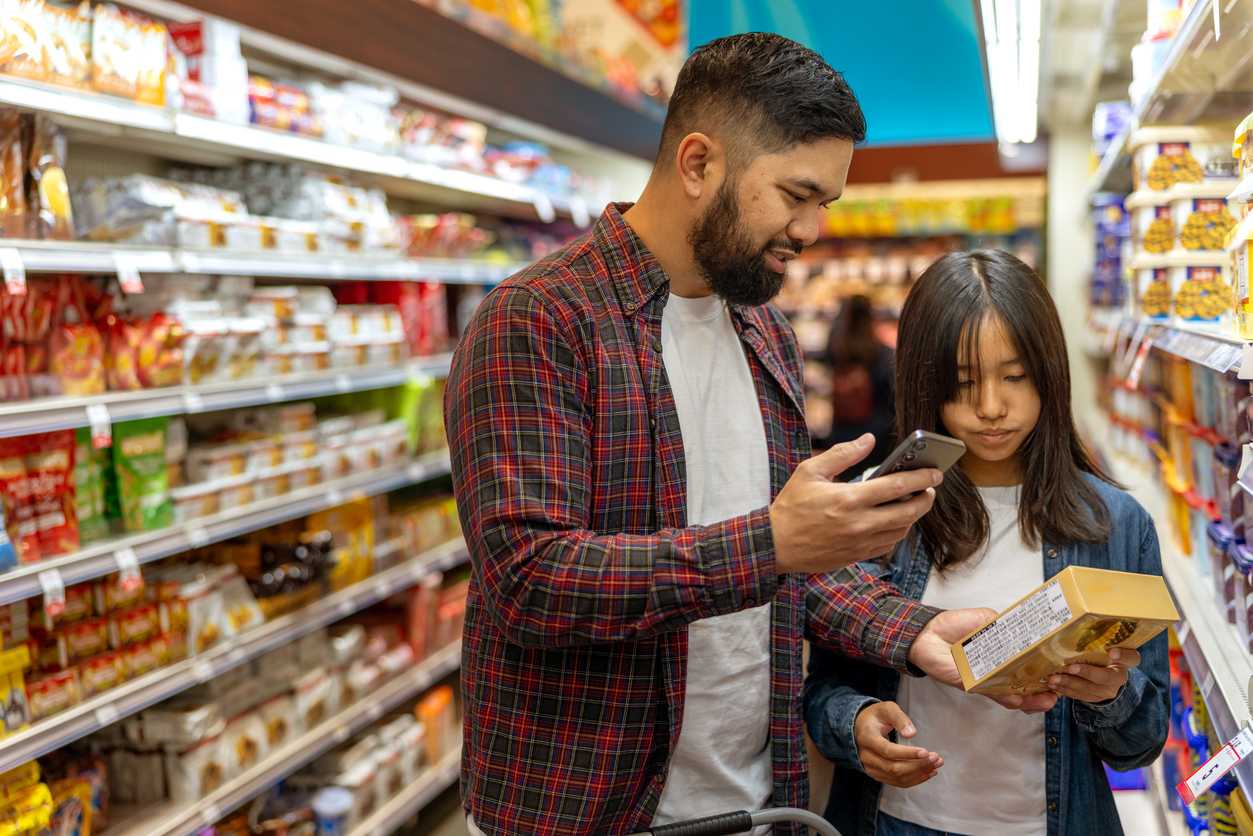
As parents trying to get by on a budget, what we don’t need is more surveillance. Especially in our grocery stores.
Especially when that surveillance could be used against us; for example, making us pay more for milk, bread, diapers — name your family staple — than the person standing behind us in the checkout line.
Especially when that surveillance has the potential to further the inequities between families with means and those without, the haves and the have-nots.
What surveillance am I talking about? Surveillance pricing. The Federal Trade Commission describes personalized pricing as the use of personal data to set prices based on what a company believes an individual shopper is willing to spend.
In plain English: A store can potentially use what it knows about you and your family to help decide what you pay.
But before I go on, I forgot at least one “especially”: Surveillance pricing is especially concerning when the information being collected is personal — what you buy, how often you buy it, where you live, where you work, what race you are, your browsing and shopping history, even what you leave sitting in an online shopping cart.
Let’s say, for example, there’s no other shopping option nearby where you live. Or you walk to the same grocery store to collect food for your family because it’s the nearest one and you don’t drive. Or you shop there because you need to save on gas. And why wouldn’t you? The average price of regular gas in the Seattle area right now, according to AAA, is about $5.71 per gallon.
By virtue of your location and need, you could become a sitting duck for higher prices.
Individualized pricing gets more troubling if an algorithm concludes if an algorithm concludes that you regularly buy a product and are unlikely to go elsewhere. Why offer you the lower price? In fact, why not charge you more?
That’s not just a dystopian grocery-store scenario. The Federal Trade Commission has been investigating surveillance pricing since 2024, including its use in the grocery industry. Its initial findings show that pricing technology companies can draw on a wide range of information — even mouse movements on a webpage — to tailor prices and promotions to individual shoppers.
The FTC has also found that companies selling these technologies pitch them to retailers as tools that can increase sales, revenue and profits. In other words, the goal isn’t necessarily to make groceries more affordable for working families.
What we do need are strong consumer protections around how our personal information can be used to determine the price of basic necessities.
A first in the nation
And on that count, thank goodness we live in Seattle.
On Sept. 22, the Seattle City Council voted 7–2 to approve Seattle’s Fair and Transparent Pricing policy, legislation aimed at protecting residents’ privacy and keeping grocery pricing transparent. Seattle’s ordinance uses a better, unflinching definition of surveillance pricing: “algorithmic-based price discrimination.” It is the first city-led consumer protection measure against surveillance pricing in the nation according to city officials.
Seattle’s new rules put restrictions on what large grocery retailers and certain other covered businesses can do with shoppers’ personal information when setting prices. Seattle’s legislation specifically points to the possibility that companies could use personal data to determine things like a shopper’s “urgency of need” and “geographic constraints” — exactly the kind of situation I described above.
Councilmember Alexis Mercedes Rinck, a sponsor of the legislation, hit the nail on the head:
“Groceries are getting more expensive for everyday Seattleites, while the buying, selling, and leveraging our private information to manipulate prices is making big national grocery corporations millions in profits.”
Rinck pointed to the impact on families already struggling to afford food:
“At a time when SNAP reductions have rocked our community and people have less to spend on food, this is an important step we can take to prevent AI-assisted price gouging and ensure fair discounts for everyone.”
What does surveillance pricing look like?
On first look, surveillance pricing might seem like a positive. Your grocery store knows you’re a loyal customer and gives you a lower price on something you regularly buy. Who doesn’t like a deal?
Seattle’s new rules don’t do away with ordinary coupons or loyalty discounts. Stores can still offer those under specified conditions.
The concern is what happens when the store knows considerably more about us.
Imagine you and I walk into the same supermarket looking for that one cereal our kids can’t get enough of — the one that’s actually nutritious rather than a sugar bomb.
The store’s data show that you buy it only when it goes on sale. I buy it every single week, no matter what it costs. My kid is uber picky, it’s the only thing I can get into him in the morning. The data also suggest that I rarely shop anywhere else. Now an algorithm has information it can use to determine which one of us needs the lower price to make the sale — and which one of us will probably pay more.
That’s a very different proposition from clipping the same coupon from the Sunday paper.
The FTC offers an even more parent-specific hypothetical. A retailer could identify someone as a new parent based on that person’s search and purchase history, then show that parent more expensive baby thermometers first.
Why? Because a worried new parent is often willing to spend more. As someone who works regularly with parents of newborns, I see this a lot. When parents are worried about their baby’s health or safety, price can quickly become secondary. Think back to your first middle-of-the-night baby fevers. Should stores make money off that kind of parent stress?
To be clear, the FTC’s thermometer example is hypothetical. The example shows how personal information could be used to determine which products — including more expensive ones — are put in front of a particular shopper. That’s where this gets particularly important for families struggling to make ends meet.
A system than can be good and bad
Surveillance pricing can cut both ways. An algorithm might decide a price-sensitive shopper needs a discount before she’ll buy something. Great.
But it could also determine that another shopper has few alternatives, urgently needs the product or is unlikely to go somewhere else. Being low-income does not guarantee the algorithm will give you the lower price.
And that’s the problem: Surveillance pricing might get one shopper a deal while leaving another paying more.
Thanks where thanks is due
And that latter is exactly the kind of pricing practice Seattle’s new rules are designed to protect shoppers from.
Because parents don’t want their fear, their income, their habits, their tastes, their employment status, race, gender, browsing history, social media activity or chatbot conversations used against them — even if that information can also be used to give them special deals on cereal.
If our families’ best interests drove grocery store pricing, perhaps the risk would be worth it. But they don’t. Grocery stores are businesses driven by the desire to make money. Period. That doesn’t make them bad. But it also doesn’t make it OK to use our personal information to figure out how much more we might be willing — or forced by circumstance — to pay.
The bottom line, in the words of Seattle Mayor Katie Wilson, is this:
“People don’t want their data fed into algorithms that decide how much they pay at the grocery store. Everyone deserves transparent pricing and equal treatment, not hidden systems that charge some shoppers more than others.”
Thank you, Mayor and Seattle City Council, for protecting consumers.