Being a parent is nonstop hard work, making it challenging to stay on top of news that impacts families in Washington state. This Hits Home is your weekly hit of news, commentary, and, occasionally, opinion. Want to have a say? Look for the “Take action” prompts. Here’s the update for the week of June 29-July 5.
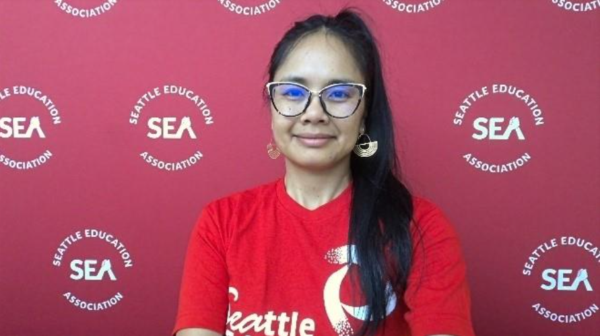
Davina Diaz, vice president of Seattle Education Association and lead bargainer (Photo courtesy SEA)
SPS starts contract negotiations with teachers, educators
Seattle Education Association (SEA), the union that represents upwards of 5,000 educators — including certificated teachers, paraprofessionals, office professionals, and substitutes — began contract negotiations with Seattle Public Schools (SPS) last week.
The two groups have 23 bargaining dates scheduled this summer in hopes of reaching a teacher contract agreement before Aug. 31, when the educator’s current contract is set to expire. Students in grades one through 12 are set to return to school on Sept. 2 to start the 2026-2027 school year. Preschool and kindergarten students are scheduled to return Sept. 8.
The union is seeking a multi-year agreement after members approved a one-year contract extension in 2025. With increasingly high gas, grocery, and other basic costs, union negotiators say teachers need stability. Union leaders have said a new contract needs to address wage increases, more training, and educator concerns over workloads and large class sizes.
“Our plan is to partner with the district and work together to improve our student and staff experiences,” wrote SEA President Ibi Idowu in a community update earlier this month. “It should become clear quickly if our priorities are not aligned. Should that happen, we will utilize support from both SEA members and the community to build the power that is critical to win at the bargaining table.”
The last time the Seattle Education Association and SPS agreed to a multi-year contract with a wage increase was in 2022, following a five-day teachers’ strike.
In a statement, district spokesperson Beverly Redmond said of the collective bargaining process: “We look forward to partnering with SEA to reach a robust, student-centered CBA [collective bargaining agreement] that reflects our employees’ dedication while recognizing the district’s fiscal realities.” Read the full story.
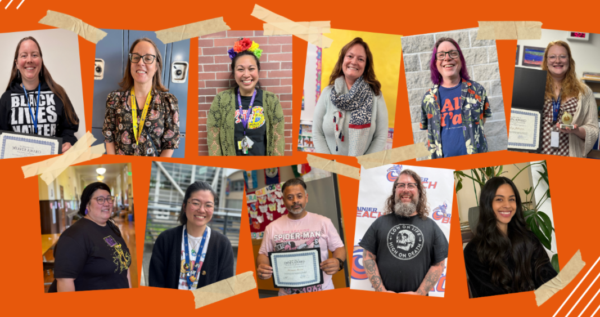
Alliance for Education award winners (Photo courtesy Alliance for Education)
These teachers are doing the work of educational justice and racial equity
Alliance for Education, the Seattle-based nonprofit that raises funds to advance racial equity and improve educational outcomes in Seattle schools, recently honored 11 Seattle Public Schools teachers, counselors, and staff members with $3,000 grants. The funds were distributed through two award programs — the Philip B. Swain Excellence in Education Awards and the Adrienne Weaver Science Teaching Awards, which recognize educators whose work is moving the needle on educational justice and racial equity in their classrooms and communities.
The Alliance stresses that honorees reflect the educators and staff who go above and beyond every day to help students succeed and to strengthen the families and communities around them. Staff who receive the awards can use the funds outside their regular school budgets. For example, they can use it for classroom supplies, student learning opportunities, or their own professional growth.
Eight of the recipients received the Philip B. Swain Excellence in Education Award, given to educators working with students in grades 6-12 who are furthest from educational justice:
- Joanne Davis of Interagency Academy
- Herman García of Denny International Middle School
- Kevin Hiller of Rainier Beach High School
- Lyndsey Johnson of Meany Middle School and Nathan Hale High School
- Ariana Nuñez of Chief Sealth International High School
- Melissa Park of Nova High School
- Noelle Tyau of Denny International Middle School
- Crystal Visperas of Jane Addams Middle School
The Adrienne Weaver Science Teaching Award honors STEM educators in the spirit of a former teacher known for her passion for science and hands-on learning. This year’s winners are:
- Andy Darring of Pathfinder K-8
- Emily Elasky of Mercer International Middle School
- Lara Megard of Catharine Blaine K-8.
Award winners are chosen through a combination of colleague and community nominations and a review of school-level data metrics. It’s a highly competitive process according to the Alliance.
“Educators and staff are at the heart of every thriving school community, with so many going above and beyond to ensure every student has the opportunity to succeed,” said the Alliance for Education President Roxanne Christian in an email announcing the winners.
U.S. Supreme Court building. (iStock)
SCOTUS to hear about WA law that protects trans runaways
The U.S. Supreme Court said Monday it will take up a fight over a Washington law meant to protect transgender youth who run away from home, agreeing to review a lower court’s dismissal of a challenge to whether the state can withhold a child’s location from parents while the young person is staying at an emergency shelter.
The 2023 law lets shelter staff hold off on calling parents right away if there’s a compelling reason not to, including a young person’s pursuit of gender-affirming care, and instead loop in the state Department of Children, Youth and Families. Justices also agreed to look at related state guidelines for reunifying runaway kids with their families, along with a decades-old Washington statute that lets kids as young as 13 get outpatient mental health treatment without a parent signing off. The case, which will be heard in the term starting in October, puts the court squarely in the middle of a heated national argument over how far parental rights extend when they bump up against a state’s efforts to protect kids.
The families behind the lawsuit, backed since 2023 by America First Legal, the group Stephen Miller started before joining the Trump administration, sued, saying the law cuts them out of decisions about their own children’s health and whereabouts, even temporarily, and that this violates their constitutional rights as parents. A federal judge tossed the lawsuit in 2024 for lack of standing, finding the alleged harm too speculative, and the 9th Circuit agreed last summer. Washington’s attorneys have made a similar point in their own filings, describing the parents’ claimed injuries as resting on a long chain of hypotheticals that hasn’t actually happened to any of them.
Washington Attorney General Nick Brown’s office says it’s ready to defend the law, noting that both lower courts already sided with the state. Read the full story.
More SCOTUS: Court holds 14th Amendment guarantees birthright citizenship to anyone born on U.S. soil
The Supreme Court struck down President Trump’s attempt to upend birthright citizenship in the U.S. in a ruling last week that the 14th Amendment guarantees automatic citizenship to anyone born on American soil — regardless of their parents’ immigration status.
Chief Justice John Roberts wrote the majority opinion, finding Trump’s executive order unconstitutional and declaring that the promise of citizenship extends to “every free-born person in this land.” Six justices agreed the order was unlawful, while Clarence Thomas, Samuel Alito and Neil Gorsuch dissented. Five justices addressed the narrower question of the case, which is whether or not the 14th Amendment itself extends citizenship to immigrants’ children. Five said yes. Kavanaugh argued the order conflicted with federal statute rather than the Constitution, leaving room, he wrote, for Congress to carve out exceptions it simply hasn’t passed yet.
Trump has urged the Republican-controlled Congress to pass legislation locking in his order rather than pursue a constitutional amendment. But some stressed that a constitutional amendment is the only way to change the right.
The ruling deals a real setback to Trump’s broader push to narrow who counts as American, though it comes right after two other Supreme Court wins that expanded his immigration authority, letting him limit asylum claims at the southern border and strip legal protections from 350,000 Haitians and 6,000 Syrians. Read the full story to learn how Washington led early efforts to fight Trump’s order.
More on this story: “The Seattle judge who had birthright citizenship correct from the start”
Even more SCOTUS: Court upholds states right to ban transgender girls from school sports teams
The Supreme Court ruled Tuesday that states can bar transgender girls and women from school sports teams, upholding bans in Idaho and West Virginia in another loss for transgender rights from a court that has repeatedly sided against transgender Americans.
Six conservative justices found the bans constitutional, while all nine agreed they don’t violate Title IX. Justice Brett Kavanaugh, writing for the majority, said states can reserve women’s and girls’ sports for biological females to protect safety and fair competition, and that neither the Constitution nor Title IX requires overhauling women’s athletics nationwide. Justice Sonia Sotomayor dissented, arguing the majority wrongly rejected an equal-protection claim from Becky Pepper-Jackson, a West Virginia teen who has identified as a girl since age 8 and is now the state’s shot put champion. The Idaho case involved a college student.
More than two dozen other Republican-led states have similar bans that are expected to hold up under the ruling, though challenges to laws in Connecticut, California and elsewhere allowing transgender athletes to compete remain unresolved.
Olympic and Paralympic Committees have already barred transgender women from women’s sports following Trump’s executive order on the issue. Read the full story at Associated Press.
For more on this story, don’t miss:
- “Supreme Court trans athlete ruling: What it means for WA” from The Seattle Times
- “How the SCOTUS trans athlete ruling affects WA” from KUOW
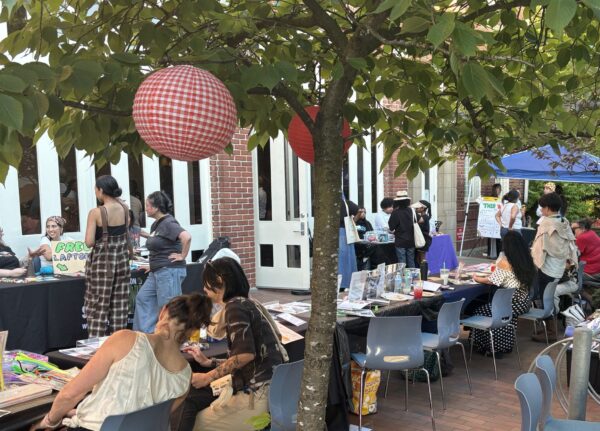
Seattle Education Forum Block Party (Photo by Elizabeth Hunter)
This Block Party was all about improving Seattle Public Schools
The last day of school was little more than a week ago, but that didn’t stop dozens of civic leaders, educators, community members, and parents from gathering at Byrd Barr Place to discuss the ins and outs of public education. As the sun set on the loveliest evening of the year, some of the region’s biggest players in education met face-to-face with their constituents at the first-ever Seattle Education Forum Block Party.
The Block Party-style gathering was a new idea, but the collaboration is not: last October, the Seattle Education Forum hosted an event for the community to meet candidates for the Mayor, School Board, and City Council.
This year’s event drew a remarkable—and diverse—array of civic leaders, including School Board directors; Seattle City Councilmembers; Deputy Mayor for the City of Seattle Brian Surratt; and the Director of the Department of Education and Early Learning, Dr. Dwayne Chappelle. Also joining? Superintendent Ben Shuldiner, who seems to be everywhere these days. As he has all year, Schuldiner emphasized the dire financial situation of Seattle Public Schools. “At our current rate, we’ll be insolvent in a year.”
In a rotating “passport stamp” style, parents met leaders and were invited to voice their concerns about what’s happening at their schools. The event was an opportunity for leaders to listen first hand and then brainstorm ways to improve the system with the community. Throughout the evening, parents and community members inquired about topicsf like school safety, school repairs, and technology.
“There were many ‘a-ha’ moments from leaders about how they can work together more effectively across their jurisdictions,” said Ian Coon, spokesperson for Alliance for Education, a Seattle Education Forum member. Read the full story.
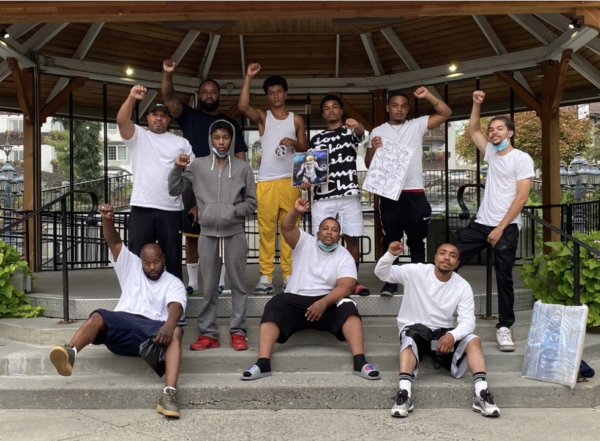
Community Passageways Seattle Community Safety Initiative
Loss of south end violence prevention team is a hit to community
Community Passageways, a Seattle nonprofit that works to reduce youth violence and steer young people away from incarceration, has announced layoffs from its Rainier Beach violence-intervention and school safety team. According to a report from South Seattle Emerald, staff, students, and neighbors pushed Seattle City Council members to save the funding for the team, presenting a 440-signature petition.
Some team members walked students to and from school and through lunch hour to discourage violence, while others helped south Seattle families with housing, jobs, and sports costs. Team members also assisted in providing grief counseling after two Rainier Beach students were shot and killed at a bus stop last January. Community Passageways took over this work from Boys & Girls Clubs’ SE Network SafetyNet in 2024.
According to the Emerald report, south end residents worry the transition will leave Rainier Beach more exposed. Read the full story at South Seattle Emerald.
The Great Listen: ‘We Keep Us Safe’ from KUOW and The Seattle Times
In the summer of 2020, 16-year-old Antonio Mays Jr. traveled a thousand miles from home to Seattle to take part in the racial justice movement sweeping the country. Less than a week after he arrived at the Capitol Hill Occupied Protest, known as CHOP, May was shot and killed within the protest zone. Protesters said he was shot while trying to defend himsel. No one has been charged and the case remains open.
The eight-part NPR investigative podcast “Embedded: We Keep Us Safe” does a deep dive into May’s death, retracing the night of the shooting, tracking down the eyewitnesses and key figures who were there and surfacing evidence that has never before been made public. The evidence uncovered by reporters may turn the case on its head. Why listen? In a world where protests are a regular occurrence and teens and even some tweens participate in these actions, we all need to understand what keeps them safe. And what doesn’t. Listen at KUOW.
<iframe src=”https://www.npr.org/player/embed/nx-s1-5853133/nx-s1-mx-5853133-1″ width=”100%” height=”290″ frameborder=”0″ scrolling=”no” title=”NPR embedded audio player”></iframe>

Family Relaxing in the Living Room
Going back to the 50s is not the answer to America’s declining birth rate | Op-Ed
New York Times opinion writer Jessica Grose used her July 1 op-ed to push back on a popular conservative myth: That reviving 1950s-style marriage is the cure for America’s falling birth and marriage rates. Grose pokes holes Erika Kirk’s commencement address at Hillsdale College, where Kirk, the wife of Charlie Kirk, told graduates to marry young and procreate amply. Kirk’s remarks, including her nod to the 50s men-as-breadwinners dynamic, set off an immediate backlash wave across TikTok. That, writes Grose, is some evidence that a call to have more kids lands very differently when families are living through what she calls a “grocery price emergency” and when they are naming cost of living as the top reason they’re putting off parenthood.
To make her case against the conservative’s young marriage-lots of kids nostalgia, Grose leans on historian Stephanie Coontz’s new book, “For Better and Worse,” which argues the midcentury nuclear family wasn’t some default human arrangement but a brief historical blip, one that only held together because postwar prosperity let a single paycheck support a household, backed by divorce laws and social norms that made leaving a marriage nearly impossible for women.
Grose points out that in the polling: just 10 percent of Americans actually think early-20s marriage is ideal and roughly 77 percent want both parents equally splitting career and caregiving. Todays fathers are more hands-on with their kids than in past generations, and gay marriage still draws majority support despite a recent slide in the numbers. She points to BYU’s 2025 American Family Survey, where 43 percent of respondents named money as the main thing stopping them from having kids, to argue that the real fix is shoring up young people financially, not pushing them into what she dismisses as a “ticky-tacky” mold that most Americans have already moved past.
“I believe that good marriages are good and that if we want more of them, we need to help young people attain stable economic footing in adulthood first and foremost,”Grose writes. Read the full op-ed in The New York Times.
Have an opinion about the opinion? Lay it on me. Email me at [email protected]
Putting Students First, a podcast from League of Education Voters
Seattle Public Schools Superintendent Ben Shuldiner joins League of Education Voters CEO Arik Korman on the latest episode of Putting Students First, a league podcast that brings students, policymakers, and education leaders together to dig into the policies and practices shaping Washington schools. The goal of the podcast is simple and difficult: to help build classrooms and learning communities “where every Washington student feels safe, supported, and a positive sense of belonging.”
In this episode, Shuldiner gets candid with Korman about what actually drives him in the job and how he knows if his priorities are working. The two dig into his plan to tackle opportunity gaps that have dogged the district for years, and how he’s striving for real engagement with students and families rather than just checking a box. Shuldiner also looks back on his own path through the education system, what helped and what didn’t, and paints a picture of the Washington school system he’d build if money were no object. It’s a wide-ranging, honest conversation with the person steering one of the state’s largest districts.

Throw these crib bumpers away. DO NOT DONATE.
Crib bumper recall: Toss them, don’t donate
Federal safety officials are telling parents to stop using LDLXLHTE-brand crib bumpers, warning the padded inserts can block an infant’s airway and pose a suffocation risk. The bumpers, sold on Amazon between April and May of this year for about $36, fall under the kind of product banned nationally by the Safe Sleep for Babies Act.
The seller, a China-based company doing business as Linhong New Energy, has ignored the Consumer Product Safety Commission’s requests to recall them or offer any remedy to consumers. The agency has now issued a formal violation notice and is urging anyone who bought the bumpers, sold in a white animal-print and pink floral pattern with pink ribbons, to throw them out rather than resell or donate them. They may have been purchased in other colors as well.
No injuries have been reported so far, but the CPSC used the warning to repeat its core safe-sleep guidance: infants should sleep alone on their backs, on a firm flat surface in a crib, bassinet, or play yard, with nothing else in there, no blankets, pillows, or bumpers. Babies who doze off upright or reclined, say in a car seat or swing, should be moved to that kind of flat sleep space as soon as possible. Anyone with an incident or defect to report can do so through SaferProducts.gov.