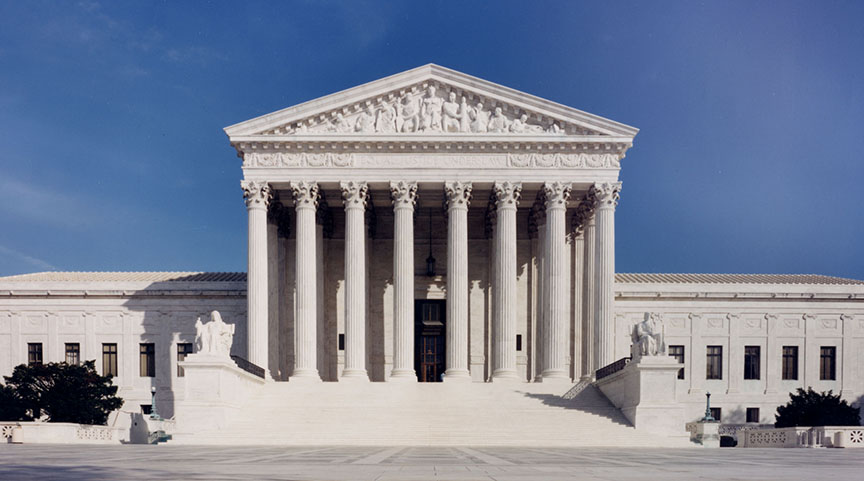
WASHINGTON — The U.S. Supreme Court Tuesday struck down President Donald Trump’s attempt to redefine the constitutional right to birthright citizenship.
In the decision, a majority of the justices upheld the country’s long understanding of automatic citizenship by birth on American soil, regardless of the immigration status of a newborn’s parents. The majority opinion, written by Chief Justice John G. Roberts, Jr., found the president’s executive order violated the 14th Amendment of the U.S. Constitution.
“Citizenship, then and now, was the right to have rights—to freely participate in our political community,” Roberts wrote. “The Framers of the Fourteenth Amendment extended that promise to ‘every free-born person in this land.’ We keep that promise today.”
While six of the justices agreed — Roberts, Amy Coney Barrett, Brett Kavanaugh, Sonia Sotomayor, Elena Kagan and Ketanji Brown Jackson — that the president’s executive order was unlawful, conservative Justices Clarence Thomas, Samuel Alito and Neil M. Gorsuch dissented.
Only five of the justices agreed that the 14th Amendment extends citizenship to the children of immigrants, with Kavanaugh partially dissenting along with Thomas, Alito and Gorsuch.
Kavanaugh argued that Trump’s executive order did not violate the 14th Amendment, but instead violated federal statute. He added in his dissent that Congress could “enact new legislation establishing exceptions to birthright citizenship for children born to foreign citizens unlawfully or temporarily in the country. But Congress has not yet done so.”
The White House did not immediately respond to States Newsroom’s request for comment, but a day before the decision, Trump said in the Oval Office that he would accept the Supreme Court’s ruling.
“It’s up to them, but in terms of for the good of the country, it’d be great if they … didn’t allow it,” Trump, who in a highly unusual move for a president attended the oral arguments on the case, said of birthright citizenship.
After the ruling, the president called on Congress, which is controlled by Republicans, to pass legislation to codify his executive order into law, dismissing the need for a constitutional amendment.
However, a constitutional amendment would be needed, not legislative law, because a majority of the justices still found that any change to birthright citizenship violated the Constitution’s 14th Amendment. Utah’s GOP Sen. Mike Lee, who previously clerked for Alito, noted that “we’re going to need a constitutional amendment.”
The opinion is a major blow to Trump, who has sought to redefine who is American as part of his broader immigration agenda.
But it also follows two decisions from the high court that vastly expanded the president’s authority over immigration policy by allowing him to limit asylum seeker claims at the Southern border and strip legal protections for 350,000 Haitians and 6,000 Syrians.
Tuesday’s decision is based on one of the first executive orders that the president signed on the first day of his second term. It aimed to deny citizenship to children born to parents who either do not have legal status, or hold temporary legal visas.
Experts warned if the order were to take effect, it could create an entire class of stateless people and cause chaos for hospitals and local governments.
Case brought by expectant parents
The case, Trump v. Barbara, was brought by expectant mothers who feared their children would not be American citizens because of their immigration status.
During oral arguments in April, a majority of the justices seemed skeptical of the Trump administration’s arguments, presented by Solicitor General D. John Sauer.
Before the justices, Sauer argued that the citizenship clause of the Constitution’s 14th Amendment, which is the basis for birthright citizenship, was meant to apply to newly freed African American slaves after the Civil War, not to children of immigrants.
Most legal scholars and historians disagree with that interpretation and have argued the Supreme Court in the 1898 case United States v. Wong Kim Ark already settled the idea that automatic citizenship was granted to children born on U.S. soil.
Ark was born in San Francisco to Chinese immigrant parents. When he left California, he was denied entry back into the United States after visiting relatives in China.
Officials at the time argued that because Ark’s parents were Chinese citizens in the United States on temporary visas at the time of his birth, and therefore were not “subject to the jurisdiction” of the U.S., he was not a citizen.
Ark took the issue to the Supreme Court. In 1898, the high court affirmed that he, along with any child born on U.S. soil, were guaranteed citizenship, and rejected the argument that the 14th Amendment only applied to newly freed African American slaves.
American Civil Liberties Union lead attorney Cecillia Wang, who argued before the justices, said that when the federal government tried to strip Ark of his citizenship, “largely on the same grounds (the Trump administration) raised today,” the Supreme Court at that time rejected those efforts and upheld the 14th Amendment.
“This Court held that the 14th Amendment embodies the English common law rule (that) virtually everyone born on U.S. soil is subject to its jurisdiction and is a citizen,” Wang, who is the daughter of Taiwanese immigrants, said.
Her parents were in the U.S. on student visas when she was born in Oregon, meaning that if Trump’s executive order were in effect at that time, she would have been denied U.S. citizenship.
Roberts agreed that the Supreme Court made the correct decision in 1898 about Ark’s case.
“What the Court held in Wong Kim Ark was simple: the Citizenship Clause incorporated the common law and granted citizenship to nearly all children born in the United States,” he wrote. “Not surprisingly, then, in the 128 years since, we have repeatedly understood the rule of Wong Kim Ark to guarantee citizenship to all children born in the United States and subject to its power.”
“We see no reason to depart from that view today,” he continued.
One of the mothers in the case, who appeared under a pseudonym, gave another ACLU attorney who worked on the case, Cody Wofsy, a statement following the high court’s decision.
“It is a difficult time in the world to stand up. We were scared to come forward, but the decision today showed me that I stood up for the right thing,” Wofsy read from her statement during a virtual press conference.
14th Amendment argument
During April’s oral arguments, Sauer made that case that the phrase in the 14th Amendment “subject to the jurisdiction thereof” means that children born to parents without legal status or temporary visitors are not “subject to the jurisdiction of the United States” and are instead subject to the laws of their home country.
The 14th Amendment reads: “All persons born or naturalized in the United States, and subject to the jurisdiction thereof, are citizens of the United States and of the state wherein they reside. No state shall make or enforce any law which shall abridge the privileges or immunities of citizens of the United States; nor shall any state deprive any person of life, liberty, or property, without due process of law; nor deny to any person within its jurisdiction the equal protection of the laws.”
Roberts rejected Sauer’s position, and wrote that the Trump administration’s “[a]rguments for limiting birthright citizenship to those domiciled in the United States fail.”
“Children born in the United States to parents unlawfully or temporarily present are ‘subject to the jurisdiction’ of the United States and are citizens at birth under the Fourteenth Amendment’s Citizenship Clause,” he wrote. “Under the Constitution, they are citizens at birth.”
The 14th Amendment was passed to rectify the Supreme Court’s decision in Dred Scott v. Sandford, in which justices ruled that neither free or enslaved Black people could have citizenship or rights. The amendment was also meant to give African Americans citizenship while also denying citizenship to the mass migration of Chinese laborers not born on U.S. soil.
The “jurisdiction” language in the amendment, tribal scholars have said, was aimed to exempt Indigenous people who resided in Native nations — part of their tribal governments — from birthright citizenship, along with the children born to foreign diplomats.
Congress in 1924 specifically passed the Indian Citizenship Act to grant birthright citizenship to Indigenous people, regardless of their residence in Native nations.
Because of this, tribal scholars have explained the language “subject to the jurisdiction” was never meant to apply to immigrants and their home country, and instead refers to the political alliance of tribes.
Congress reacts
Following Tuesday’s decision, Democrats praised the decision.
Senate Minority Leader Chuck Schumer, Democrat of New York, said in a statement that “despite Trump’s best efforts to bully them, the Supreme Court just reaffirmed that if you are born in America, you belong in America.”
“No matter how much President Trump tries to steal citizenship from people that the Constitution has said have earned it and reverse the grand American tradition of welcoming newcomers to our nation, the Supreme Court confirmed today that those born in America are American,” he said.
Chairs of the Congressional Tri-Caucus — the Congressional Hispanic Caucus, Congressional Asian Pacific American Caucus and Congressional Black Caucus — issued a joint statement that the high court’s ruling was a rejection of “Trump’s dangerous and exclusionary vision of America.”
“We are American, we belong here, and we will continue to defend birthright citizenship for generations to come,” said New York Reps. Adriano Espaillat of the CHC; Grace Meng of the CAPAC; and Yvette Clarke of the CBC.
Wang, of the ACLU, who argued the case before the Supreme Court, said in a statement that Tuesday’s decision reaffirmed a core American principle.
“If you are born here, you are a citizen,” she said. “A president cannot change the Constitution by executive fiat.”
An immigration advocacy group that has also challenged the Trump administration’s efforts to redefine birthright citizenship, We Are CASA, said the decision was a victory for immigrant families.
“The Trump administration’s attempt to deny citizenship to United States-born children, threaten generations of children with legal uncertainty, and overturn more than a century of settled constitutional law has failed,” said Shana Khader, the deputy legal director at We Are CASA.