
If you have a teen looking for a part-time job or you are trying to map out your household expenses for next year, expect some changes in your next few paychecks. Starting January 1, Washington’s baseline minimum wage is going up by 60 cents, landing at $17.73 an hour.
The 3.5% bump keeps Washington at the top of the list for the highest state minimum wage in the country—miles ahead of the federal rate, which has been stuck at $7.25 for over a decade. But if you live or work closer to the city, the floor is even higher. Seattle’s local minimum wage is taking a bigger jump, climbing 84 cents to a flat $22.14 an hour for all workers.
What parents should know about teen pay rates
If your 14- or 15-year-old is looking to lock down their first job, their paycheck will look a little different. Under Washington Department of Labor & Industries (L&I) rules, employers can pay minors in this age bracket 85% of the adult rate. That means for the youngest workers, the state rate moves up to $15.07 an hour. The moment they turn 16, they legally graduate to the full adult baseline.
Keep in mind that local rules can override this. For instance, the Seattle Office of Labor Standards (OLS) requires the full local rate for employees inside city limits, and the city has eliminated tip credits, meaning small businesses can’t use tips to pad out that hourly requirement. Neighboring areas like SeaTac, Tukwila, and Renton also set their own higher baselines, so it is worth checking the specific city rules wherever your teen applies.
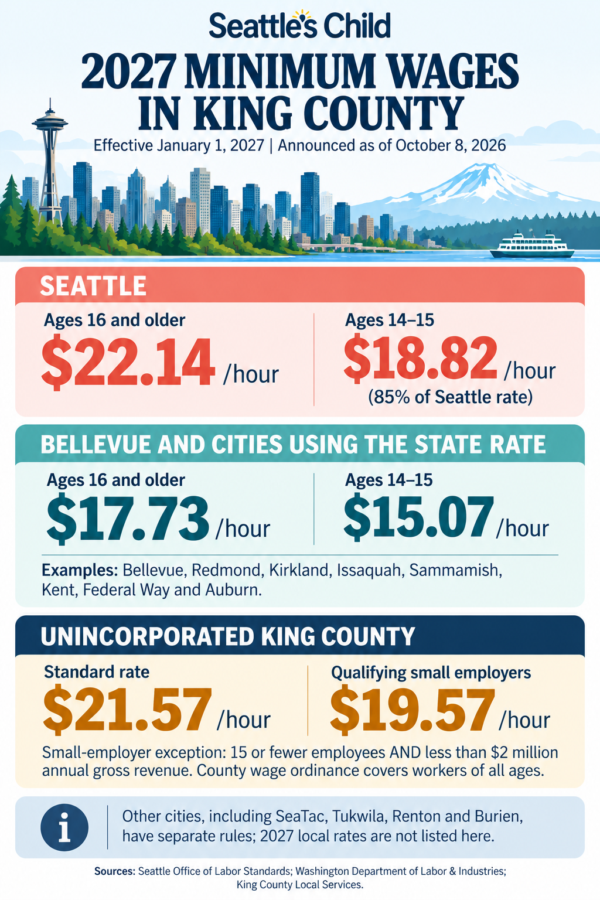
AI was used in the generation of this graphic. Not all cities in King County have announced or verified minimum wage increases for 2027.
Why does this keep changing?
These annual raises are built directly into state law to help paychecks keep pace with inflation. Every fall, L&I calculates the shift based on the federal Consumer Price Index (specifically the CPI-W), checking how much everyday costs climbed between August of last year and August of this year. Because the Puget Sound area faces steep local inflation, cities like Seattle use regional data to adjust their numbers even further.