
The bottom line: Grab your teen and run, don’t walk, to The Paramount Theater where Alicia Keys’ “Hell’s Kitchen” is on stage through July 26 — if not for the music, which runs a powerful and varied gamut from pop to classical to rap, or the dancing, with its heart-pumping command, then go for the perfectly crafted every-teen story. By that I mean only this: a whole lot of teens will see a bit of their own sticky reach for adulthood in this show.
Jersey: “I don’t want you out on the streets.”
Ali: “I’m not out on the streets, I’m outside the building.”
If there were two sentences to sum up the struggle between Jersey, a single mother determined to keep her child safe in inner-city New York, and Ali, her excitement-hungry 17-year-old daughter, it’s those two sentences uttered in the first act of “Hell’s Kitchen.” In a poignant coming-of-age story, Ali’s gasping for the sweet air of independence is universal to all teens, jumping as each inevitably will, the line between childhood and consequence-driven youth adulthood.
At the same time, the show has a big heart for the crazy ride that is parenting a teen. I certainly recognize the itching-to-break-away girl I was at 17 in Ali. And I am the mother who longed to sing, as Jersey does, “Can’t we talk for a minute, just stop for a minute,” following a blowout with my teenager.
At its core, “Hell’s Kitchen” understands and even celebrates the passion and pain of both sides of the parent-teen dynamic, and it is that which elevates the show to a “must-see” in my book. That and the dazzling, video-infused set, flawless choreography, and high voltage voices throughout.
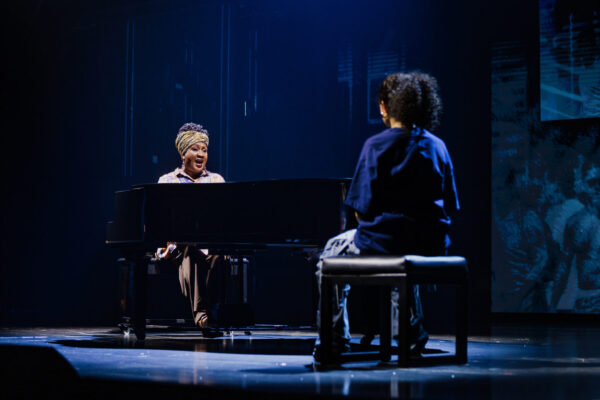
Roz White as Miss Liza Jane and Maya Drake as Ali (Photo by Marc J Franklin)
Synopsis
Set in 1990s Manhattan, Ali is chafing against Jersey, who thinks the only way to keep her kid safe is to keep her inside their Times Square-adjacent apartment. Ali, however, will not be deterred. She finds ways to hang out with her friends and musicians outside her building and to turn her crush on an older bucket drummer named Knuk into a full-on love affair. At the same time, an elderly neighbor becomes Ali’s unofficial piano teacher and ancestral guide (a knockout Roz White as Miss Liza Jane), igniting in Ali a passion for music and Black artists in the apartment building’s aptly named Ellington Room. For a time, it looks like Ali’s got it all.
That is, until her mom finds her in a compromising position with Knuk, who is apparently unaware of Ali’s age. Jersey does the unthinkable to Ali’s mind: she has cop friends take Knuk away. Although we later learn the officers let Knuk out without arrest just down the road, the show doesn’t sugarcoat the marginalization and historic abuse of young Black men. In trying to protect Ali, Jersey pushes her daughter further away.
Cue Act II, where we meet Ali’s not-quite-deadbeat-but-still-lovable musician dad, Davis. Knuk and Ali realize now is not the right time for their relationship to blossom. And a loss brings the disparate pieces of a hurting family back together, focusing the mosaic of Ali’s maturation.
There is a turning here on both sides of the mother-daughter divide. Ali learns she loves and needs her mother. Jersey learns, in the words of her best friend, that Ali is “not a criminal, she’s a teenager.” She realizes that a teen needs room to spread her wings. In this way, the story examines who gets to decide what a young adult’s life looks like and what such a decision can cost across generations.
It is really Mis Liza Jane who spells out the very different work that sometimes causes loving adults and the teens in their lives to clash:
“My job is to prepare you,” she tells Ali. “Your job is to write your own story.”
Warning to parents of kids a little too young to write their own stories: there are a lot of f-bombs in this show, both spoken and sung, and mature references to romantic relationships.
An inner-city adolescence
The show is loosely based on Alicia Keys’ own adolescence in New York, and the score combines new songs with Keys’ existing catalog. “Hell’s Kitchen” was written by Kristoffer Diaz, a Pulitzer Prize finalist, and directed by Michael Grief, with outstanding choreography by Camille A. Brown. All that talent comes together in a fast-moving production that runs more than two hours but feels like far less. If you do bring a younger child, you’re unlikely to hear “I’m bored.”

Kennedy Caughell as Jersey and Maya Drake as Ali i (Photo by Marc J Franklin)
So many standouts
Roz White’s Miss Liza Jane has already been mentioned, but truly, this entire cast in this touring production shines. The show has its stealer in the voice of Kennedy Caughell’s Jersey. Her rousing, ceiling-reaching “Pawn it Out” nearly caused the audience on opening night to spontaneously combust. It was that powerful. At the same time, Maya Drake’s Ali is smart, sassy, pitch-perfect, and delightful in that role. Drake is making her professional stage debut in the part.
Caughell also gets this reviewer’s nail-on-the-head description of mothering. There’s a secret that kids, especially teens, can never fully understand — until they are parents themselves. Teens and young adults are designed to go out in the world and not think too much about their parents. I recall a good friend telling me, “You’ll want to track and call them all day every day, but don’t expect to hear from your kids in their teens and 20s. They are trying to get away from you, remember.”
“I’m always thinking of you,” Jersey sings to her daughter. No truer words.
The details
- What: “Alicia Keys’ Hell’s Kitchen”
- Age Recommendation: The official age recommendation for the production, playing through July 26 at The Paramount Theater in Seattle, is 8 and up. I wouldn’t bring an 8-year-old given the more mature content, but a tween or teen? Make a beeline.
- Where: The Paramount Theatre, Seattle
- When: July 22 and 23 at 7:30 p.m., July 24 at 8 p.m, July 25 at 2 p.m. (ASL-interpreted). and 8 p.m., July 26 1 p.m. and 6:30 p.m. (open-caption performance)
- Tickets: Starting at $54