Being a parent is nonstop hard work, making it challenging to stay on top of news that impacts families in Washington state. This Hits Home is your weekly hit of news, commentary, and, occasionally, opinion. Want to have a say? Look for the “Take action” prompts. Here’s the update for the week of Aug. 2-9.

A lot of parents are jumping for joy since learning they will receive more child care co-pay support from the City of Seattle (Photo from iStock)
Families get a child care boost from City of Seattle
Now that Mayor Katie Wilson has signed the spending plan for the Families, Education, Preschool, and Promise Levy (FEPP) passed by voters last November, Seattle’s Department of Education and Early Learning (DEEL) has moved forward on its vision to make child care more affordable for local families. This week, the department emailed the families of 555 children participating in the city’s Child Care Assistance Program to let them know they will receive, on average, an additional $499 per month in childcare co-pay support thanks to FEPP funding. Infants from newborn to one year of age will get the highest level of support, with an average monthly co-pay increase of $754.
“For a family with a young baby, an extra $754 in your pocket every month makes a huge difference. Those dollars can go toward diapers, rent, healthcare, groceries, savings, or any number of other expenses,” said DEEL Director Dwane Chappelle. “This funding is just one piece of the broader support now available to Seattle families through the levy.”
Marissa Rousselle, DEEL’s Impact & External Affairs Division director, said parents who received the email announcing a co-pay support increase were pretty excited: “Thank you so much for this incredible news! It truly made our year,” one parent replied.
Another wrote: “This will be such an amazing release on our financial situation. With inflation, it has been even more challenging to keep us floating.”
If you live in Seattle and need assistance with child care costs, the city’s program may help.
“We are always accepting applications to CCAP, and we know there are many quality, licensed child care providers who have capacity to support more families,” said Rousselle. Go to the DEEL website to apply for child care assistance.

The 12 giants in Thomas Dambo’s “TROLLS: A Field Study” exhibit opening in October (Photo courtesy Imagine)
More TROLLS are coming!!!
If you and yours have delighted in the Puget Sound’s five lumbering wooden trolls created by Danish artist Thomas Dambo and installed in 2023, mark your calendar for Oct. 15. That’s when 12 more of Dambo’s whimsical giants will arrive in our areas. The The installation of the traveling “TROLLS: A Field Study” exhibit has been months in the planning with Point Defiance Zoo & Aquarium (PDZA) and Northwest Trek Wildlife Park where the trolls will lurk in the trees and along paths until Jan. 28, 2027. Both parks say the installation is a reflection of a mission they share with Dambo: to promote sustainability and environmental awareness. Four trolls will be hidden in greenery at PDZA) and eight hang out along the winding trails and native wildlife habitats of its sister wildlife refuge, Northwest Trek in Eatonville.
“Honestly, the idea just fit us,” said Mick Szydlowski, spokesperson for PDZA and Northwest Trek. “When we first learned about Thomas Dambo’s trolls, it felt like discovering a new species we didn’t know we needed. The zoo is already a place where people come face‑to‑face with awe.

USDAgov / CC BY 2.0.
Robbing Peter to pay Paul for school meals?
Seattle’s free school meals plan is finally funded, but is it possibly a case of robbing Peter to pay Paul? Tuesday’s unanimous finance committee vote allocated $3.6 million for universal breakfast and lunch at Seattle Public Schools, moving surplus cash the city had already committed to a North Seattle affordable housing project. This is the third round of council debate over Mayor Katie Wilson’s meals plan, first pitched in April, as both the mayor and the council have negotiated over where to find funding for the program.
That $3.6 million the finance committee moved to pay for the meals program comes from JumpStart payroll tax money that had been pegged for Northgate Commons, a project meant to replace an existing complex with as many as 1,400 mixed-income homes, twice the current stock of affordable units there. Seattle Housing Authority officials have said the project’s demolition phase cost less than expected, creating a $5 million cushion. While the council’s finance committee reallocation amendment insists funding for Northgate Commons is sufficient even with the reallocation to universal school meals, committee chair Dan Strauss stressed that the funds would need to be replenished. Keeping a cushion for affordable housing projects makes a lot of sense given that crises can and have occurred within the affordable housing industry in the not-so-distant past: the COVID-19 pandemic caused a surge in construction costs between 2019 and 2023.
Tuesday’s $3.6 million reallocation would cover free meals for all students during the 2026-27 school year. The full Seattle City Council will take up the reallocation from affordable housing to school meals next week. Read the full story in The Seattle Times.

(iStock)
State AG gives advice on supporting WA fire victims
Looking for ways your family can support families impacted by devastating wildfires in the Spokane area and other parts of the state? Washington State Attorney General Nick Brown has some advice: “Take precautions to ensure donations go to reputable charities,” the office advised in a statement this week.
“The destruction in Spokane is heartbreaking, and generous people across our state want to help,” Attorney General Nick Brown said in the statement. “It’s important to give safely to ensure your hard-earned money is helping those in need.”
The best way to support families is to donate to the City of Spokane directly. Spokane’s H.O.M.E. Starts Here Fund is currently accepting donations to assist those affected by the recent wildfires.
If you are giving to non-profits or charities, the Attorney General’s office has tips for how to ensure your donation will really benefit the people you hope to help, including how to research a charity asking for money, how to deal with high-pressure tactics and why you should use caution when giving through a QR code. Thinking of donating to a crowdfunding campaign? The AG’s office also has some advice for keeping those donations safe from fraud. Find the AG’s tips for protecting your gift and making sure it gets to those who need it here.
Sadly, in times of crisis, predatory and criminal behavior happens. Does something sound fishy in an ask you received in an email or via a phone call? If you are suspicious of a fundraiser or solicitation for which proceeds are said to be going to fire victims, report it to the Attorney General’s Office Consumer Protection Division via the agency’s form. Read the full story.
TAKE ACTION: Help families in their time of crisis by making a donation to Spokane’s H.O.M.E. Starts Here Fund.
(iStock)
Trump, again, tries to limit birthright citizenship
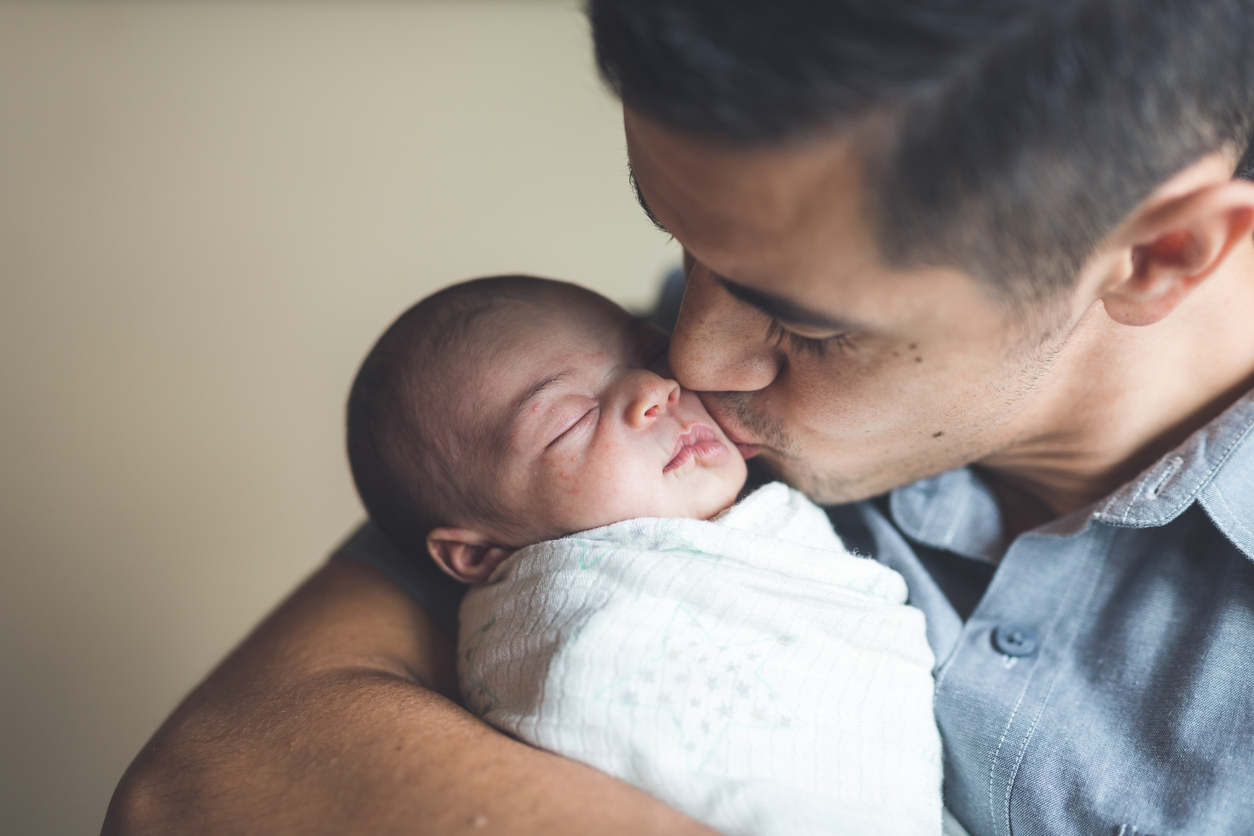
President Donald Trump signed two executive orders on Thursday as part of his more than year-long push to deny babies born to noncitizens their right to U.S. citizenship. The move follows a June 30 Supreme Court decision that an executive order signed by Trump the his first days of second presidency to roll back birthright citizenship violated the 14th Amendment.
The two new orders orders will likely see legal challenges.
In 2025, Washington state led several other states in a similar lawsuit against President Donald Trump’s executive order to end birthright citizenship. That case, Washington v. Trump resulted in an early injunction blocking the policy and was upheld on appeal. According to plaintiffs, about 153,000 babies across the country were born to two parents without legal immigration status in 2022, including 4,000 in Washington. The June 30 Supreme Court ruling, however, was in another case, a class action brought by the ACLU on behalf of a Honduran mother.
Officials in the Washington State Attorney General’s Office said they are reviewing the two new executive orders signed by Trump. For now, said the office’s Deputy Communications Director Mike Faulk, “We’d just refer the president back to the Constitution: ‘All persons born or naturalized in the United States, and subject to the jurisdiction thereof, are citizens of the United States and of the State wherein they reside.'” Read the full story.

(Petition)
Seattle teacher’s union members call on union president to resign
Members of the Seattle Education Association (SEA) are calling for their newly elected union president to resign after a Seattle Public Schools investigation found she “more likely than not” injured a student with autism at Rising Star Elementary. According to multiple media reports, Olla Ibrahim and Tyson Marsh, the boy’s parents, recently filed a tort claim in King County Superior Court against teacher Ibijoke “Ibi” Idowu and the school district. The parents allege they found bruising on their third-grader on Dec. 9, 2025 that the boy reported came at the hands of Idowu.
The district’s investigation was built on interviews with more than a dozen staff members, students and witnesses and conducted between December and June. Idowu, placed on leave Dec. 11, disputes the findings and told the Seattle Times the report ignored witnesses who said they never saw physical contact severe enough to leave marks.
Last week, a post by The Bulletin, an independent publication covering Seattle Public Schools, reported that most SEA members had voted for union officers before the accusations against Idowu and subsequent results of the SPS investigation became publicly known. Some members have launched a petition demanding Idowu’s removal from the union presidency. As of this week the petition had nearly 600 signatures, more than the roughly 550 (10% of SEA’s roughly 5,582 members) needed to force a recall vote. Read more at KUOW.
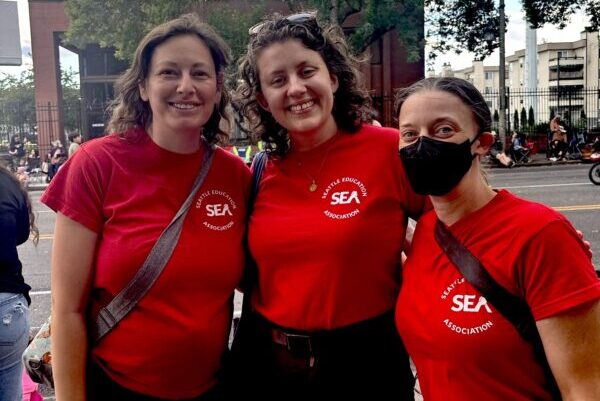
(Photo from SEA bargaining update)
Teacher contract negotiations going slow
With just weeks to go until the start of the school year, Seattle Public Schools teacher contract negotiations are moving very slowly.
In an update early last week, Seattle Education Association (SEA) Vice President Davina Diaz reported that the two sides had “moved the needle” on very few of the 57 proposals the union brought to the table. The union represents about 5,800 educators.
“SEA has put on the table all 18 of our ‘small’ issues, called that because we believe they’re less expensive and easier to reach agreement on. So far we have reached agreement on two of those,” Diaz wrote in an August 7 community update. “Though we put them on the table, we haven’t discussed the biggest issues– traditionally the most expensive issues go last. We’re committed to winning more time for supporting students in our days, safer schools, and respectful pay.”
In an August 6 update to union members, Diaz was noted she was not impressed with some proposals that SPS has so far put on the table. For teachers, Diaz said, those offerings are tantamount to “longer work days, more control over our time, and [taking] back the pay we get for the extra work we do when substitutes are unavailable. It is nice to hear the district tell us they expect us to say no and come back with something we like more. ”
Officials at Seattle Public Schools said the district has faith in the process.
“While we realize much remains to be done, we are optimistic about what we can accomplish together,” said district spokesperson Beverly Redmond. “Our bargaining approach is focused on meeting our students’ needs while responsibly sustaining our limited public dollars over the long term. This is consistent with the direction the School Board provided through a resolution adopted in July, which directs the district to bargain in good faith, with mutual respect, and in a manner that supports the district’s long-term fiscal health.
“The process is ongoing,” Redmond added. “The district is at the table on a near-daily basis and deeply engaged. Bargaining works best between the parties, in good faith, at the table – and that is where our focus remains.”
The union negotiating team has asked for more bargaining dates beyond the six currently scheduled:
“SEA is feeling the urgency,” Diaz said. “By the end of the month, the SEA membership will have to vote on approving a tentative agreement with the district or on a strike authorization. We do not want to strike, but I share the possibility to be completely transparent about what’s on the horizon. We are confident that if the district shares our urgency, we can get to an agreement.”
“We need to move faster,” Diaz said. Read the full story.

West Seattle Library will is now closed for HVAC installation (Photo courtesy Seattle Public Library)
Seattle’s Carnegie libraries are about to get even cooler
Starting this Sunday, the doors of both the Fremont and West Seattle branches of the Seattle Public Library will close until early November for a major improvement. If you’ve taken your kids to the Fremont or West Seattle facilities (or any other library branches built in the early 1900s and funded by Andrew Carnegie) on one of Seattle’s hotter summer days, you know the definition of sweltering. But during the closure, each library will have a brand new electric HVAC system installed.
The cold air upgrades are part of SPL’s Cooling Center Project, a $5.5 million, five-library upgrade funded by the Federal Emergency Management Agency (FEMA) that aims to improve ventilation and cool historic buildings. SPL’s Columbia, Queen Anne, and University branches should also have air conditioning in place in 2027, at which point 27 SPL branches will be cool havens on hot days.
The Carnegie branches are historic landmarks, which means that all upgrades have received approval from Seattle’s Landmarks Preservation Board. Read more on this story at KUOW.
Read this one with your tweens and teens | Op-Ed
Oh, boy. New York Times columnist Bret Stephens hit the nail on the head so squarely with his Aug. 6 column, he managed a countersink in one blow. His message: DO NOT WRITE with AI.
Ever.
As in never ever.
And it’s a message our tweens and teens (and let’s be honest, all of us parents who have allowed AI to write something better than we thought we could) really need to hear. Stephens lists the myriad things we and our kids might be tempted to ask ChatGBT or Claude to write for us — and why we shouldn’t.
“Do none of these things not because they are unethical. Writing with AI is unethical when it’s a deception: when you pass off words, ideas and information as your own when they aren’t. An acknowledgment can largely address the problem,” Stephens writes. “Do none of these things, either, because you might be able to learn to write better than an AI can. Pretty soon, if not already, you won’t, just as you can’t outrun a car or outplay a chess app.”
Ouch. Ask yourself honestly, if you’ve been amazed by how well AI writes for you, do you feel a little foggy and frozen when you sit down to write without that assistance? Damn. Got me. I do.
This opinion is a really important one to read with your kids. Then re-read it. Then talk about it. Then make up a little contract with them that states, more or less, “I will not use AI to write.”
Read the full column in The New York Times.
(Photo courtesy City of Seattle)
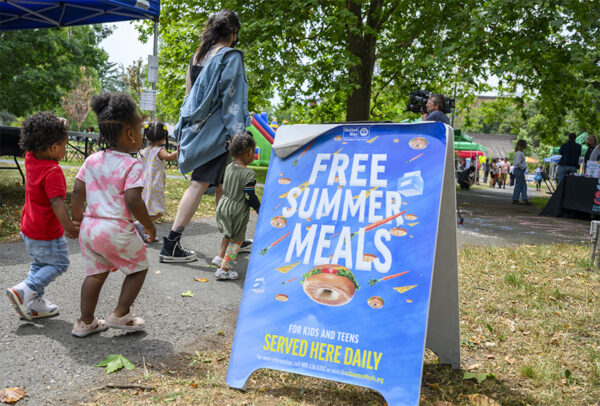
Free summer meals for kids still being served
Summer can be a financially difficult time for families. With kids at home for most meals, rather than receiving free meals at school, food budgets can start to ache. The Summer Food Service Program (SFSP) can help stretch the dollars in your family’s food budget. Through the program, any student aged 1 to 18 can pick up lunch and snacks any summer weekday at one of 36 sites throughout the city. Meals are available at Seattle community centers and parks through Aug. 31. Just show up, and your child will get a healthy breakfast, lunch, and snacks. No ID. No forms. No need to prove you’re a legal resident.

(iStock)
Preteen suicide rates are increasing annually
America’s youth are experiencing a mental health crisis, a fact confirmed by numerous studies in recent years and high suicide rates among teens. But preteens are also struggling, according to a report by the nonprofit news organization Stateline.
Since 2008, the number of U.S. preteens (kids ages 8 to 12) who die by suicide has increased by an average 8.2% annually, according to researchers at the National Institutes of Health.
Washington is not immune to the trend. According to the 2025 Washington Healthy Youth Survey, 17% of surveyed 6th graders and 8.5% of 8th graders who responded to the survey said they had contemplated suicide. According to the data, 5.4% of responding 6th graders and 4.2% of responding 8th graders reported having actually attempted it. While 8th grade suicide contemplation and attempts in both grade groups have gone down since the pandemic, suicidal ideation among 6th graders is beginning to trend up again.
Experts are looking for ways to reduce suicide risk among preteens, and many believe that tweens and teens need more frequent assessments by pediatricians and other professional caregivers. In the meantime, the American Foundation for Suicide Prevention has resources for parents or others who frequently interact with children, including a toolkit called “Talk Saves Lives” that offers guidelines and tips for steering conversations. Read the full story from Stateline.

Nanit Smart Baby Monitor System (Photo courtesy Nanit)
Baby watching and beyond
Let me just give you the headline from The New York Times:
Aw, It’s Baby’s First A.I. Surveillance System.
And the article’s subhead: Nanit and other start-ups want to track your children through the night — and soon, for much longer than that.
And one more thing. I’ll give you the line that jumped out at me from technology writer Sapna Maheshwari’s report: “Baby monitors have their roots in fear.”
Now, new baby parents, click this link to the full New York Times article and decide for yourself whether or not technology monitoring is best for you and your baby.
LISTEN: Is your kid spirited inside, shy outside?
Do you have a kid who is rambunctious at home — happy, engaging, extroverted —but strangely, painfully shy in public or at gatherings? If so, this episode of Janet Lansbury’s top-rated parenting podcast Unruffled is for you. Lansbury offers perspective and tips on how to help a child feel comfortable in their own skin, even in the discomfort of the world outside your house. Lansbury is author of “No Bad Kids: Toddler Discipline Without Shame.” The podcast is recommended by The Washington Post, The New York Times and other major media outlets.