Editor’s note: As officials at Seattle Public Schools and the union representing district teachers, paraprofessionals, counselors and other employees negotiate a contract for the 2026-27 school year, we will keep you updated here. Keep checking back for new developments.
UPDATE: Sept 1, 2026; 6 p.m.
This brief reflects the state of negotiations as of Tuesday’s reporting and daily district update. Because bargaining is ongoing and the district said it would post progress every two hours through the night, always check the SPS Facebook account for the most up-to-date information on whether school will start on time tomorrow.
Nearly 50,000 Seattle Public Schools students are due back in class Wednesday. On Tuesday afternoon, Superintendent Ben Shuldiner told reporters that he was “hopeful” the district and Seattle Education Association, the union representing 6,000 of its teachers and other educators, would reach a contract agreement before then. Negotiations turned tense over the weekend, and a mediator was brought in to help move the process forward beginning Sunday. The union did not echo Shuldiner’s use of the word “hope” on Tuesday, but sent out an email to the media stating that the two sides had made “promising progress” during a Monday session that ended after 1 a.m.
In the news conference, Shuldiner promised parents the district would post updates on the negotiations every two hours Tuesday night on its social media accounts and website, starting at 5:30 p.m. The school also posted information on its webpage about what will be available to parents should a strike occur.
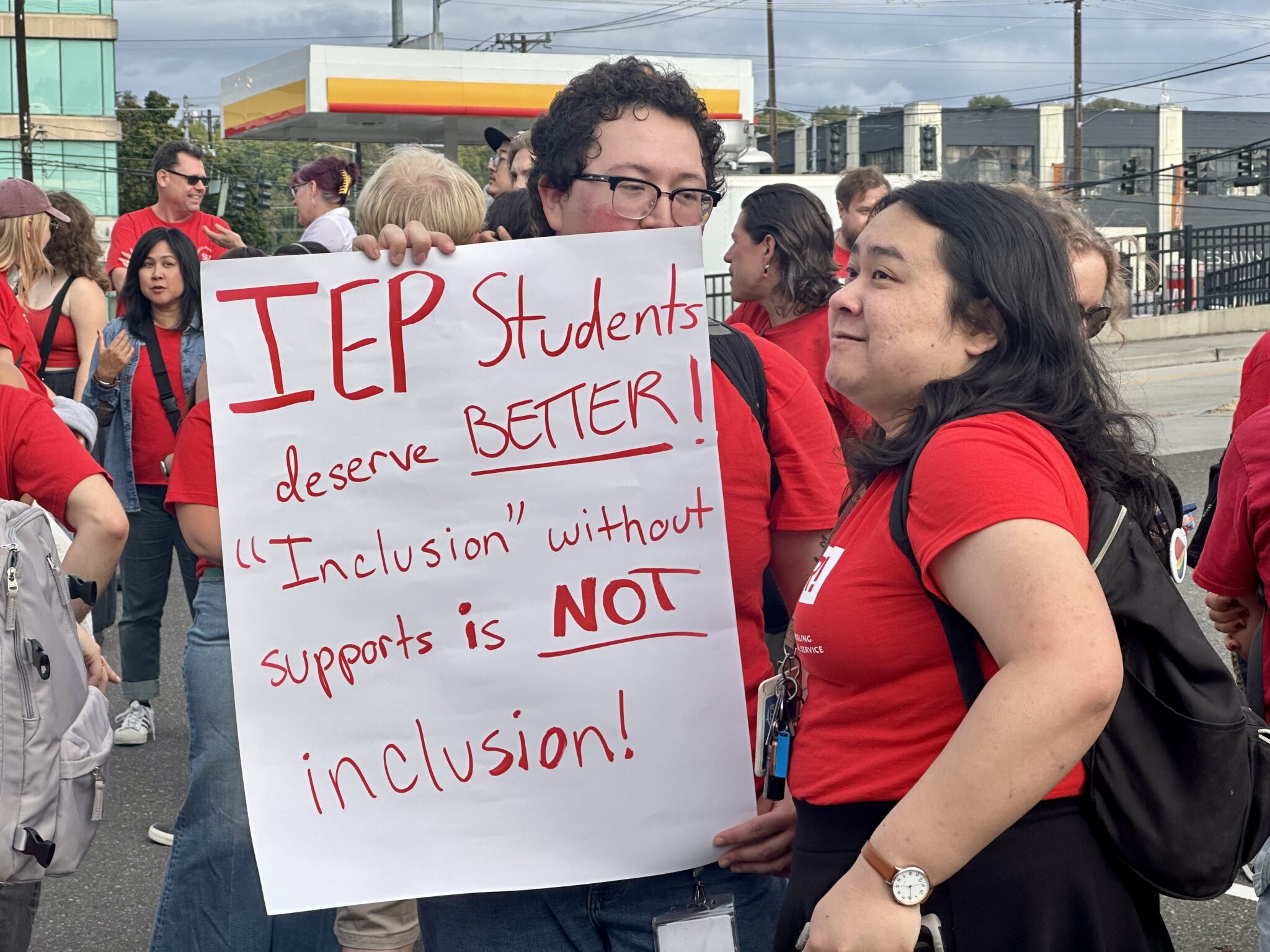
Meanwhile, several hundred teachers gathered at the John Stanford Center, the district’s administration building, to rally for a fair contract. While some at the event expressed hope that a contract agreement would be reached by the end of the day, others felt confident it would not.
“At the end of the day, I will only be hopeful when an agreement is reached,” said a first-grade teacher who requested anonymity. “Throwing the hope word out is just marketing by the district.”
“I’m definitely feeling a lot more hopeful. It sounds like the mediator is moving things along a lot faster,” said Sam Friedman, a fifth-grade teacher at Pathfinder K8, adding that they are comfortable with a strike should one be called. “Personally, I’m someone who is okay with a little chaos and as to when we’re getting to actually start with the students. Of course, I’d really love to be there with the students tomorrow, but I I feel like we have some real opportunities here to make sure that we are holding fast for what our students really need. I’m excited to start with students, but I’m also always excited for a good union victory.”
During his press conference before the rally, Shuldiner would not state a firm deadline for announcing whether schools will be open tomorrow for the first day of school, comparing that call to a snow-day decision that can land in the middle of the night. “Our hope is that we’re going to have some real answer before the end of the night,” he said. Specifically,, he said he hoped to inform parents by 11:59 p.m., but added that he would make that call depending on how well negotiations were progressing.
If the strike delays the start of school, grab-and-go-style bagged breakfast and lunch for students will be available free of charge at every school from 9 a.m. to 1 p.m. Wednesday, with no check of student status required to pick one up. He said that most nonprofit before- and after-school programs will run as planned, but parents should call their child’s school and the nonprofits that partner with those schools to determine whether their child is eligible to attend.
A redesign of the district’s special education services and staffing has been a major sticking point in the bargaining. At a press briefing on Monday, Shuldiner said the district had brought at least four versions of a special education plan to the table for consideration. Members of the teachers’ union have said they want a redesign of special education taken off the table and that the district’s proposed changes will ultimately mean fewer special education teachers and larger student-teacher ratios. On Monday night, the union brought a new proposal to the table on the issue.
Shuldiner would not provide details on that proposal, instead saying: “We’ve been moving back and forth at such a quick speed. What that says to me, people really want to try to get this done. They were able to present us some ideas. We were able to present some more ideas, and that has been one of the huge things that makes me hopeful.”
Several teachers at the rally remain concerned about changes to special education, especially any reducing the number of instructional assistants in classrooms. Auri Cichomski is a teacher at Cleveland High School but previously worked as an instructional assistant (IA). Cichomski said that he is concerned about any proposals that would increase the student-to-teacher and IA ratios in special education classes, for example, moving from 10 students, one teacher and three instructional assistants in elementary classrooms to more students and fewer IAs.
“Students need their support. IAs are the ones who really get to know individual students’ IEPs,”Cichomski said. “They know the specific accommodations that are needed. When you take instructional assistants out of the classroom, students just don’t get served as well as they need to because it’s just a lot to ask for a teacher with 20-plus students and one instructional assistant to know every single accommodation.”
Throughout the district’s 106 schools, teachers have been preparing for class this week in case an agreement is reached, a strike is avoided, and the first day of school starts as planned.
UPDATE: Sept 1, 2026
Contract negotiations between Seattle Public Schools (SPS) and Seattle Education Association (SEA), the union representing 6,000 SPS teachers and other educators, turned into bargaining by missive Sunday night as SPS Superintendent Ben Shuldiner sent out a newsletter to parents explaining the district’s stance on unresolved contract issues and questioning the union’s public updates on the bargaining process: “Every now and then the union has shared their opinions (once with a poop emoji) about the district’s proposals, which you are probably not supposed to do.”
SEA lead negotiator and vice president Davina Diaz shot back with an Aug. 30 community update lambasting the district for leaving negotiations Saturday:
“Last night, SPS walked away from the bargaining table. We are three days away from the scheduled return of our students and we have been clear that our intent is to bargain around the clock and avoid a strike. We’re disappointed and angry that the district would waste this precious time.”
Mediator called
Shuldiner held a press conference Monday afternoon in which he said the district called in a mediator on Saturday night and that a mediator was onsite to work with SPS and SEA bargaining teams by Sunday. Mediated talks continued on Monday, Shuldiner said.
“Really, what happened is that we came to the table, and we thought that something was happening that we really felt that maybe a third party should be in, and that actually turns out to be a really good decision because right now, as we speak, there’s a mediator in the building, there’s a union, there is a district,” Shuldiner said. “We’re all continuing to meet.”
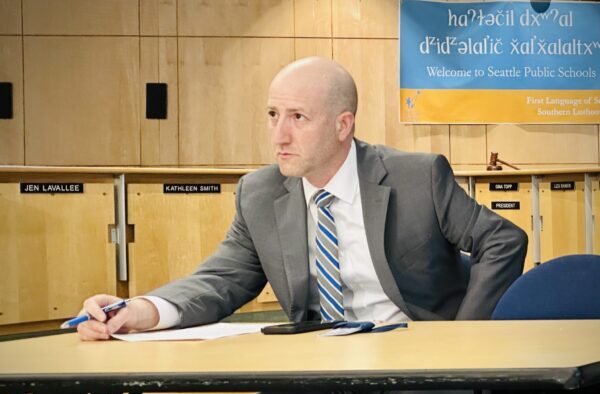
Seattle Public Schools Superintendent Ben Shuldiner at a press conference on Monday, Aug. 31 (Photo by C. Murfin)
In their website and email communications to parents and the public, both sides said the other would be responsible for a strike should one occur, and that their side was ready and willing to move a contract agreement forward.
“SEA does not have to strike. Period, full stop. If they do, that is completely up to them. Our schoolroom doors will remain open as long as we can possibly do so. But if they close, that is because someone else is shutting them,” Shuldiner wrote. He said at the press conference that if teachers wanted to work despite no new contract, their current contract remains in place.
“Again, we are not the NFL owners. We do not lock people out. We want people to work. Our doors will be open. Our arms will be open. We will be serving food,” Shuldiner said. “If people want to come to school and work, we would love that. That would be certainly our dream. ”
SEA says district holds the strike prevention ball
In her weekend update, Diaz said the SEA bargaining team has continued to remain at the table and will continue to do so: “We are three days away from the scheduled return of our students and we have been clear that our intent is to bargain around the clock and avoid a strike. Up until last night, we were making progress on many smaller issues, though SPS still had not budged from their original positions on big issues like their one-sided special education reform proposal.
“The ball is once again in SPS’ court,” Diaz wrote. “Posturing doesn’t help us get back into classrooms; real negotiation does.”
On Tuesday, Sept. 1, the union sent an email out that stated “SEA members want to be back with our students on Wednesday. Our bargaining team worked past 1 a.m. to get closer to the agreement our students need. We feel we made promising progress today and will return to the table this morning.”
SEA members will rally today at 5 p.m. at the John Stanford Center.
The wage increase divide
During his press conference, Shuldiner reiterated that the district’s 8.8% was a minimum guarantee and that wages could go up from there should the IPD elevate substantially. But he stressed that the wage math was complicated and that the district’s longer term expectation of deficit cannot be ignored.
“Why is it difficult? It’s difficult because we’re broke. If we had money, I would love to give it to everybody, but the problem is we don’t. And so when we don’t have the money, it makes these kinds of discussions and decisions very, very difficult,” Shuldiner said.
SEA members have questioned the district’s spending priorities throughout the months-long bargaining process.
Along with wage increases, a redesign of the district’s special education services has been a sore point in the bargaining. On that issue, Shuldiner stressed that the district’s proposal to ensure that kids in need of special education services receive the services they need in their neighborhood schools has evolved over the negotiations, saying on Monday that it is in at least it’s fourth iteration.
Can special education redesign be taken off the table?
“Here’s the thing about special education,” Shuldiner said. “It’s actually something I care incredibly deeply about. As a school district, we just have to do a better job for our students, especially our students with IEPs. One of the things that we’ve had an issue with is that this district has thought of students with IEPs and other service needs — that special education has become a place and not a service, and that’s not the way to think about it. What we’ve been trying to do, engaging deeply with SEA, is to come up with lots of different ideas around how to do that better because one of the things that’s happened is that those students are not being served the way that they need to be, because in essence we treat kids in a very similar way, even if they have very different needs.”
Members of the teachers union have said they want a redesign of special education taken off the table and that the changes proposed by the district will ultimately mean fewer special education teachers and larger teacher-student ratios for special education teachers. That concern spurred a group of SPS general education and special education elementary teachers and instructional assistants to launched spsforkids.org this weekend, outlining what they experience in the classroom and calling the district to withdraw its proposal as part of the current contract negotiations.
But Shuldiner said Monday the topic can’t be separated from a teacher agreement.
“Why it can’t be taken off the table is because special education is so important for our children, and so we need to make sure that we’re consistently talking about it,” Shuldiner said. “Now, certainly, the idea of doing it immediately was never our intent. We always had a kind of a roadmap in terms of doing that. Maybe it’s a year. Maybe it’s a two-year. But the reason why it’s so important to have it during the negotiation is that so much of how we structure this district is in the (CBA) collective bargaining agreement.
“If we’re going to make systemic change to the district, we need our labor partners, especially SEA, to really be a part of it,” Shuldiner stressed.
Teachers see cuts in staffing, increased workload that doesn’t serve kids
Shuldiner’s explanation of the special education disconnect between the union and the district didn’t work for teachers listening in on the press conference on YouTube.
“The district describes its proposal as an investment in special education, while SEA says it results in a net loss of 100 instructional-assistant positions,” one teacher, who preferred to remain anonymous, said. She wants Shuldiner to explain “in actual FTEs, how many positions are being eliminated, added, and reassigned and why SPS considers that an increase in student support.”
“An additional 70 instructional assistances are being reassigned to district. How will removing them from schools help our students? This raises serious safety concerns, too,” she said.
Shuldiner said he would not bargain in public, but said the district is wide open to ideas on the question of how to better serve kids with special education needs. For more on the special education debate, checkout this report in The Seattle Times.
UPDATE: Aug. 30, 2026
Seattle Public Schools (SPS) and its teachers met to try and move the needle forward on a new teachers’ contract agreement, but by Saturday evening both sides were gearing up information campaigns for the increasingly likelihood that agreement is not reached by Wednesday, the scheduled first day of school. The educator’s current contract ends on Monday. Last Wednesday, union members voted to strike, “if necessary.”
While SPS and the Seattle Education Association (SE) bargaining team returned to the bargaining table on Saturday, nearly 200 teachers gathered at Seattle’s Judkins Park to make strike signs in case they are called to the picket line on Tuesday and to voice their frustration with the district’s contract proposals. So far, the two sides have reached agreement on only about 20% of the 57 contract issues brought by the union. Check out The Seattle Times coverage of the sign-making event.
At the end of the day Saturday, teachers reported the bargaining session that day “did not go well.” According to an SEA update, the district walked away from the table Sunday.
The union has been posting bargaining updates on its website since negotiations began in June. On Saturday, the district posted information on the bargaining process for the first time.
“For the past several months, Seattle Public Schools has come to the bargaining table with purpose, persistence, and a clear commitment to students, families, educators, and schools,” that update said. “SPS remains steadfast in its commitment to working with Seattle Education Association (SEA) to achieve an agreement that serves all students, supports our employees, remains fiscally prudent, and positions our schools for a successful year.” The district update outlines the district’s rationale for what it has brought to the table.
The superintendent will begin holding daily press conferences regarding the bargaining on Monday, Aug. 31.
Wages, a key issue
Wage increases were not on the list of tentative agreements by Saturday.
SPS’s current proposal offers guaranteed raise: 2.6%, then 3.6%, then 2.6% over the next three years — about 8.8% total, no matter what happens with inflation.
The union wants wages increased by 1.5%, then 2.0%, then 2.5% (about 6% total) — plus whatever inflation turns out to be each year, using a government inflation measure that neither side gets to set. Inflation by that measure has run about 2.4% to 3.7% a year recently (it spiked to 6.46% in 2023, right after the pandemic). If inflation stays within the normal 2.4–3.7% range for the next three years, SEA’s ask could add up to 12–15%. SEA’s request would result in lower wages than SPS’s offer only if inflation dropped to around 1% or less, which hasn’t happened recently.
Remove it from the table?
Along with wages, a district proposal for a special education redesign has teachers up at arms. The proposal spurred a group of SPS general education and special education elementary teachers and instructional assistants to launch spsforkids.org this weekend, outlining what they experience in the classroom and calling the district to withdraw its proposal as part of the current contract negotiations. The website urges parents and others to email the removal request to SPS Superintendent Ben Shuldiner, Seattle School Board members, and state representatives.
“This redesign proposal should not be happening in contract negotiations. The current contract already provides a joint district–union task force,” the website says. “Ask the superintendent and the board to use the task force to do a proper redesign and to remove this redesign from the strike deadline.”
SEA is also encouraging teachers to email district leaders. According to SEA’s Aug. 28 bargaining update, members of the union have “sent more than 600 messages to every school board member calling for a student-focused contract now.”
UPDATE: August 28, 2026
Teachers and other Seattle Public Schools educators will gather Saturday, Aug. 29, to prepare for a possible strike as teacher contract negotiations with the district slowly continue. Both sides say they are working hard to avoid a walkout — and a delay of the first day of school on Sept. 2.
The teachers’ current contract ends Aug. 31.
The teachers, members of the Seattle Education Association union, said in an email on Friday that they will “make picket signs, practice chants, and prepare for a possible strike that would begin on September 2.”
On Wednesday, the members voted 91% in favor of authorizing a strike if a tentative contract agreement isn’t reached soon. At least 100 teachers are expected to be on hand starting at 3 p.m. at Seattle’s Judkins Park.
In the meantime, the Tukwila Education Association, which represents about 230 teachers in that district, and the Tukwila School District reached a tentative agreement on a new contract Friday afternoon.
UPDATE: August 28, 2026
Following a vote by members of the Seattle Education Association, the union representing 6,000 Seattle Public Schools teachers, paraprofessionals and other educators, to strike if a contract agreement is not reached with the district before the scheduled start of school Sept. 2, Seattle’s Child got a an email message. The subject read “Law firms to SEA & SPS: Threatened strike is illegal.” The message included a letter sent to both sides of the bargaining table, outlining several Washington State legal codes regarding public employee strike rights.
“We write as attorneys and advocates for parents, students, and communities to remind you in light of recent news reports of SEA’s strike authorization vote: The threatened strike by the Seattle Education Association is illegal under state law,” attorneys Daniel R. Suhr and Aaron Withe wrote. They pointed to Washington State Statute RCW41.56.041, which says: “Nothing contained in this chapter shall permit or grant any public employee the right to strike or refuse to perform his or her official duties.”
What’s the real legal upshot? There’s more to the law, and strikes have happened (most recently by Seattle teachers in 2022) without legal action. Check out The Seattle Times’ dig into the issue.
UPDATE: Aug. 26, 2026, 9 p.m.
Untenable. Unreasonable. Misguided. Those were words members of the bargaining team for the Seattle Education Association (SEA) used to describe some of the teacher contract proposals put on the table by Seattle Public Schools.
According to a teacher in attendance at an hours-long SEA general meeting Wednesday night, SEA bargaining leaders said they had “no choice but to ask the membership to authorize the bargaining team to call a strike if necessary.”
Applause rose up in the Seattle Convention Center where the meeting was held after that request. Then, following debate, the teachers and other educators represented by the union (including paraprofessionals, counselors and secretaries), authorized a strike. The SEA represents nearly 6,000 educators who serve the district’s approximately 50,000 students.
Union reps told the teachers that for the past six months they had “worked in a highly strategic manner.”
“If we’re going to have a contest, it is a contest about the right things,” a teacher at the meeting reported a SEA team member told those gathered downtown. “The parents are going to hear from us that our proposals are about students and your ability to come to work in an environment that allows you to do your best work and not be inundated with the pressure that has been building and building.”
The union bargaining team called the district’s proposal for special education untenable. They also said they believe that SPS can afford modest wage increases, based on district data. So far, they told members, district proposals would not provide enough relief from too-big class sizes and overly heavy caseloads.
In a news release following the general meeting SEA said he strike vote sends “a clear message that Seattle educators are united and ready to take action to secure the high-quality public schools and support our students deserve. The vote was overwhelming, with 91% voting yes.”
“Our members have spoken, and we are united in our commitment to Seattle students,” said SEA Vice President and Lead Bargainer Davina Diaz. “We are ready to keep working toward an agreement that gives educators the conditions we need to support every student and build the thriving schools our community deserves.”
“We don’t want to strike but unless the district starts prioritizing student learning and supports, the district is giving us no choice,” said SEA President Ibijoke Idowu.
Authorization of a strike does not mean that teachers will automatically walk out. Negotiations are expected to continue as they have since June. The two sides have spent up to 12-hour days, in 24 sessions, including weekends, trying to reach agreements on the 57 contract proposals brought to the table by the teachers’ union. As of Wednesday they have reached tentative agreement on fewer than 10 of those issues.
Pay is among the unresolved issues. SEA is seeking increases of 1% to 3% for certificated employees and 3% to 5% for classified employees, in addition to state cost-of-living adjustments. According to the union, Seattle teachers currently earn an average of $96,170 annually, while classified employees earn an average of $67,858.
The district is simultaneously confronting a projected $100 million budget deficit. SEA says its wage requests account for the district’s financial constraints.
For now, negotiations will continue.
“We won’t know if we’re striking until Sept 1,” one teacher said following the vote.
If a strike is called, she said, it would likely start Sept. 2, the day students in grades 1 through 12 are scheduled to return to class. Preschool and kindergarten students are scheduled to start Sept. 8.
In an email statement sent to Seattle’s Child in before the vote, SPS Superintendent Ben Shuldiner said that the district has been respectfully bargaining with the union:
“The opportunity for conversation and progress remains,” Shuldiner said. “Our team members have been working diligently to move negotiations forward, meeting throughout the weekend and continuing their round-the-clock efforts every day this week. Their dedication reflects a shared commitment to finding mutual agreement.
SPS is working to open the school year successfully with an agreement that centers our students, supports our educators, and keeps our school district fiscally viable into the future.”
Union leadership pushed back in its release.
“We don’t want to strike but unless the district starts prioritizing student learning and supports, the district is giving us no choice,” said SEA President Ibijoke Idowu.
UPDATE: Aug. 26, 2026
With Seattle Public Schools (SPS) scheduled to start classes next week, educators will meet tonight to decide whether to authorize a strike if contract talks with the district fail. A yes vote is likely, according to educators close to the discussions.
Today is also the day that the Seattle School Board is scheduled to vote the district’s proposed 2026-27 budget, the first put forward by Superintendent Ben Shuldiner who arrived to the district in February and “gone line by line through both central office and school spending” to identify approximately $20 million in central office and schoolbased savings for 2026-27 to close the gap on a projected $100 million budget deficit.
Members of the Seattle Education Association, the union that represents teachers and other school staff, will gather for a closed general meeting at 5 p.m. at the Seattle Convention Center. Depending on where negotiations stand by then, teachers could be asked to approve a tentative contract or give the union authority to strike.
The first day of a class-delaying strike would likely be Sept. 2, the day students in grades 1 through 12 are scheduled to return to class. Preschool and kindergarten students are scheduled to start Sept. 8. The last Seattle teachers went on strike was in 2022, when teachers walked the line for five days.
Authorization of a strike does not mean that the 6,000 union member educators will actually take to the picket lines. Negotiations would continue between union representatives and SPS officials, who have been gathering around the bargaining table for up to 12-hour days, including weekend, since June. SEA represents teachers, paraprofessionals, counselors, secretaries and other staff.
As of Monday, the two sides has settled only a handful of the union’s 57 contract proposals. At that time there were still 50 issues on which the two sides had not reached tentative agreements.
Pay is among the unresolved issues. SEA is seeking increases of 1% to 3% for certificated employees and 3% to 5% for classified employees, in addition to state cost-of-living adjustments. According to the union, Seattle teachers currently earn an average of $96,170 annually, while classified employees average $67,858.
The district is simultaneously confronting a projected $100 million budget deficit. SEA says its wage requests account for the district’s financial constraints. SEA is also seeking smaller classes, more staff for kids receiving special education services, and changes to workload.
UPDATE: Aug. 25, 2026
Teachers and other members of the Seattle Education Association (SEA) will meet tomorrow to decide whether to accept a tentative contract from Seattle Public Schools (SPS) or authorize a teacher’s strike. But, according to an Aug. 24 SEA bargaining update by union Vice President Davina Diaz, “It’s looking increasingly unlikely that we’ll have an agreement in time to present it to the membership on Wednesday.” The union and SPS officials planned to meet from 9 a.m. to 9 p.m. today.
“While we continue working on smaller issues, we’re simultaneously focusing on a package including the biggest issues – Special Education, pay, and pressurization,” Diaz wrote on Monday. “We shared in an update weeks ago that their opening proposals were completely unacceptable. We’re pushing hard to move them and there’s been very little give. We’re getting creative and trying to find some ways forward that work.”
SPS Superintendent Ben Shuldiner said in an Aug. 25 email statement that from his perspective, “Bargaining continues in good faith and with respect for our labor partners.
The opportunity for conversation and progress remains,” Shuldiner said. “Our team members have been working diligently to move negotiations forward, meeting throughout the weekend and continuing their round-the-clock efforts every day this week. Their dedication reflects a shared commitment to finding mutual agreement. SPS is working to open the school year successfully with an agreement that centers on our students, supports our educators, and keeps our school district fiscally viable into the future.”
If there’s not tentative agreement to offer up to teachers to vote on Wednesday, Aug. 26, Diaz said teachers will be given an in-person update on where bargaining stands.
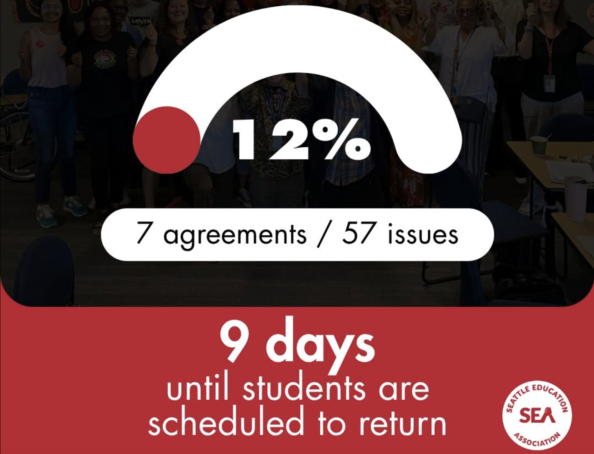
Seattle Education Associations meter on contract negotiation progress as of Aug. 24
UPDATE: Aug. 22, 2026
Teachers union rep says ball to prevent a strike is ‘ in the district’s court’
With only 11 days left before classes are scheduled to start for Seattle Public Schools students in grades 1 to 12, the district and the union representing its teachers have yet to reach a contract agreement.
In an update last Thursday to union members, Seattle Education Association (SEA) Vice President Davina Diaz stressed: “It’s time for SPS to pick up the pace.”
“It’s not time at the bargaining table that makes a difference—it’s the willingness to make compromises and move toward agreement,” Diaz wrote. “The district is not being responsive on the subjects that hold the greatest weight for our students and members: pressurization and wages.
“When we say pressurization, we mean relief from the increases in caseload, class size, and workload that take our time and focus away from students and lead to burnout. And when we talk about wages, we mean making sure all SPS employees can afford to live in the city where we work—with larger wages for lower-paid workers—to help create more continuity and stability for students,” Diaz wrote.
SEA members will meet on Wednesday, Aug 26, to either approve a tentative contract agreement or authorize a strike. On Friday, with only 12 days to the start of school, the union posted that it had come to agreement on only 6 (11%) of 57 contract issues.
Beverly Redmond, SPS spokesperson, offered a more confident view of bargaining and the chance of reaching a contract before Sept. 2 or any subsequent strike.
“We’re optimistic,” said Redmond on Saturday. “What I can say is that we’re at the table today and everyone on either side is being positive.”
The SPS Superintendent echoed Redmond in a statement, noting that the two sides have been meeting regularly for long bargaining sessions.
“The conversations have been thoughtful, respectful, and focused on finding solutions that support students, staff, and school communities,” Shuldiner said. “I am optimistic about the progress that can be made together and our shared commitment to reaching an agreement. All parties are meeting on a constant and consistent basis, having scheduled weekend bargaining and full-day sessions.
Shuldiner added: “We are dedicated to achieving an agreement that serves our students, supports our employees, remains fiscally prudent, and positions our schools for a successful year.”
In June, Shuldiner acknowledged that the district could face some layoffs in the effort to reduce a projected $87 million budget deficit for the 2026-27 school year. But a Thursday community update, Diaz said any lack of funds to raise teacher wages is not a problem of deficit, but rather a problem of priorities:
“We understand the district has budget problems, but it also has budgeting problems,” Diaz wrote. “Budgets are moral documents that show who matters, and who doesn’t.
“The spending on highly-paid administrators paints a clear picture of priorities that don’t align with what our students need. SEA is digging into the district’s annual $1.3 billion budget and finding that part of the problem is state funding. And part of the problem is the district’s misplaced priorities.
“The ball is clearly in the district’s court,” Diaz wrote.

Teachers gathered last week to support the Seattle Education Association contract bargaining team (Photo courtesy SEA)
UPDATE: Aug. 9, 2026
With only two agreements, union teams says ‘we need to move faster.’
With just weeks to go until the start of the school year, Seattle Public Schools teacher contract negotiations are moving very slowly.
In an update early last week, Seattle Education Association (SEA) Vice President Davina Diaz reported that the two sides had “moved the needle” on very few of the 57 proposals the union brought to the table. The union represents about 5,800 educators.
“SEA has put on the table all 18 of our ‘small’ issues, called that because we believe they’re less expensive and easier to reach agreement on. So far we have reached agreement on two of those,” Diaz wrote in an August 7 community update. “Though we put them on the table, we haven’t discussed the biggest issues-—traditionally the most expensive issues go last. We’re committed to winning more time for supporting students in our days, safer schools, and respectful pay.”
So far, negotiators for the district and teachers have discussed protections for sanctuary schools and members of the LGBTQIA+ community, a district proposal regarding use of security cameras, extra teachers’ hours, and teachers’ “right to return.” The latter gives an educator who was moved or laid off due to budget cuts or lower student counts the priority to go back to their original school or job if that exact position opens up again.
The union frames its wage and benefits demands around three yardsticks, according to SEA: “what SPS can afford, how SEA’s contract compares with others in the area, and how it compares with the cost of living in King County.” Its central request is “competitive wages” across every job category the contract covers, though the union wants office professionals and paraprofessionals in particular to see bigger percentage increases.
The remaining proposals outlined by SEA focus on giving educators more support in the classroom. Among those priorities are reducing class sizes, ensuring every school has sufficient academic, behavioral, social, and mental health resources, and providing stronger support for teachers who share responsibility for special education classrooms. The union has also added a new proposal in response to this summer’s increase in federal immigration enforcement. It is asking Seattle Public Schools to formally designate all school campuses—including school buildings and surrounding grounds—as sanctuary spaces for students, families, and staff.
In an August 6 update to union members, Diaz was noted she was not impressed with some proposals that SPS has so far put on the table. For teachers, Diaz said, those offerings are tantamount to “longer work days, more control over our time, and [taking] back the pay we get for the extra work we do when substitutes are unavailable.”
Diaz added: “It is nice to hear the district tell us they expect us to say no and come back with something we like more. ”
Officials at Seattle Public Schools said the district has faith in the process.
“While we realize much remains to be done, we are optimistic about what we can accomplish together,” said district spokesperson Beverly Redmond. “Our bargaining approach is focused on meeting our students’ needs while responsibly sustaining our limited public dollars over the long term. This is consistent with the direction the School Board provided through a resolution adopted in July, which directs the district to bargain in good faith, with mutual respect, and in a manner that supports the district’s long-term fiscal health.
“The process is ongoing,” Redmond added. “The district is at the table on a near-daily basis and deeply engaged. Bargaining works best between the parties, in good faith, at the table – and that is where our focus remains.”
The union negotiating team has asked for more bargaining dates beyond the six currently scheduled:
“SEA is feeling the urgency,” Diaz said. “By the end of the month, the SEA membership will have to vote on approving a tentative agreement with the district or on a strike authorization. We do not want to strike, but I share the possibility to be completely transparent about what’s on the horizon. We are confident that if the district shares our urgency, we can get to an agreement.”
“We need to move faster,” Diaz said.