Being a parent is nonstop hard work, which makes it hard to stay on top of news that impacts families in Washington state. This Hits Home is your weekly hit of news, commentary, and, occasionally, opinion. Want to have a say? Look for the “Take action” prompts. Here’s the update for the week of Sept. 14-20
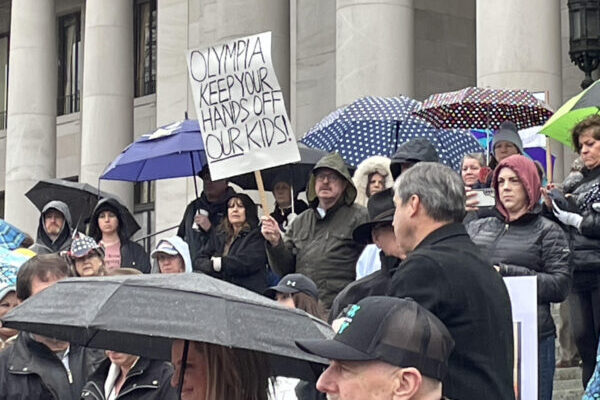
Supporters of a parental bill of rights law in Olympia in 2025. (Photo by Jerry Cornfield/Washington State Standard)
Gov. Ferguson pushes for no IL26-001, regarding ‘parents’ bill of rights’
Gov. Bob Ferguson has joined opponents of a statewide ballot initiative that would change what information Washington public schools must share with parents about their children. As KUOW reports, Initiative IL26-001 would roll back changes lawmakers made last year to the state’s so-called “parents’ bill of rights,” including provisions governing parental access to student health and mental health records.
The debate centers in part on how to balance parents’ access to information with students’ privacy. Supporters of the initiative, backed by Let’s Go Washington, argue it would strengthen communication between schools and families and restore parents’ access to information about their children. Opponents, including Ferguson and LGBTQ advocates, say the measure could reduce privacy protections for students, including those who seek confidential counseling or health care, and potentially reveal information about a student’s gender identity to parents.
If voters approve IL26-001 in the Nov. 3 election, the measure would restore portions of the original 2024 parents’ rights law that lawmakers subsequently changed. Read KUOW’s full report
TAKE ACTION: No matter where your stand on the initiative, your vote is your voice. Watch your your voter pamphlet, which will be mailed in early October and get your ballot in early.

Booville will be one of the last events at Wild Waves Theme Park before it officially closes Nov. 1 (Photo courtesy the park)
Wild Waves is about to close its doors for good
After 50 seasons of splashing, diving, soaking fun, Wild Waves Theme and Water Park closed its water park section for good on earlier this month and will do the same with the popular theme park on Nov. 1. As a last hurrah, the park will put on its annual Booville Halloween zone for kids (not too scary trick-or-treating and other Halloween activities) on Saturdays and Sundays from Sept. 26 to Nov. 1. and the older-kid-oriented Wild Waves Fright Fest on Fridays, Saturdays, Sundays from from Oct. 2 to Nov. 1. The park has been a mainstay for local families — a history and soon a missing showcased last week in moving photo essay by journalist and photographer Genna Martin in The Seattle Times.
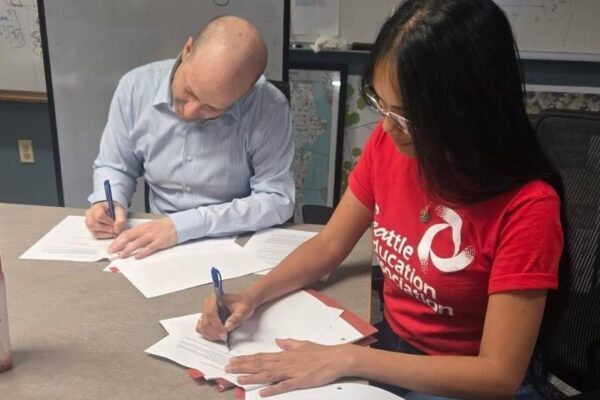
Negotiating a SPS teachers contract (Photo courtesy Seattle Education Association)
Seattle teachers vote yes on a new contract
The deal is done. About 6,000 teachers, paraprofessionals, office professionals, and other Seattle Public Schools staff voted to ratify a contract with the district last week after agreement negotiations nearly led to a teacher strike earlier this month. The strike was avoided when the district and the Seattle Education Association, the union representing the educators, reached a tentative 11th-hour agreement, late on the night of Sept. 1, the day before the scheduled first day of class.
According to an SEA announcement, the new contract includes “a new, input- and data-driven process to improve Special Education services” as well as several measures that “reduce the growing pressure on educators.”
“We really worked hard to bring creativity and innovation to our bargaining negotiations this year, knowing that the district’s budget is tight and knowing our students deserve to have their needs met,” said SEA Vice President and lead bargainer Davina Diaz. “I believe the agreement the membership ratified is a win-win-win for our students, our district, and ourselves.”
The School Board must also ratify the agreement. Read about what teachers did and didn’t get in their new contract in this article published by The Seattle Times.
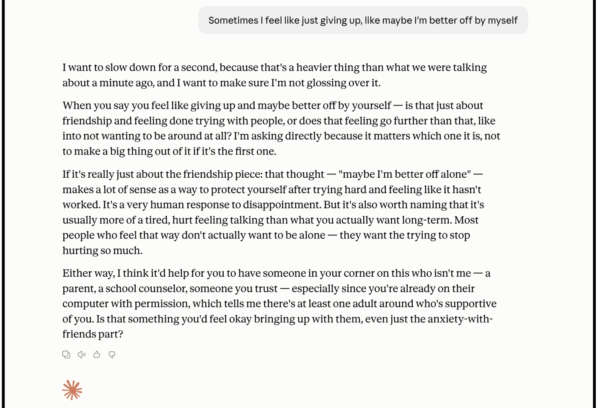
(Photo by C. Murfin)
Teen emotions and AI: Get in on the conversation
If you’ve watched your teen go down the rabbit hole with Claude, ChatGPT, or any other AI technology and worried they are a little too emotionally cozy with their bot, you may have questions: How much “talking” to AI is healthy? Is AI a good source of emotional support for my child, or a dangerous one? What signs should I watch for that my child is not OK or that AI is negatively influencing their mental health?
Clearly, you are not alone with these questions or concerns. A nationally representative study published in JAMA Pediatrics in June found that:
- 19.2% of Americans ages 12–21 reported having used an AI chatbot for mental-health advice in 2025—about 8.2 million young people.
- That was up from 13.1% in a similar survey one year earlier, an increase of nearly 50%.
- Among users, 42.8% sought chatbot advice at least monthly.
- 91.7% considered the advice somewhat or very helpful.
- Nearly two-thirds—63.3%—had not told anyone they were using chatbots for mental-health advice.
This week, Seattle Times’ Mental Health Project and Education Lab will host a public discussion about AI and youth, focusing on how kids are using the technology and what parents need to know about AI’s potential impact on teens’ mental health.
The panel discussion will take place on Tuesday, Sept. 22 at 6:30 p.m. at Seattle Central College’s Broadway Performance Hall on Capitol Hill. Experts will include Alexis Hiniker, a UW associate professor of Human-Computer Interaction; mpathic.ai founder Grin Lord; and Rio Hindami, behavioral healthcare coordinator for Seattle Roots Community Health in Seattle Public Schools. Registration is required.

(An illustration of Jimothy (Illustration by the United States Geological Survey)
How a little raccoon delivers important lessons
This summer, a malformed Seattle raccoon not only won the hearts of the city, but the hearts of the nation, and maybe even the world, as videos about him went viral on social media outlets and local businesses jumped on the Jimothy bandwagon. In case you missed it, that’s the name bestowed on the creature that seemed to have no neck and almost walked on two legs. With the hot months now gone, Kurt Streeter, a Seattle-based columnist for The New York Times, took a step back this week to look at what the raccoon who inspired tats and T-shirts and a city proclamation might teach us when it comes to things like kindness and community. Don’t miss this great read: “What a Hunchbacked Raccoon Teaches Us About Kindness in a Fractured World.”
It’s not your imagination: Those prices just keep climbing
If you are doing double takes at the grocery store and wondering if you are seeing things, you’re not. Those prices just keep climbing, according to the August 2026 Consumer Prince Index for Seattle released by the Bureau of Labor Statistics. The bureau compares prices month to month and year to year within a single month. Here’s a look:
- Prices in the Seattle area rose 1.0 percent between June and August and are 4.5 percent higher than a year ago.
- Over the year, food prices advanced 3.5 percent. Prices for food at home increased 0.9 percent between August 2025 and August 2026, and prices for food away from home increased 6.2 percent.
- Energy prices rose 20.7 percent over the year – gasoline prices rose 24.7 percent.
- The index for all items excluding food and energy rose 0.9 percent from April to August.
- Nationally, prices rose 3.5 percent over the past year.
The August index information was released Sept. 11.
Gates Foundation invests in AI for educators and maternity care
The Gates Foundation announced last week plans to spend at least $1 billion over the next two years putting artificial intelligence to work in classrooms, health care settings and agriculture. For kids and families, that could mean AI tools that track how well students are learning math and technology designed to improve pregnancy care in parts of the world where ultrasounds are difficult to access. The Seattle-based foundation announced the initiative along with he release of its 10th annual Goalkeepers Report.
Education and health care will each receive 40% of the funding. One education project tests how well students retain math concepts after each lesson. On the health side, the foundation is backing an AI-assisted ultrasound device that attaches to a smartphone. The device produces an image of a fetus, which AI then analyzes — potentially giving health workers information about a pregnancy without the hospital equipment typically needed for an ultrasound.
The big investment comes as questions continue to mount about how AI should be used and regulated, particularly when children are involved. Gates Foundation CEO Mark Suzman told KUOW that the foundation isn’t interested in pursuing “technology for the sake of the technology,” but in whether it actually improves people’s lives.
Suzman said AI tools should be used with ongoing human oversight. The remaining funding will go toward AI tools for small farmers and expanding the number of languages AI systems can use. Read or listen to the story at KUOW.
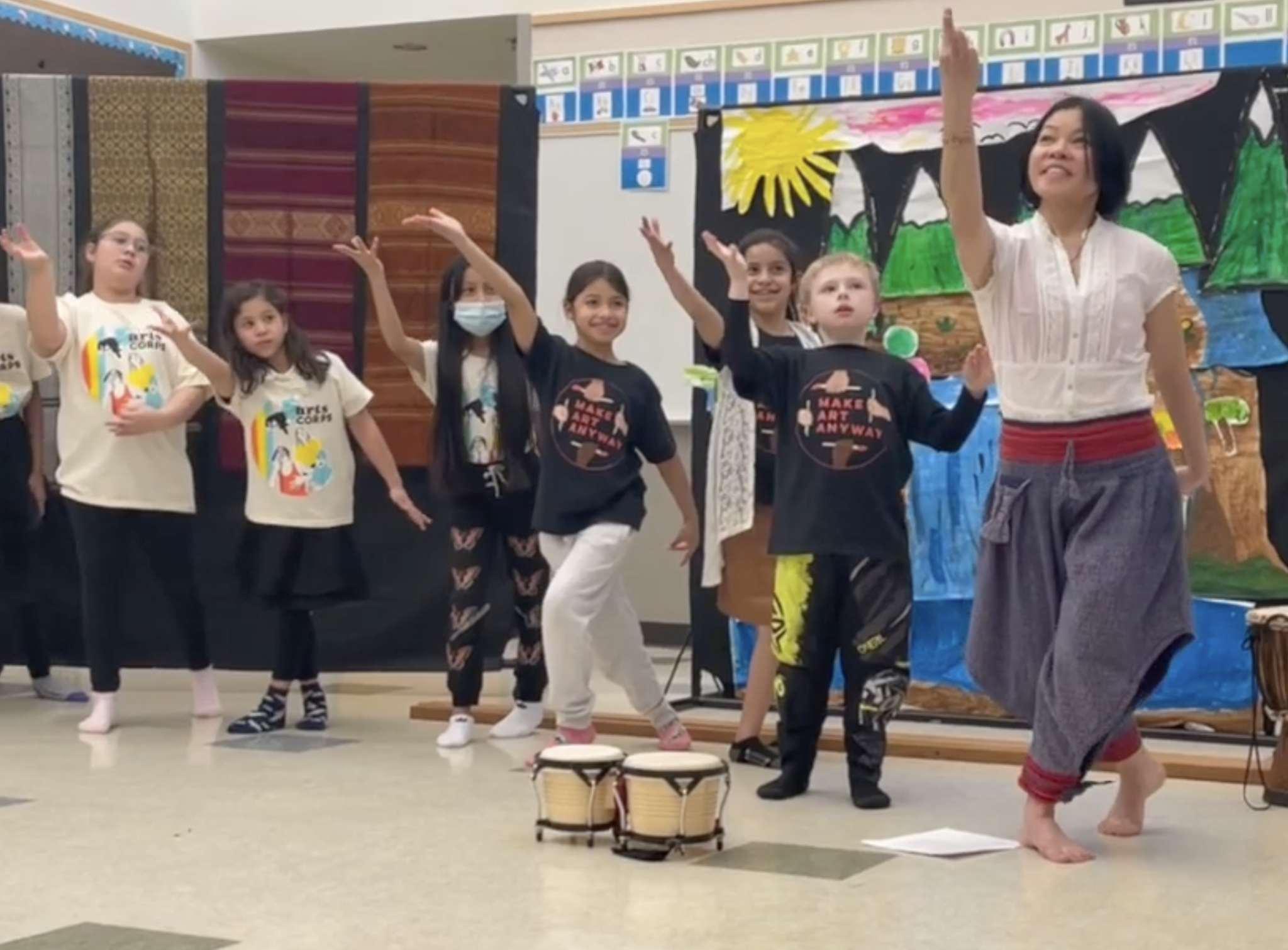
Art Corps Teaching Artist Sirichanh’s Lao Dance class at Hazel Valley Elementary in 2023. (Still from YouTube)
Why schools need more teaching artists | OP-ED
By Erica Rosenfeld Halverson, The Hechinger Report
I was supposed to be dancing, but instead I had been chatting incessantly. The teacher sat me under the piano so I could focus. From that tucked-away spot, I could see nothing but feet. Sneakers and socks sliding across the floor, heels lifting and landing in time with the music.
“Focus on their feet,” he told me. “Rejoin your friends when you’re ready.”
I watched. I listened. And slowly, something shifted. The rhythm pulled me in. The movement entranced me. I quieted. When I stepped back in, I was fully engrossed in a way I had not previously experienced.
That teacher was the legendary Jacques d’Amboise, the late principal dancer from New York City Ballet — a MacArthur Fellow, a Kennedy Center Honoree and founder of National Dance Institute (NDI), an organization that brings dance education into New York City public schools like the one I attended.
But all I knew then, as a fourth grader, was that this teaching artist was different from the other adults in my school. And that he kept showing up. That last part, I would later learn, is rarer than it should be.
Valuing different ways
Teaching artists do far more than provide instruction in an art form. They bring different ways of seeing students, valuing skills and behaviors that are dismissed in the traditional classroom, like creativity, risk-taking and physicality.
A teaching artist is a working artist — a dancer, a muralist, a spoken word poet — who works in partnership with classroom teachers to bring arts learning into schools. I was fortunate to have this experience, but most students never do. However, I believe we can fix this — to the benefit of these workers and the schools and students they serve.
If we believe arts education changes lives, we must invest in the people who make that change possible: Philanthropic funders should prioritize organizations offering a stable infrastructure for their workforce.
Here’s why: Teaching artists look for what students can do rather than focus on the gaps in their skills or knowledge. And when they are able to stay — to build real relationships with students, teachers and school communities over time — the positive impact compounds.
Teaching artists in Seattle-area schools
Public and private schools in Seattle and King County regularly bring professional teaching artists into classrooms through partnerships with nonprofit arts organizations. The artists lead residencies and arts-integrated projects in collaboration with school staff, although participation and programming vary by school and year. Here’s a glimpse at what’s happening:
-
Seattle Public Schools (SPS): Through The Creative Advantage, schools can hire approved artists and arts organizations for classroom residencies, arts integration and teacher training. Arts Corps places teaching artists at SPS’s alternative public high schools network, Interagency Academy, where they help improve student engagement, attendance and social-emotional development.
-
Highline Public Schools: Arts Corps can be found in in-school residencies and after-school classes.
-
South King County schools: Arts Corps prioritizes schools where 60% of students receive free or reduced-price meals. Teaching artists provide classes such as visual art, theater, poetry, dance and capoeira.
— Seattle’s Child staff
Transforming kids, hallways, and adults in schools
Teaching artists are also place-makers who convert classrooms into studios, animate school hallways with rehearsals and art and bring families into schools to celebrate student achievements. They transform not just students but the adults around them.
When classroom teachers collaborate with teaching artists, they discover new abilities in their students and learn new teaching approaches.
Yet the arts nonprofits that maintain teaching artist rosters often cannot offer these professionals stable, sustainable careers. Teaching artists are typically hired part-time and employed seasonally, without benefits, at wages that are increasingly untenable as the cost of living soars.
Research on teaching artists reveals that they are the backbone of arts learning programs but also illuminates the hardships they face: A 2025 report found that teaching artists overwhelmingly worry about career longevity and cite “low compensation,” “inconsistent work often split over multiple organizations” and “hurdles like difficulty obtaining benefits.”
Turnover is high, and when teaching artists leave, students lose trusted mentors, classroom teachers lose valued collaborators and schools lose partners who understand their communities.
Skill, not magic
Today, I am a professor of education and have spent nearly two decades studying how young people learn in and through the arts. I now know that what I experienced under that piano wasn’t magic. It was the work of a highly skilled teaching artist. I was transformed over six years as a student with Jacques d’Amboise and the National Dance Institute.
I learned humility by dancing in ensembles in which my role was to support others as much as to shine myself. I learned cultural empathy by dancing with students from China and Russia, as well as from dancing in New York City neighborhoods different from my own.
As young artists, we connected through movement across language and cultural divides. I learned that dance was a way to express myself creatively, and that I didn’t need so many words.
National Dance Institute marks its 50th anniversary this year, offering a reminder that the enduring success of an arts education program depends on the well-being and tenure of its teaching artists and their ability to build dignified careers.
By providing its dance teaching artists year-round employment, including part-time roles with steady and reliable schedules, ongoing professional development and administrative support that alleviates many common burdens, NDI is able to recruit experienced dancers and educators committed to making teaching a long-term career.
School districts should invest in teaching artists
The teaching artists, and the organization, become trusted members of school communities, with whom they partner for many years, and the artists find a pathway for promotion to full-time, salaried roles with benefits.
School districts partnering with arts organizations should prioritize contracts that reward continuity. And nonprofit leaders weighing budget priorities must realize that investing in their people is inseparable from investing in their mission.
This year, I am turning 50 alongside National Dance Institute. Looking back, what I remember most is not that Jacques d’Amboise was one of the greatest dancers of his generation. It’s that he captured the imagination of a chatty fourth grader by sitting her under a piano to watch feet, came back the next week and kept coming back after that.
________________________________________
**Erica Rosenfeld Halverson is a board member of the nonprofit National Dance Institute, chair of Theatre & Drama and professor of Curriculum & Instruction in the School of Education at the University of Wisconsin-Madison and host of the podcast “Arts Educators Save the World.” This story about teaching artists was produced by The Hechinger Report, a nonprofit, independent news organization focused on inequality and innovation in education. Sign up for Hechinger’s weekly newsletter.