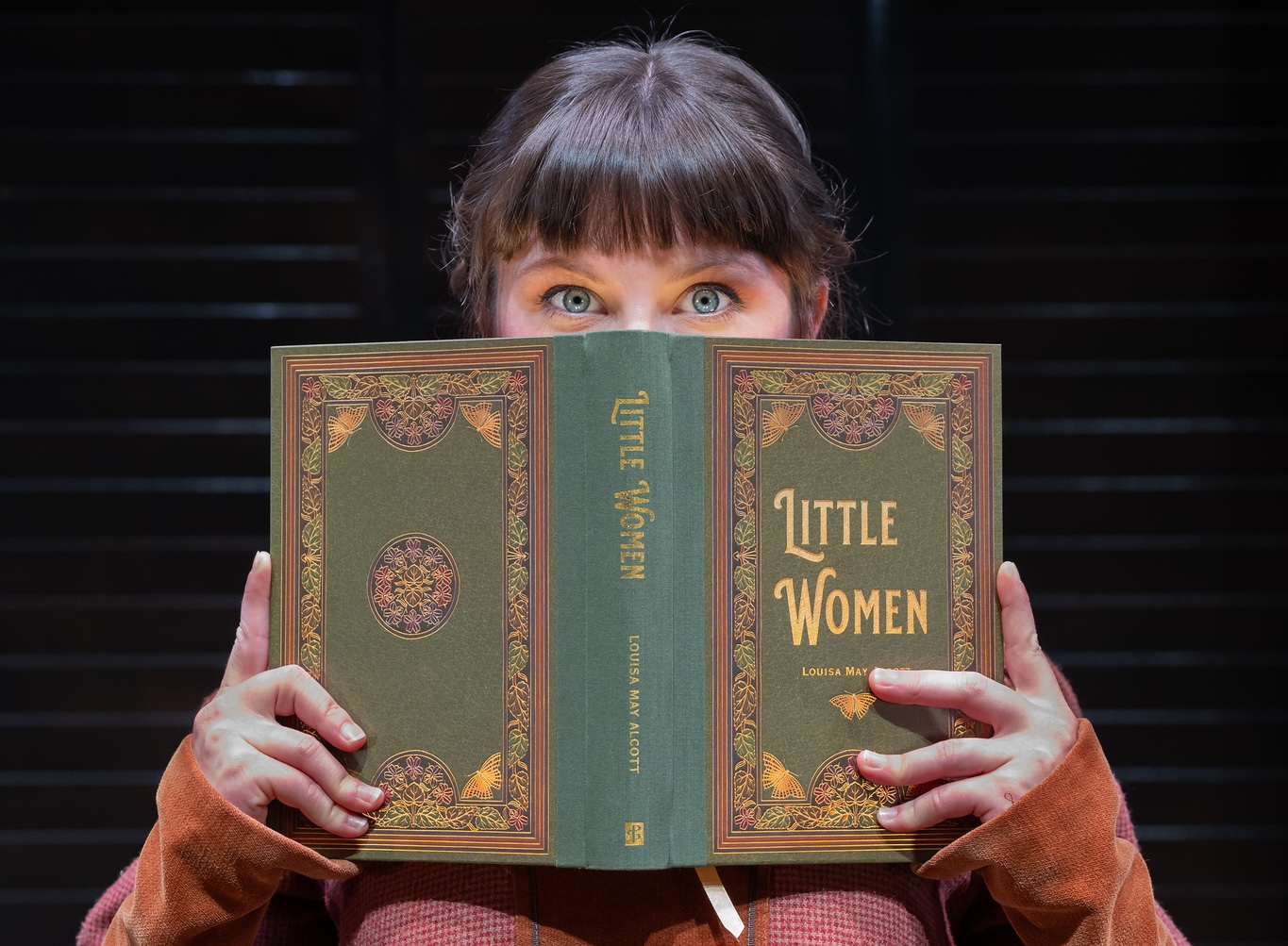
What if Jo March, the feisty writer-sister in author Louisa May Alcott’s beloved novel “Little Women” could argue with the woman who invented her?
In playwright Lauren Gunderson’s adaptation of “Little Women,” she can and she does. Alcott isn’t simply the name on the book cover; she’s a character in the play, moving between her life as a writer and the fictional world of the March sisters. She talks to her characters, questions her decisions and sometimes discovers that the people she created have ideas of their own.
It’s a twist that gives audiences two stories at once: the familiar tale of four sisters growing up during the Civil War and the story of the woman who turned her own family’s experiences into one of America’s most enduring novels.
“Louisa May Alcott’s Little Women” runs Nov. 18 through Dec. 26 at Seattle’s Taproot Theatre Company.
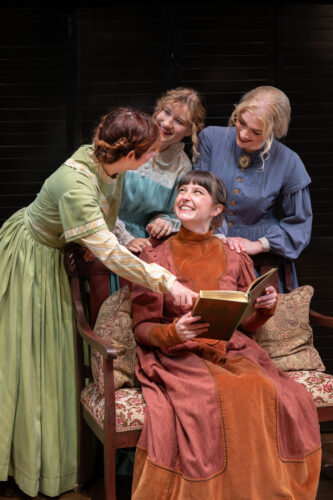
(Photo courtesy Taproot Theatre Company)
Synopsis
The March sisters — practical Meg, headstrong Jo, gentle Beth and ambitious Amy — are growing up in Massachusetts while their father serves in the Civil War. Money is scarce, their mother is doing her best to keep the household together, and each sister has a different idea about what she wants from life.
The story begins at Christmas, when the girls give away their breakfast to a family with even less than they have. From there come sibling squabbles, friendships, romance, disappointment, illness and loss. There are also plays to put on, stories to write and dreams that don’t always fit the expectations placed on young women in the 1860s.
For imaginative kids
Gunderson’s version draws directly from Alcott’s novel, first published in 1868, while introducing the author herself. In this show, Alcott becomes Jo, her fictional counterpart, and moves between writing and the story taking shape around her.
If you have kids who like to make up stories, draw comics or imagine themselves as characters in books, this show’s device offers something beyond another retelling of a classic: a look at how an author builds a fictional world from real experiences.
A conversation with the director
Karen Lund, Taproot’s producing artistic director, has directed several Gunderson plays at Taproot. Lund says Taproot has previously staged five Gunderson plays, including three from the popular Christmas at Pemberley series, co-written with Margot Melcon. She appreciates Gunderson’s ability to bring familiar literary characters to the stage without losing their humor or emotional complexity.
Lund spoke with Seattle’s Child about the production, its appeal to young audiences and what parents should know before bringing children.
Seattle’s Child (SC): Why bring Little Women to the stage during the holidays?
Karent Lund: “This will be Taproot’s sixth time presenting a play by Lauren Gunderson, including three very successful productions from her Christmas at Pemberley series, co-written with Margot Melcon. I love the way Lauren brings stories from page to stage, while keeping their humor, heart, and poignancy intact. For me, Louisa May Alcott’s Little Women feels especially right for the holidays: it invites us to think about family, generosity, and the imperfect but loving ways we care for one another. It’s an opportunity to slow down, share a story, and enjoy being together.
SC: What makes this adaptation different from the many film and stage versions of Little Women?
Lund: This production is called Louisa May Alcott’s Little Women because we get to know not only the beloved March family, but also the woman imagining their story. We meet Louisa as she takes on writing the novel, wrestles with her doubts about it, and discovers how deeply it connects with readers. She speaks directly to the audience, her family, and the characters she has created who were inspired by her real-life mother and sisters. I love that we’re invited into the act of storytelling itself. For young people who like to write, draw, or make up stories, I hope that offers a wonderful glimpse of how something personal can become something others recognize themselves in.
SC: How exactly does Alcott fit into the action?
Lund: She isn’t simply a narrator standing outside the action. As a director, I’m fascinated by the moments when she discusses and debates the direction of the novel with her own characters. Although they’re inspired by her sisters, they’re also her creations—and they don’t always seem willing to do what she wants! There’s humor and humanity in that tension. I hope young audiences find it encouraging, too: even the person writing the story has questions, doubts, and discoveries along the way.
SC: Taproot is a relatively intimate theater. What does that add for children watching the play?
Lund: One of the things I treasure about Taproot is how close our audience is to the actors. Wherever you’re sitting, you’re right there with the March family, sharing the small moments as well as the big ones. For children, I hope that makes the experience feel less like watching a story from a distance and more like being invited into it. This production asks the audience to play along and to imagine places, seasons, and the passage of time with us. That partnership between actors and audience is part of what makes live theatre so special to me.
SC: What age do you recommend this show for and why?
Lund: Our recommendation is for ages eight and up because the play also contains themes of war, death, serious illness, and grief. Beyond age, I’d encourage parents to think about whether their child enjoys settling in for a longer story and can sit comfortably through a theatre performance. You know your child best. A little preparation can help too: talk about how a live play works and how the actors may invite us to imagine things rather than show us every detail.
SC: What do you hope children take away from the March sisters’ experiences?
Lund: What I love most about the March family is how real, human, and flawed they are. Like the rest of us, they’re trying to do better for the people they love and build the futures they imagine, but sometimes they get in their own way. Jealousy, anger, frustration, impatience; those feelings are familiar to all of us, children and adults alike. We watch these young women face struggles we recognize. Sometimes they rise to the occasion, and sometimes they fall short. I hope young viewers leave knowing they don’t have to be perfect to be worthy of love or capable of doing something good. There is heroism in trying, in making amends, and in beginning again. Our intentions and efforts matter, not just our successes.
SC: Should children read the novel before seeing the play?
Lund: Come ready to have fun and bring your imagination! You don’t have to know the book to be curious about the story. Before you come, you might ask your child, “How do you think actors could make us imagine a different place or a whole season without showing us everything?”
Then, enjoy discovering the answers together. The actors will speak directly to you and invite you to imagine the world of the play.
After the show: Questions for kids and parents
The March sisters make different choices, have different ambitions and don’t always understand one another. Their disagreements offer plenty to talk about on the way home.
- Which March sister did you understand best? Was she also your favorite?
- Jo wants to become a writer, but people expect young women to follow certain rules. What expectations do you think kids face today?
- Why do you think Alcott included herself in this version of the story? What changed when the author could talk to her characters?
- The sisters sometimes hurt one another’s feelings. Who handled a disagreement well? Who might have done something differently?
- If you could rewrite one scene from another sister’s point of view, which would you choose? How might the story change?
- What did you imagine while watching that wasn’t actually shown onstage?
For children who enjoy writing, try a follow-up activity: Write a short scene based on something that happened in your own family, then change one detail to make it fiction. What happens when a real experience becomes a story?
If you go
What: Louisa May Alcott’s Little Women, by Lauren Gunderson, directed by Karen Lund
When: Nov. 18–Dec. 26, 2026
Where: Taproot Theatre’s Jewell Mainstage Theatre, 204 N. 85th St., Seattle
Ages: Recommended for ages 8 and older. Children younger than 5 are not admitted, including infants.
Run time: Approximately 2 hours and 15 minutes, including a 15-minute intermission.
Accessibility: A closed-captioned performance is scheduled for Dec. 16.
Budget option: A Pay-What-You-Can performance is scheduled for Nov. 19 at 7:30 p.m.
Tickets and performance schedule: Taproot Theatre