We all want to help our children with homework, finding that fine line between hovering too closely and helping too much, or backing off too far and having them fail.
My two children were polar opposites when it came to homework help. My son, with ADHD, needed to be watched, prompted and timed. My daughter, who came out of the womb organized, did not. Once I made the mistake of micromanaging her. "If I ever bring home a grade lower than a B you can check on my homework," she said. Point taken. I was available as a resource if she asked for help.
Most children fall between those two extremes, but Alicia Craven, program manager for 826 Seattle, a nonprofit writing and tutoring center, stresses that homework help should be individualized to each child. Some students prefer to be totally isolated while doing their homework, some do better if they're listening to music, and others are more productive if they're talking with other students. I asked Craven how parents can constructively help their children with their homework.
Are there some general guidelines for parents?
Routines around homework are important: Have a set place where it should be done with all of the materials available. Ask students what they are working on, and then join in to help them. Students should have a "flight plan" or chart for what needs doing each day, in what order, with breaks built in.
We can sometimes customize homework assignments to match kids' interests, such as writing out spelling words with different colored pencils if the child likes art.
A local teacher made the suggestion that parents add a sticky note to the paper so that teachers can see more than the finished product – i.e. "She breezed through the first eight problems, but we spent 20 minutes on the last two." This helps the teacher know where the student needs more instruction.
How much should we check and correct our students' work?
"Sometimes a student will say "I finished it," but it's important how it's finished. Try to find 15 minutes at the end of the homework session to look over all of the assignments.
Always be positive, even if there are things that need correcting. For example, have students read a writing assignment back to you. They will usually read correctly, even if the written punctuation and grammar are bad. You can help them correct the writing to match their oral presentation. If a student can't figure out how to begin a writing assignment, put the paper away and have him speak his ideas to you while you take notes. Then help him edit the notes to meet the assignment.
Capitalize on what the student does know. Rather than saying "Let's see what the holes look like," we could say "Let's see what you do know, and work from there."
Watch out for doing too much for your student. If he can't tell you the content in his own words, he probably hasn't understood it.
Are there different ways to help students at different ages?
In first through third grades, try to sit beside the child or be in the same area. Perhaps you can do some quiet work, like writing or bill-paying. You can even do the same assignment she is doing and give each other input. Plan a fun activity to do together when the homework is done.
In fourth through sixth grades, you are more likely to say, "Here is where you are set up to do your homework. Work on it for X amount of time and then come check in with me."
In middle and high school, sitting with a parent to do homework won't be appealing. At the beginning of the week, have students give a summary of what they must accomplish and set yourself up as a resource. Have conversations about research methods. Make sure they have organizational systems in place to keep track of assignments, using a planner or organized binder with tabs for each subject.
If homework becomes a power struggle, it may be best to have someone else check the work through a tutoring center, library study zone or school or neighborhood homework club. Take advantage of your library's online live-chat tutoring, usually provided by paid experts in different subjects.
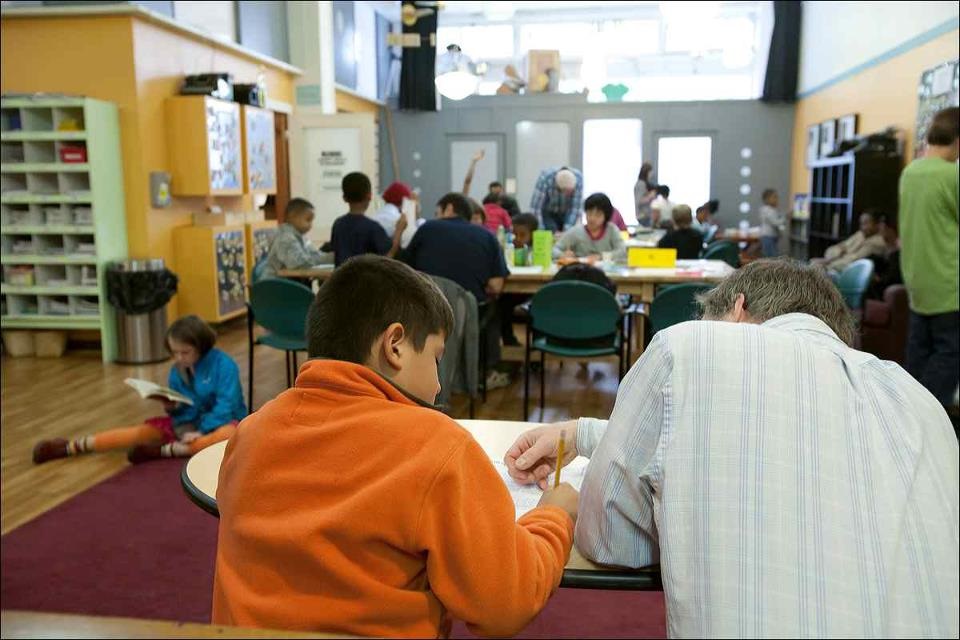
Photo courtesy of 826 Seattle.