As a foreign diplomat, my grandfather cared deeply about civic duty. Walking to the polls with him is one of my happiest memories, one that floats to the surface each time a voter’s pamphlet or ballot arrives in the mail.
“Voting is not just a right,” he’d pontificate. “It’s a duty and the backbone of our democracy.” And then he’d launch into the story of how my great-grandfather, a Washington state senator, went out and talked to every voter in Sunnyside, Washington — on foot, for many miles, through knee-deep snow …
Walking the talk
During my teenage years, my grandfather would review the voter pamphlet with me, reading the candidate statements out loud (much to my grandmother’s chagrin). We’d discuss my thoughts and he’d listen to my reasoning. The minute I turned 18 — on my birthday — my grandfather took me to register to vote. In celebration of my first vote, my grandmother baked a red, white, and blue cake with my name on it, as though I’d just been born into democracy.
My kids received a similar civics lesson. “Your vote,” they heard repeatedly from us, “is your voice.”
A lot of unheard voices
In the midst of the presidential campaign drama and the monumental redirect to Kamala Harris as the Democratic candidate, I began to look at voting data from the last presidential election. One statistic caught my attention:
According to Tufts University’s nonpartisan research group CIRCLE, ony 47% of young people ages 18-29 voted in the 2024 presidential election.
Washington state’s young voters weren’t much better than the national accounting. While Washington ranked 12th in terms of highest voter turnout, according to Tufts only half (51%) of the nearly 480,000 eligible voters ages 18 to 24 in our state cast a vote in that election. These numbers are down from participation in the 2020 presidential election.
In King County, youth turned out in higher numbers than the rest of the state, as did all the voters in all age categories. Nevertheless, tens of thousands of eligible voters ages 18-24 and in King County stayed home on presidential election day in 2024.
The importance of voting
Especially as the highly contentious presidential election draws near, I can’t help but think about my grandfather and his mantra.
“Every vote matters,” he would say. In other words, “YOU matter.”
It’s something our kids, especially teens on the cusp of adulthood, need to hear. It’s especially important when our personal rights are at stake.
Yes, many young people express apathy about politics. But make no mistake. They are worried.
Start them voting before they can vote
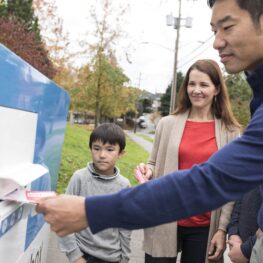
I think I’ve always known that—and felt it in my peers in my younger years. That’s why, well before my own kids could read or truly understand what Election Day was, I started our voting tradition. When my daughter was a baby in Seattle, I marked my ballot and spoke out loud about who or what I was voting for and why. She gurgled and cooed back at me. Then we walked to the voting booth. Once she, and later my son, were out of my arms, they walked to the voting station and sat and watched as I voted. On the way home, in Shoreline by that time, they proudly sported their “I Voted” stickers. When booths were replaced with drop-off boxes, we continued our Election Day walk tradition. My kids opened the box and dropped my vote in. If no sticker was available, I gave them a treat for being so responsible. On their 18th birthdays, as my grandfather did for me, we took them to register to vote.
My kids are adults now—adults who never fail to exercise what my grandfather called “a right and a responsibility.” We still discuss our votes and the reasons for them together, and walk to the drop-off box on Election Day—even though we could simply mail in our ballot. There’s something about that walk. In a way, it is a physical manifestation of the power and hope each ballot holds.
Tell them what matters
My grandfather, who lived through two world wars, a depression, and seven decades of voting, would say that America is no place for voter apathy — in any age category. Our hope for the future, he would argue, is to tell our children, early and often, “Your vote is your voice.”
I hope you’ll follow his lead: involve your kids as you fill out your ballot. Go through the candidate statements with your teens, and remind 17-year-olds that in Washington, they can register and vote in primaries as long as they will turn 18 by the following general election. Take them to register and stick that ballot, when it comes, on their pillows with a note that reads “Please vote.” Add a second line to the note: “YOU matter.”
I’m not a grandparent yet. My kids are considering whether that is the right path for them in these difficult and uncertain times. But if I am lucky enough to become one, you can bet I’ll be my great-great-grandfather’s whisper in their ear: “Your vote is your voice.”
And I will get myself to my daughter’s or son’s home on a grandchild’s very first Election Day to take that walk with their parents to the drop-box. I already have a box of “I Voted” stickers, just in case.
Read more:
Should young kids go to protests?