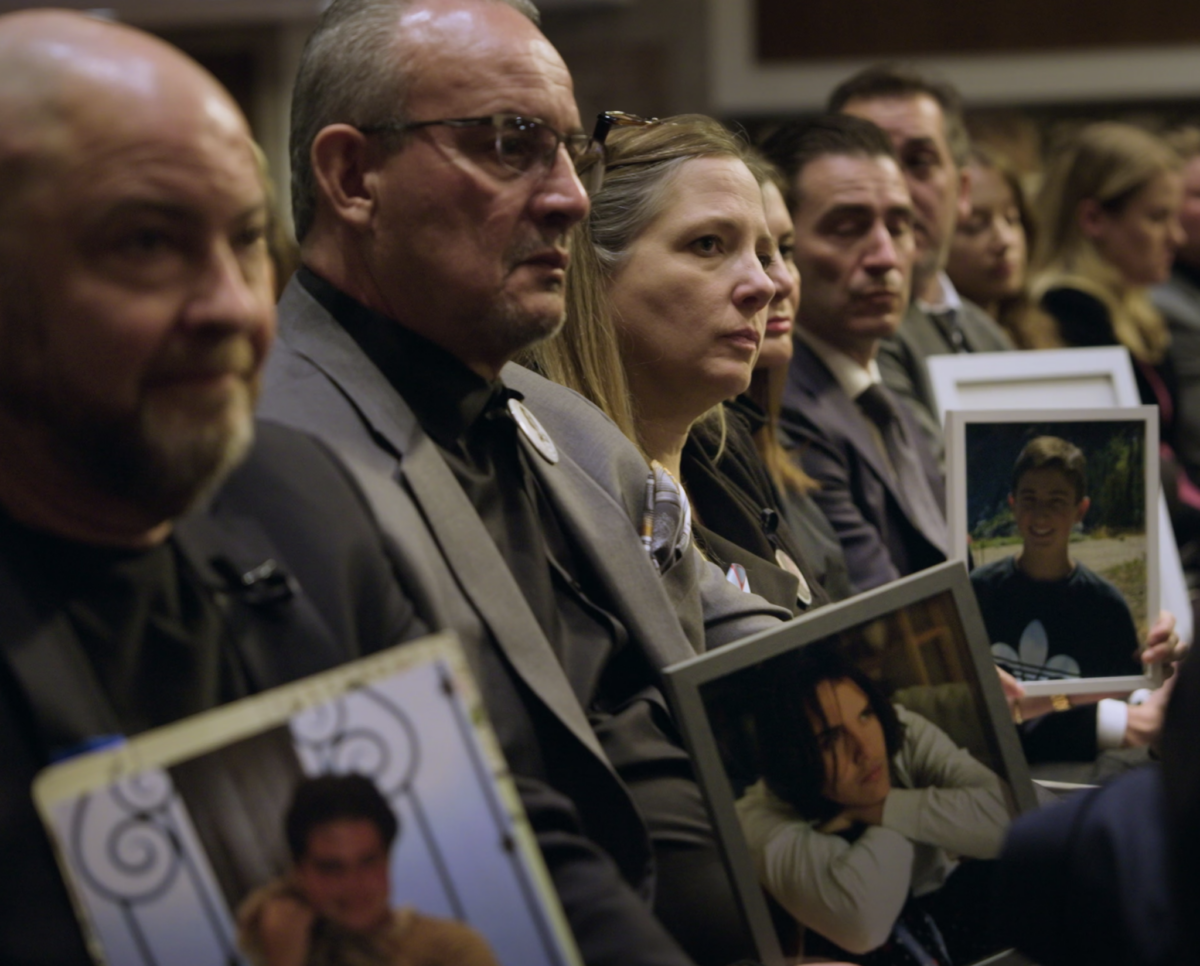
The bottom line: Parents should not look away from the film “Can’t Look Away: The Case Against Social Media.”
The moving and important film, directed by Perri Peltz and Matthew O’Neill, exposes social media companies whose platforms — including TikTok, SnapChat, Instagram and Facebook — for knowingly harming children and fueling the crisis of social media and teen mental health.
The film is now available to watch online at home, which I something I recommend you do with tweens and teens, especially if they’re on social media. The movie rental fee is $7.
“You can’t be a parent in 2025 and not see the threat social media platforms pose to children,” said Emily Cherkin, founder of Seattle-based company The Screentime Consultant. Cherkin has been sounding the alarm on kids’ screen use and social media use for nearly a decade.
Knowingly causing harm
“Can’t Look Away” begins with an eerie black and white blur protecting the identity of a male speaker, a former global executive of trust and safety at a large social media platform. In two sentences, he makes it clear why attorneys at Seattle’s Social Media Victims Law Center (SMVLC) are building cases against TikTok, Meta, and Snap on behalf of the families who have lost kids after viewing content on their platforms.
“Do I think the main social media platforms today, with the current level of protections, are safe for children?” the former executive asks. “No. There’s more than enough evidence to show otherwise. Are the tech platforms that I’ve worked for aware of the examples of underage users who’ve been very negatively and often tragically impacted by the use of the platforms?
“Yes, of course they are.”
Seattle-based attorneys take on tech giants
The film introduces the work of the SMVLA, founded in 2021 by Matthew Bergman, a Seattle attorney, law professor, and community activist. Bergman recruited attorney Laura Marquez-Garrett, a 20-year veteran of complex litigation specializing in electronic evidence and forensic investigation, and others passionate about holding social media companies legally accountable.
“The social media companies know what their products are doing to young people. They know the levels of addiction, they know the levels of suicide, but they have no legal breaks on their behavior,” Bergman said. “These are not easy cases, but we have clients whose stories are resonant, whose harms cannot be swept under the rug. It’s very real and very hard to think about somebody losing their child.”
SMVLA is now representing more than 4,000 families claiming their children’s deaths or injuries were related to social media usage. They are preparing a landmark case against Snapchat and other social platforms, arguing these companies used product design that knowingly contributes to child exploitation, addiction, and harm.
The companies have been getting away with not addressing the issue despite awareness by clinging to Section 230 of the Communications Decency Act. The section protects social media companies from being held liable for content posted on their platforms.
Bergman’s firm has taken a unique approach to victim lawsuits. It seeks to apply product liability principles in court to gain justice for families and to force social media companies to prioritize user safety and design safer platforms to protect users, especially children and teens.
Grieving parents fighting back
“Can’t Look Away” follows the stories of several of the families represented by SMVLA.
Brandy and Toney Robert’s 14-year-old daughter, Englyn, hanged herself after watching a how-to on Instagram.
“I looked through her phone about a month after she passed, and I found a video of a lady on Instagram modeling self-strangulation, and exactly what that lady did on that video is what our child did,” Toney Roberts tells filmmakers.
We meet the parents of 15-year-old Riley Basford, who committed suicide within just a few hours of being sextorted by strangers through Facebook Messenger.
We hear the story of a teen who shot himself after a search on social media — and hear the 911 call from his mother. The boy searched for inspirational quotes to help with a recent break-up, but was quickly sent posts encouraging him to kill himself.
And we learn of another teen who nearly died from a fentanyl overdose after receiving what he thought was the painkiller Percocet to treat a headache from a drug dealer on SnapChat. The film demonstrates how SnapChat’s platform provides easy cover for dealers and easy access for teens.
To a one, the parent plaintiffs in “Can’t Look Away” tell us that their goal in going after social media companies in court is not about restitution, but about protecting other kids.
“I can’t bring my son back, but I sure can do whatever I can to make sure that no other mother has to go through it,” the mother of the sextorted teen tells us.
Social media: It’s designed to addict
The film stresses an ugly truth: a generation of kids is now addicted to social media platforms built to do just that, addict them. With algorithms engineered to exploit kids’ developing brains and keep them clicking, social media platforms are fueling a public health crisis.
“I set this firm up because I think that unless the civil justice system gets involved and holds these companies accountable, we’re going to have several lost generations of kids,” Bergman stressed.
The statistics in “Can’t Look Away” back that possibility:
- In 2022, social media companies made an estimated $11 billion in advertising to minors.
- 95% of teens use social media; over a third are on it “almost constantly” (Pew Research).
- 57% of teen girls report persistent sadness or hopelessness (CDC).
- The American Psychological Association and U.S. Surgeon General have both issued urgent warnings linking social media to rising rates of anxiety, depression, and suicidal ideation among youth.
These numbers show why social media and teen mental health is now one of the most urgent public health conversations.
A reviewer who is also a parent
This film brought me to tears.
I am a parent of a now-adult son who became addicted to Facebook and other social media in his teens. In fact, I supported his early use of social media, thinking it would help him connect and make friends. More than 10 years ago, I didn’t understand the potential harm.
I am a lucky mother. My then-16-year-old did not commit suicide after a Facebook extortionist intercepted a nude video he naively sent to his girlfriend — and then made good on their threat to send it to his friends and family if he didn’t send $10,000. My son said he wanted to kill himself. I believed him. Thankfully, he received only love and support from his family and friends, who graciously refused to open and instead deleted the images sent to them by the criminals.
My son told me immediately of the sextortion. I can imagine many kids would not tell their parents they made such a mistake. This film made it painfully clear to me the power of teenage embarrassment and shame, and how things might easily have gone for our family.
Back to the bottom line
“Can’t Look Away” is a must-see.
The film is also more. It’s a must-act.
While Matthew Bergman and Laura Marquez-Garrett (who will appear at the screening) and all the legal experts at the SMVLC do the legal work of fighting for justice for families and trying to stop future tragedy, we parents also have work to do.
First we need to keep our kids off social media for as long as possible.
Second, we need to stop blaming ourselves when our kids eventually start using social media. Instead, we all need to join the fight to hold accountable the companies who design social media and demand they modify those products to protect kids’ vulnerable, still-developing brains. These companies are driving the crisis of social media and teen mental health.
As Cherkin says, “We can’t look away.”
Read more:
Why ‘Color Book’ will stay with any parent who watches it