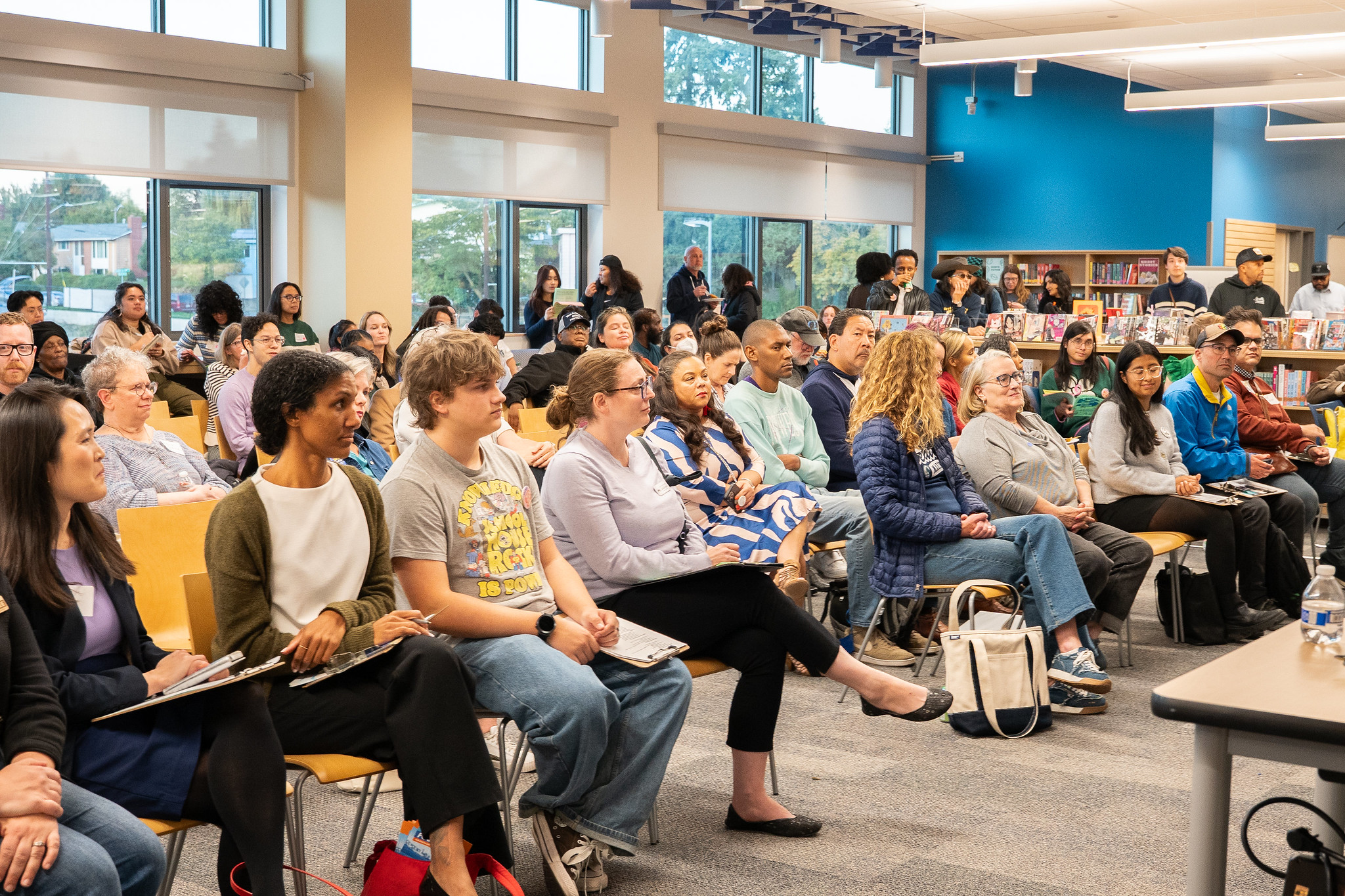
This month, the Seattle Education Forum offered something rarely seen in traditional candidate events: a space where students and families, those most affected by education policy but often furthest from political power, had the opportunity to speak directly with the people who seek to represent them. The result? An evening where candidates, from school board hopefuls to King County Executive contenders, moved beyond rehearsed talking points and genuinely engaged with community voices.
This forum was made possible by Southeast Seattle Education Coalition, Alliance for Education, Black Education Strategy Roundtable and League of Education Voters, as well as other culturally-rooted community partners. Together, we created an intentional space for dialogue in the newly rebuilt Rainier Beach High School, a fitting location for a conversation about the future of public education.
Community members listen for how candidates will meet their needs. (Image: Aliyah Silvestre)
For years, families and students have raised the alarm: our public schools are not serving all students equitably. These concerns occasionally surface at school board meetings, but far more often, they remain within households, unheard and unaddressed. This forum was designed to change that by elevating everyday experiences into policy-relevant discussions, surfacing critiques, sparking ideas and issuing calls for accountability and support.
What emerged was powerful. Candidates heard firsthand about the challenges facing students not just inside school walls, but throughout their communities. While the issues raised were wide-ranging, they underscored one central truth: education sits at the intersection of many systems, and meaningful change requires collaboration that crosses regional and institutional boundaries.
Concerns around Housing
Much of the forum discussion centered on student enrollment and the growing affordability crisis. As Seattle’s wealth gap widens, many families simply can’t afford to stay in the city. This is driving school enrollment declines, especially in neighborhoods hit hardest by displacement.
One School Board Candidate pointed to recent district data showing that for every single-family home in Seattle, about 0.3 school-age children live there. In standard multifamily units, that number drops to 0.1. But in affordable, family-sized multifamily units, the number jumps to 0.8 children per unit. The takeaway is clear: enrollment isn’t declining because families don’t want to be here. It’s because they can’t afford to be.
Reversing this trend requires deeper collaboration between the School Board, City Council, and housing advocates. If we want vibrant schools, we need housing policies that allow families to stay. Quite literally: if you build it, they will come.
Concerns around Safety ICE, School Resource Officers, Mental Health
At the forum, families and students described safety as more than reacting to violence, it means creating spaces where students feel physically and emotionally secure.
The School Board’s decision to exclude School Resource Officers from Seattle schools sparked discussion. Participants noted progress from non-policing strategies like added district safety staff and community violence prevention. Parents and students emphasized that safety must also consider the harm policing has caused in many communities. For students of color, true safety includes psychological well-being.
Concerns extended to federal immigration enforcement. Though schools are legally protected, many families fear those protections may be ignored here at home as we see across the nation. Some prepare through private networks and plans. Community members called for stronger policies to prevent cooperation with federal immigration agencies and ensure school leaders are ready to respond as proactively as possible and are equipped with the resources to do so.
Mental health was a recurring theme. Families stressed the need for more school-based mental health services, including culturally responsive counselors. Real safety means emotional support, trauma-informed care and healing environments rather than punishment.
These discussions made clear that safety must be holistic–prioritizing care, trust and lasting well-being– that go beyond the current conversation of reactive policies and narrow definitions of safety.
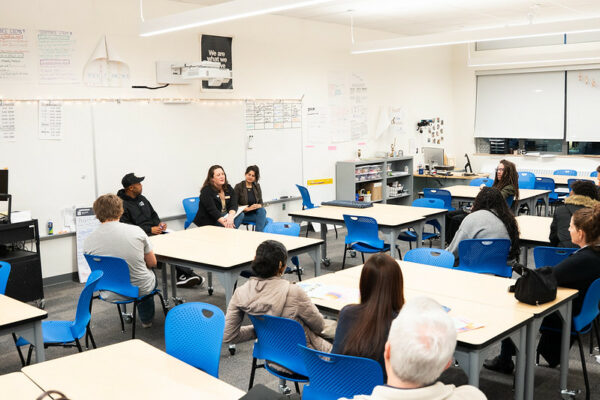
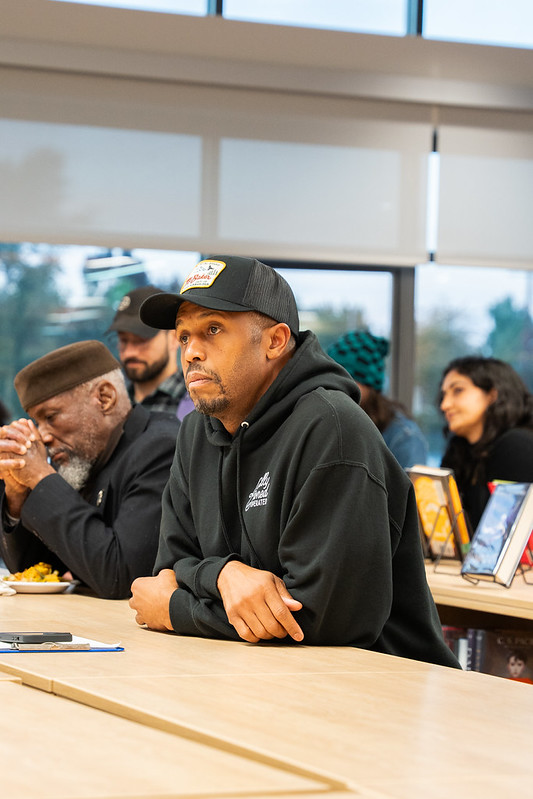
Candidates get face to face with parents and other community members. (Image: Aliyah Silvestre)
Concerns around Funding
One of the clearest takeaways, for both us as organizers and the candidates in the room, was the urgent need for stronger collaboration across government offices. A key example came up during the discussion: the City of Seattle included increased school funding capacity in its state legislative agenda this year. While the intention was right and aligned with community needs, the effort was pursued in isolation, without meaningful coordination with school leaders or advocates. As a result, it fell short.
This raises an important question: could greater collaboration have led to better outcomes? Across the board, there is broad agreement on the “what” and the “why” of supporting our schools. Where we continue to fall short is in the “how.” Moving forward, we must demand that our leaders not only commit to education equity in words but work together across agencies, jurisdictions, and sectors to deliver on that promise. Our students deserve nothing less.
A reminder of what’s needed
By centering the voices of those most impacted, this forum lights the way forward and reminds us that collective determination and bold action are essential to building the schools our students deserve.