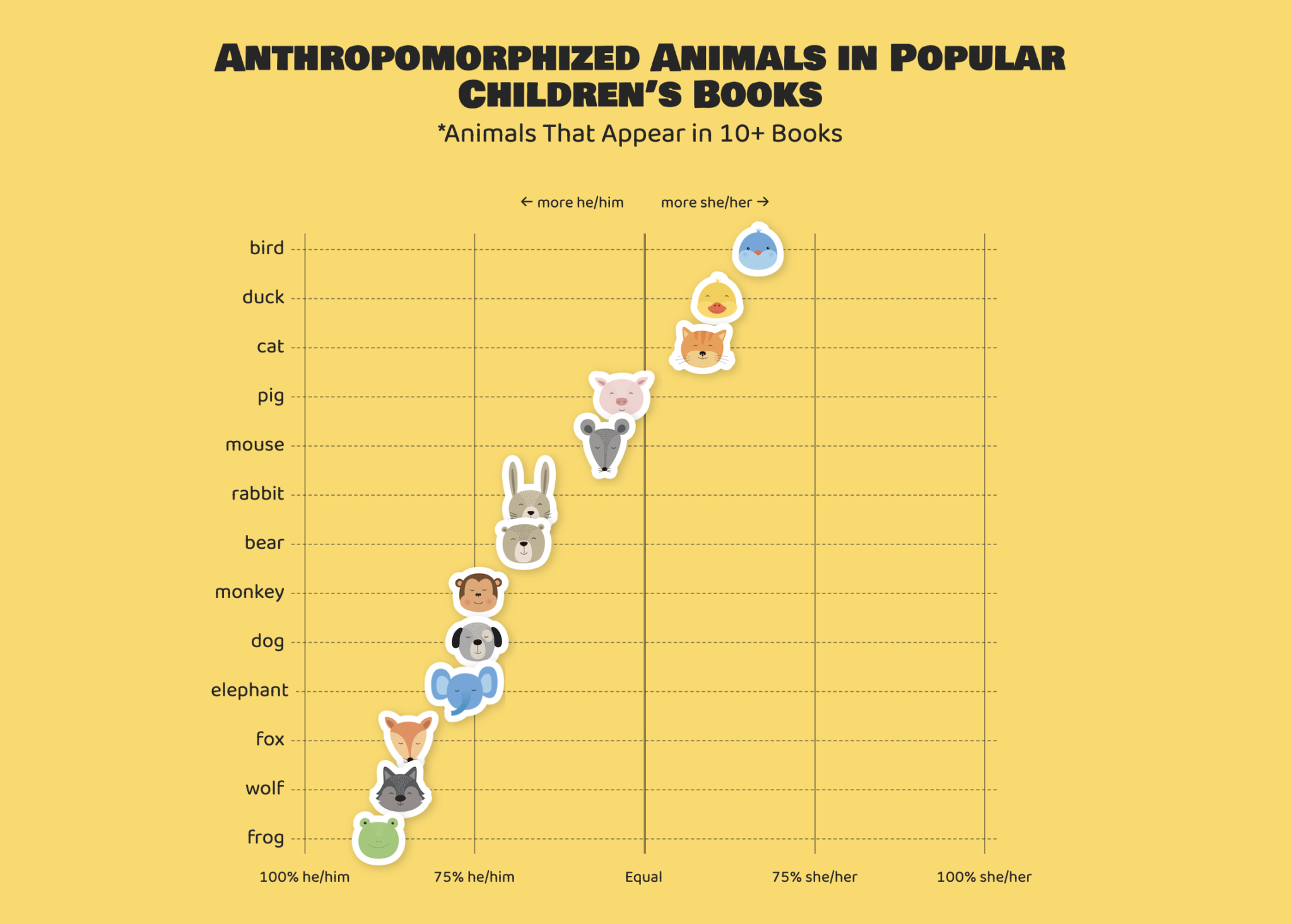
Which animals are gendered in kids’ books? And why are so many of them boys? Those are questions a Massachusetts data-journalist dad and researchers at the University of Washington set out to answer. Of course, before they could do that, they had to determine if their niggling feeling was correct: Do most animals in children’s books and in people’s minds s skew male?
The answer — after analyzing 300 books and responses from 1,300 people asked to complete the sentence And then the bear said, ‘I must go to the river.’ Upon arriving….” — was clear. Yes, more animals in kids’ books are referred to by male pronouns. But gender neutrality certainly made a show.
Its in The Pudding
“There was a lot more gender neutrality and ambiguity in the survey responses—though, since their stories were much shorter than a typical kid’s book, it was perhaps easier to maintain gender neutrality,” the researchers wrote when they published their analysis results last year on The Pudding, where their results are both easy to understand and cutely laid out. “While he/him was still the most frequently used pronoun in the survey results, many respondents referred to the animal by name (26%), by it (17%), or by they/them (3%).”
“My biggest takeaway from The Pudding analysis is how sneaky gender bias is with animal characters, and how much they expose our ingrained cultural assumptions,” said University of Washington researcher Melanie Walsh. “Today when authors create human characters, they are usually thoughtful about choosing the character’s gender or racial background. Often they intentionally work against longstanding stereotypes and toward more diverse representations of the world. But when imagining animal characters, people almost let their guard down. They think, ‘Well, they’re only animals,”even though the animals wear clothes, live in a house, and talk like a person. So the gender breakdown of animal characters actually exposes the unconscious masculine bias that still dominates so much of our storytelling and culture.
Walsh added that a lot of readers might not notice the bias. “The other big takeaway is that, without data, it can be hard to fully realize the extent of gender bias in kids’ books.
“My collaborator Russell and I manually read through hundreds of children’s books, and the stories didn’t feel as male-dominated reading them one by one as they actually turned out to be when we crunched all the numbers,” Walsh said.
And the next question is …
Walsh and doctoral students Imani Finkley and Yuanxi Li didn’t stop after identifying those animal pronoun trends. They became curious what happened to the results when books were written with artificial intelligence.
The upshot of their new study, aptly entitled “Neutrality Bites: Gender Representation in AI-Generated Animal Stories“? AI models writing kids’ animal stories don’t just repeat human gender bias; they erase female characters almost entirely, defaulting to “it” or no gender 57% of the time and giving animals female pronouns just 2% of the time.
“We were surprised by how much AI models amplified the gender bias that we saw in human-authored stories, with only 2% of the stories featuring female characters,” Walsh said. The AI models were, overall, six times less likely to feature a female animal character than human authors. And some of the newest and supposedly most improved models, like GPT-5, displayed the most masculine bias—65% of GPT-5 stories included male characters, compared to 1.8% female characters, with 33% ungendered or described as ‘it’ or ‘its.'”
The numbers suggest that gender bias in AI models may actually be getting worse over time, not better.
“That means we have to remain critical whenever we’re using AI models, or engaging with material crafted by AI, which may now include kids’ stories,” Walsh stressed. “We also have to demand more transparency from AI companies.”
The researchers were also surprised by cases where AI models chose not to gender the animal character or gendered them neutrally (it/its). Those cases indicate that AI companies may be discouraging models from explicitly gendering a character in cases where the character’s identity is ambiguous.
“That seems like a good thing—on the surface,” Walsh said. “But the result is that female characters got totally suppressed. And masculine bias still broke through. So if this is how AI companies are trying to reduce gender bias, it’s not working.”
How they are represented matters
Walsh said called representation “hugely important” in children’s storytelling and media.
“There’s an enormous amount of research on this subject. Stories influence how kids think about themselves and the world during a crucial period in their social and psychological development, and this includes ideas about gender roles and norms,” Walsh said. “It’s vital that kids see representations not only of themselves but also of people who are different from them, because kids are developing skills like empathy and imagination.”
The importance of representation isn’t a new understanding, said Walsh. “We’ve known all this for a long time, but the new factor is AI. Should we even be using AI at all? And if we do, what should we look out for? These are the kinds of conversations that we hope our research can contribute to.”
At a time like this
Walsh said the research is far-reaching, especially as stigmatized genders. ”
“I want to mention the importance of trans and non-binary gender representation in stories, especially because trans rights are so under threat in this country,” Walsh said. “We don’t fully address this in our most recent paper, but we do argue that AI models should more equitably represent a broad spectrum of social identities. We think it’s crucial to think beyond a normative gender binary in these conversations. Trans youth matter.”