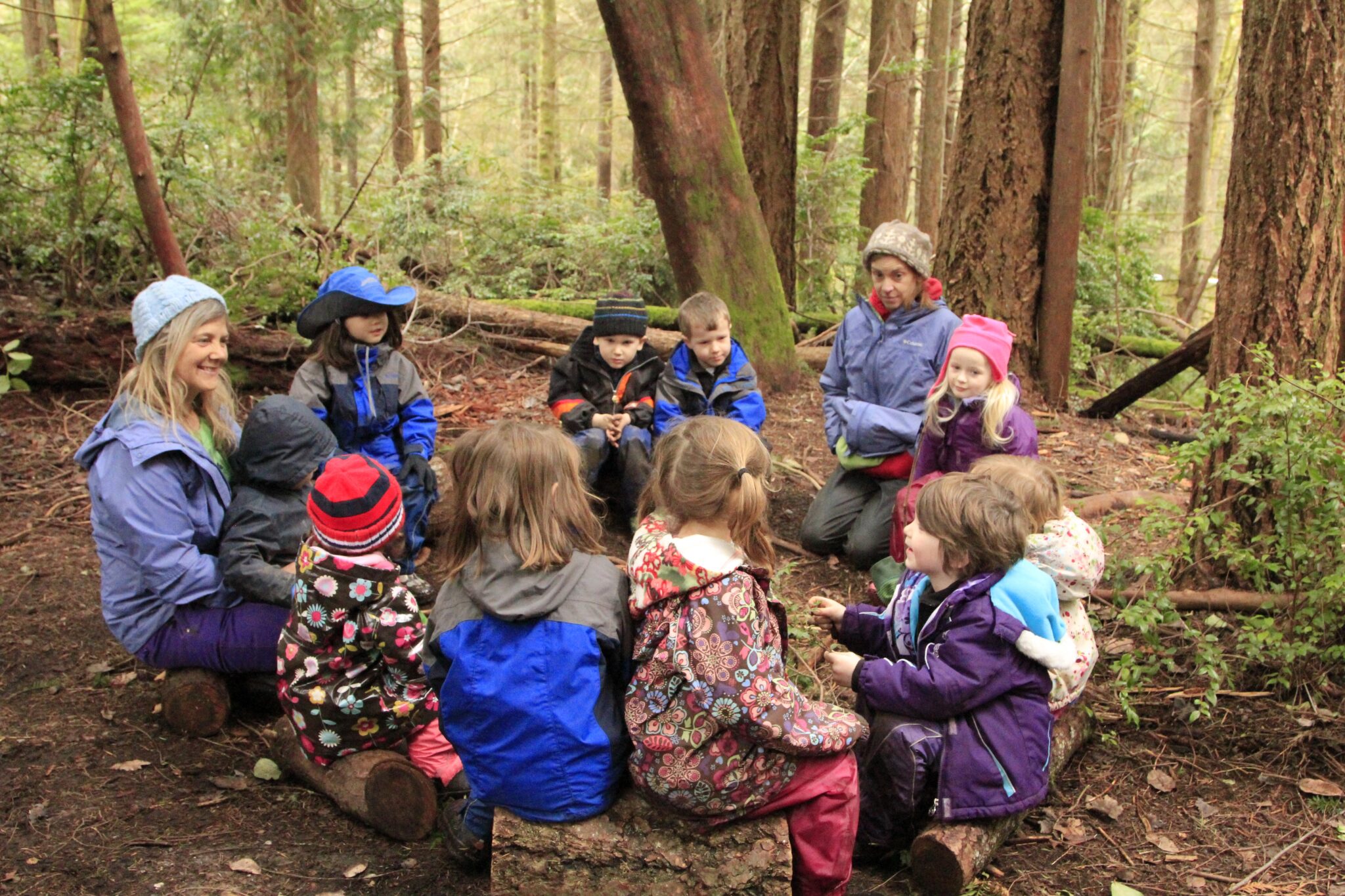
When children go to Cedarsong Nature School, there’s no such thing as staying inside because of bad weather. Actually, there’s no such thing as staying inside, period.
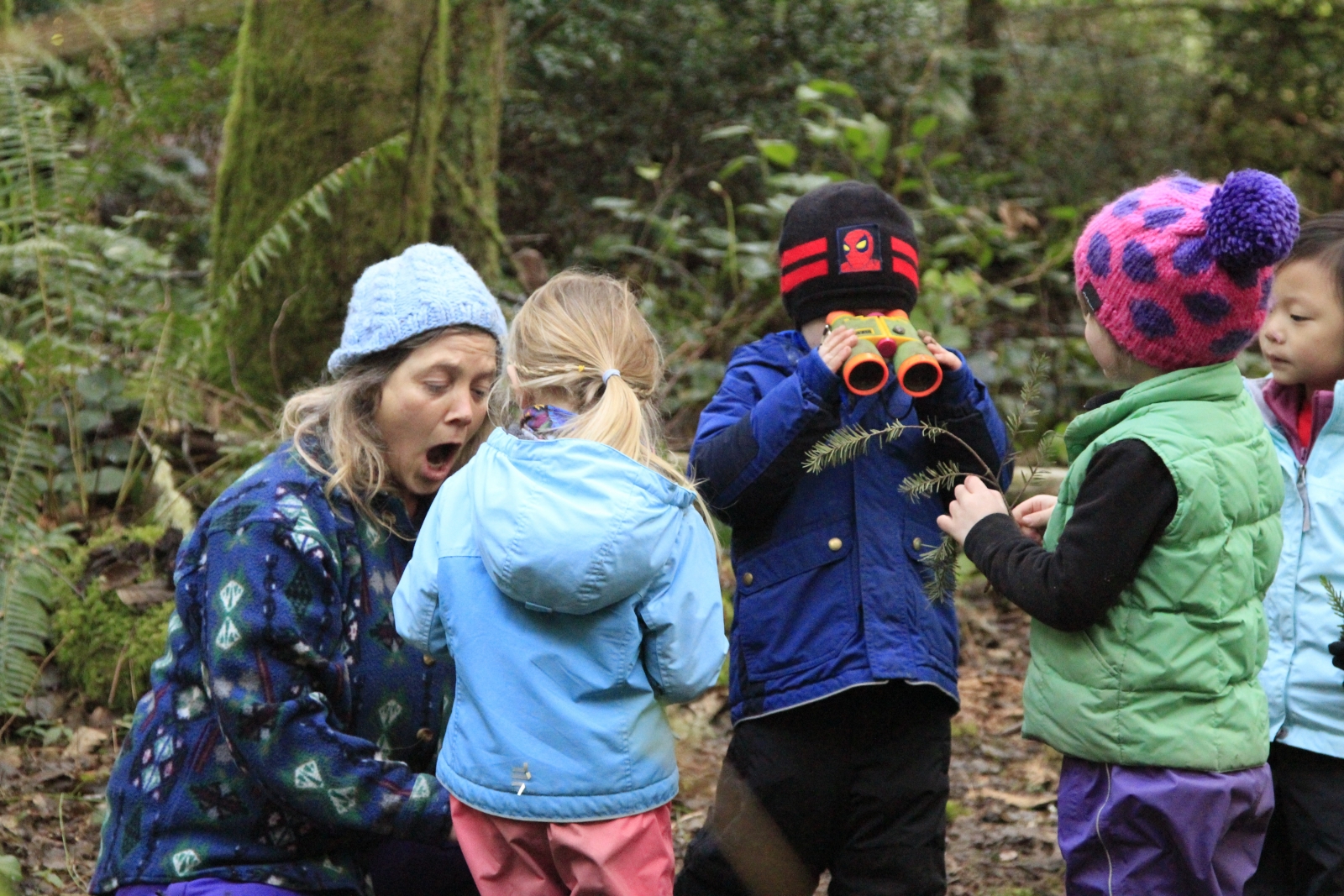
So don’t look for banks of computer tablets here, or other technology-based learning. It’s quite the opposite, in fact. Preschoolers at Cedarsong do their learning by tromping muddy paths and watching for deer and listening to birdsong, poking in tide pools or balancing themselves on a rock. Organic snacks are served, “supplemented with wild seasonal foraged foods.”
Children ages 2 to 6 spend their entire school day at the preschool outside in the woods, fields and beaches of Vashon Island for up to five hours daily. That means whether there’s snow, rain or shine. It’s a type of “forest preschool” popular in Europe (called “Waldkindergarten” in Germany, which boasts hundreds), and growing in popularity here, if both the extensive waitlist and mobbed teacher training workshops at Cedarsong are any indication.
Families love the approach — so much so that two-thirds of the student body comes from off-island and must commute by ferry to the school from as far off as Everett and Gig Harbor. And don’t dismiss the program as simply a traditional preschool held outside, or just a daylong recess, says its founder, Erin Kenny.
“The main distinguishing feature here is our interest-led, flow learning,” Kenny says. “There is no agenda to the children’s day. When the children show up, they play and discover in nature really deeply. The learning comes from the discoveries they make. The kids are making fantastic observations … about the natural world. The really neat thing is, they integrate quite well into formal education when they start that (after preschool). They have really learned not just what to think, but how to think.”
The key is plugging the children into the natural world, not asking them to sit still, memorize facts or to use computers or other technology before they’re ready, says Kenny: “My whole mission is the importance of a free-flow learning environment. There is huge therapy for children in spending three, four or five hours in nature, and not dealing with transitions all days. They need uninterrupted playtime in nature and relaxation. That is something most of today’s children are missing.”
Courtesy of Cedarsong Nature School |
Waldorf schools, although they use brick-and-mortar buildings along with considerable time in the great outdoors, likewise take the connection to the natural world seriously, and use technology in a slow, graduated fashion. The youngest Waldorf students have almost no connection with computers or anything else with a screen during the day, while high schoolers may build robots.
It’s all about common sense, says Nettie Fabrie, director of pedagogy at the Seattle Waldorf School, which just this fall moved its 86-student high school program to new digs at Seattle’s Magnuson Park (200 younger Waldorf students have facilities elsewhere in North Seattle). Young children crave and need outdoor exploration, gardening and work with natural materials, according to the Waldorf philosophy.
“In our early childhood program, our focus is on how we want the children to be well-coordinated in their bodies, so they can hop and climb a tree, balance over logs or whatever else they find in the woods,” Fabrie says. “That way they are well-coordinated in their gross motor skills, and later on, in fine motor skills.”
Even in grade school, technology is shelved in favor of working on critical fine motor skills, Fabrie says. “If we introduce the computer then, it disconnects from hand-eye coordination. That’s why we focus quite a lot on those skills like handwriting and cursive, all these really important things.”
It’s not until high school that computers are used routinely at Waldorf, she said.
Waldorf schools here and elsewhere have more than a few families whose parents work in high-tech jobs, but who recognize the value of their slow approach to technology, Fabrie says: “We are absolutely not against technology. It is just that you (must) introduce it in the right time.”