
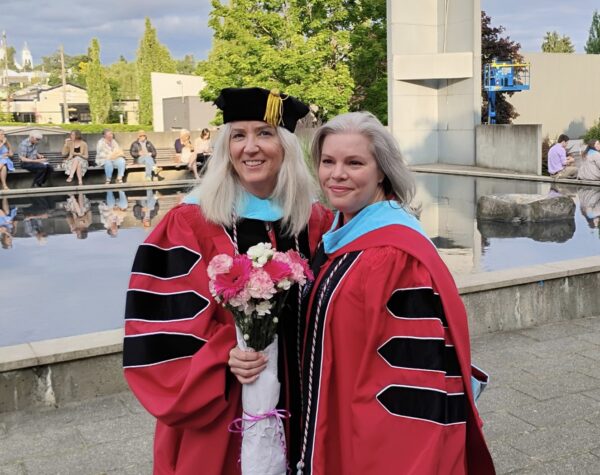
If you’ve ever thought your impressive motherhood skills – from creative problem solving to budgeting and managing contractors – belonged on your resume, you’ll want to meet three women who recently earned their doctorates from Seattle University after researching what they call the “motherhood advantage.”
Laura Marie Rivera, Carolyn Burroughs, and Mindy Ursino, all mothers of four, believe the leadership skills mothers bring from home to the workplace should be better recognized and valued by employers.
Rivera, a writer and educator who twice ran for the Seattle School Board, has been surprised by how curious people have been about their findings so far.
“There’s a real hunger out there for this type of information,” Rivera said, noting that they discovered they seemed to be opening up a whole new area of research.
Burroughs, a former Seattle U employee who is looking for her next full-time position while exploring the next stages of their Intuitionship research, was surprised after they interviewed or surveyed nearly a thousand women, how many of them didn’t consider themselves leaders, and leaders didn’t attribute any of their skills to what they learned through motherhood.
Rivera said she considered adding a new section to her resume when she reentered the paid workforce after staying home with her young children. What would have been in that section? Mentorship, careful budgeting, negotiating, HR skills from managing part-time contractors, organizational skills, leading through uncertainty, and conflict resolution.
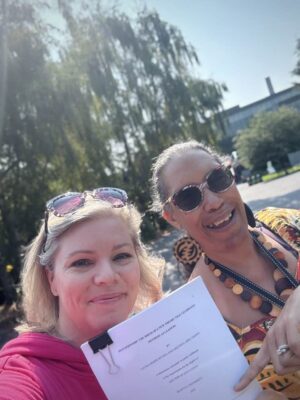
Rivera and Burroughs with an early draft of their dissertation proposal. (Image courtesy Intuitionship)
“When you put them together, it’s a full body of work,” Rivera said. “Moms are doing all of that before breakfast.”
Burroughs remembers a TED Talk she saw with an HR person who said if you have two qualified applicants and one is “scrappy,” hire that person. She feels the same things about mothers. “All things equal, hire the mother,” she said.
Rivera says if it were up to her, she would literally hire all mothers, for their qualities as creative problem solvers and persistence.
“The mother is going to give you nonstop work. The mother is going to give you solutions where there are none,” she said.
More than 80% of women between the ages of 40 and 44 are mothers, according to the Pew Research Center. Actually, women in their early 40s are more likely to have children than a decade ago. According to the Bureau of Labor Statistics, the number of mothers in the workforce has been growing at the same time. By 2020, about 65% of mothers with children under 3 were employed outside the home, with somewhat higher rates among mothers with older children. But they are underrepresented in top management roles.
People talk of the cost of taking time away from work to focus on raising children, even for a short leave. This cost – the motherhood disadvantage – is mostly financial.
Women who take time off from paid work lose wages they would have earned as well as retirement savings from that time period. But even more significantly, research by the U.S. Census Bureau found that full-time working mothers with children under 18 earned 31% less than their male counterparts, or $17,000 less per year, and about $500,000 less over a 30-year career.
(Image courtesy Intuitionship)
Add to that financial toll the cost of staying home while technology continues to evolve, and the result is a “knowledge gap” that could cost you opportunities when you return to the office.
Rivera doesn’t discount the reality of this research-documented motherhood tax, but she thinks society fails to recognize the advantages gained during that time, doing a different kind of leadership work, the “motherhood advantage.”
“The skills developed through motherhood — adaptability, strategic thinking, emotional intelligence — are not peripheral to leadership. They are foundational and often undervalued,” Rivera said.
And when those advantages are recognized, Rivera and Burroughs expect the results will eventually benefit all women, all parents, all caregivers.
“Mothers deserve to see this research, and they deserve to see themselves in that leadership lens,” Rivera said. But the people who really need this information are hiring managers and leaders whose companies will benefit from embracing the “motherhood advantage” and diversifying the people making workplace decisions.
Burroughs says people often compliment her on abilities she can trace directly back to getting dinner on the table for four kids under 6, including her never-fail “get it done” attitude. And her negotiation skills? She once talked her four sons out of their dearest desire to adopt a dog with a cost-benefit analysis that ended with: If we get a dog, then one of you won’t get to eat.