Digital media’s grip on our daily lives is undeniable. Most of our news, entertainment, and correspondence is online, and I’m not just talking about adults. Consider findings from Media Literacy Now about the amount of time children and youth engage with digital media, including social media, movies, and video games.
“Children ages 2 to 8 spend an average of two hours per day, children between 8 and 12 spend four to six hours, and adolescents over 12 years old spend an average of seven to nine hours per day.”
The Policy Push for Media Literacy
It’s no wonder that states and school districts have adopted policies in recent years around safe technology use and responsible online behavior. In 2016 WA state became the first state in the nation to pass media literacy education legislation, which refers to the ability to think critically about media messages and assess their influence and purpose. Legislation also required that digital citizenship be taught, which refers to appropriate and legal use of technology and responsible behavior. While all teachers play a role in integrating these lessons into their curriculum, much of the responsibility falls on school librarians.
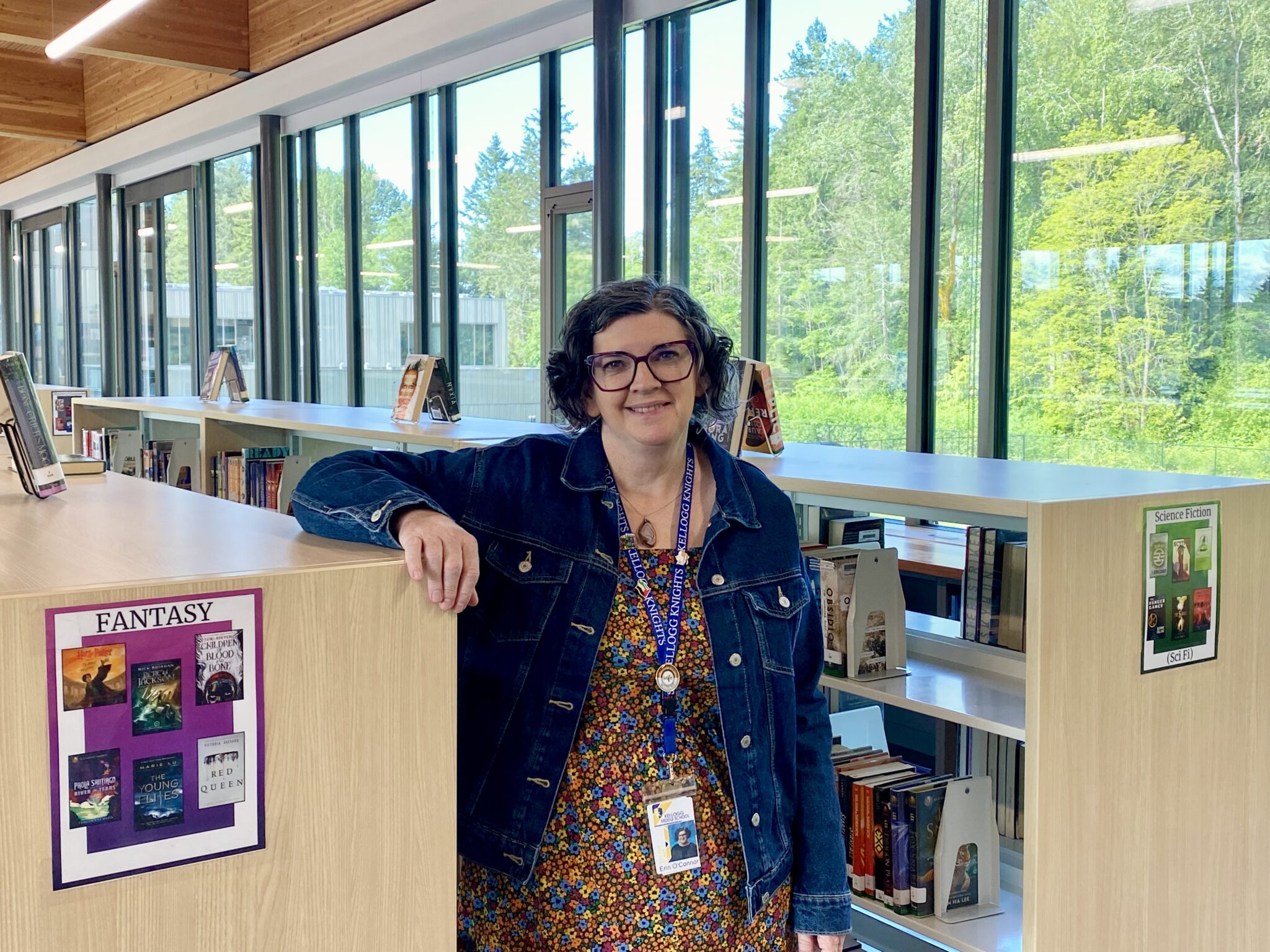
“The role of a school librarian has evolved a lot to incorporate these kinds of lessons,” said Erin O’Conner, a teacher librarian at Kellogg Middle School in Shoreline. In the Shoreline Public School District, each school has a full time teacher librarian, someone who has both a teaching certificate and either a Masters in Library and Information Science or an endorsement in Library Media.
As the teacher librarian, O’Conner is expected to provide lessons in media literacy to students. Digital citizenship is typically taught by other teachers. The district doesn’t have a set curriculum, so she is responsible for finding resources to guide her instruction. Online sources from the American Association of School Librarians and Common-Sense Media are helpful. She also registers for trainings like the annual Misinfo Day which is sponsored by the University of Washington’s Center for an Informed Public.
Teaching Media Literacy in Action
O’Conner typically has 50 minutes with students per class period, and integrates media literacy lessons into her overall work. Like identifying credible resources, and rooting out AI-generated content meant to spread disinformation.
“For example, how to look closely at a photograph and recognize small inconsistencies within (extra fingers, asymmetrical eyes),” she said. “Which means that it has been altered.” She also familiarizes them with “lateral reading,” which is when you leave an organization’s website to do a search about it to verify its credibility.
Overall, O’Connor says that Gen Z gets it. “They’ll make fun of their parents or grandparents who are posting things that are very clearly AI.”
Kristi Leland is an elementary school teacher librarian at Olympic View Elementary and Wedgewood Elementary in Seattle. In the past ten years, she’s noticed a change. She always takes a survey to ask how many kids have a phone and have access to social media.
“Early on maybe a handful of 4th graders had a phone, no 4th grader had social media. Maybe two or three 5th graders had access to social media.”
A free slide deck for Grade 7 Digital Citizenship, from Common Sense Media. (Courtesy Common Sense Media)
In the last few years, a lot more 4th and 5th graders have phones and access to social media. These are the grades she spends the most time talking with about media literacy and digital citizenship. However, these lessons are a small part of what she does. Teacher librarians in Seattle Public School’s (SPS) elementary schools are halftime positions, regardless of the size of the school. Leland splits her time between Wedgewood and Olympic View so that she is at both schools every week. Although she has a set schedule for working with each grade, she only has 30 minutes a week with the K-3 students. Fourth and 5th grades come bi-weekly for 45 minutes.
With such limited time, promoting books to kids takes priority. Especially for older kids who, Leland says, “reading doesn’t carry the same excitement that a phone does.”
While some of her media literacy and digital citizenship work is woven into the larger curriculum, Leland does have specific lesson plans she uses with her students, especially the older ones. She works with 5th graders on identifying altered images and examining why they’ve been altered. She also talks about making online comments and “what would be an appropriate comment.” For K-2 she talks about healthy screen time use and finding a balance.
Leland believes responsible digital media use is a shared responsibility. Every family has different rules about the use of devices in their homes which creates a challenge for teachers. “I can start the conversation,” she says, “but they really need to be conversations that families have with their children at home.”
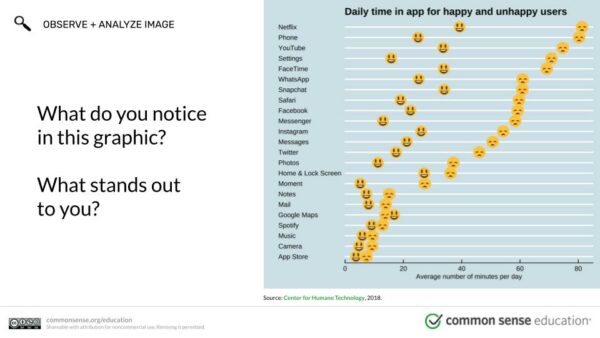
An example slide from a Common Sense Media Digital Citizenship lesson plan. (Courtesy Common Sense Media)
Doing More With Less
When O’Connor got her endorsement in Library Media in 2019, she said her program focused a lot on media literacy and digital citizenship. This was not the focus when Leland received her endorsement a mere four years earlier in 2015. She has largely taught herself. She’s gone to the National Council for Computer Education Conference and she’s attended media literacy trainings through Google.
Not only are O’Connor and Leland trying to adapt to a rapidly changing world, they are working with limited resources. Both Shoreline and SPS currently have budget deficits which are forecast to continue into the 2025-2026 school year ($6.5 million and $100 million respectively). Among other things, this affects funding for trainings, which are essential to keep librarians abreast of digital media’s evolving landscape, and effective teaching practices.
“We’re always dealing with how to go to professional development when we have no money,” said O’Conner. The Misinfo Day was free. A grant from the WA State Library allowed her to go to the 2025 WA Library Association conference. This may not be an option next year due to President Trump’s executive order to dismantle the Institute of Museum and Library Services.
For Leland, limited resources prevent her from being full time, which would allow her to see each grade every week and work more with teachers on technology lessons. She does not have an assistant, but she is grateful for parent volunteers who help check-in and shelve books.
In Shoreline, O’Conner said teacher librarians used to be supported by full time library technicians, who essentially acted as assistants and helped with everything from shelving books, teaching lessons, technology support, and manning the library when the teacher librarian needed to leave. The budget crisis forced the district to cut these positions two years ago.
“It’s a hard time to be in education,” says O’Connor, “but the kids keep me going.” Despite funding challenges, O’Connor and Leland are committed to ensuring students use media wisely and responsibly. At the same time, they are passionate about their primary responsibility, to foster a love of reading and make their libraries inviting to students. Both pride themselves in creating spaces where kids can connect, not just during class time but before school or during lunchtime and recess.
“Being a school librarian is the best job,” said Leland.