From our news partners at The Seattle Times: Washington will be the eighth state to adopt the "Next Generation Science Standards," which outline what students should know about big ideas of science, key practices scientists and engineers use to solve problems, and fundamental concepts that apply across all scientific fields.
 |
Eighth-graders at Cascade Middle School applied Newton's laws of motion to an unusual experiment involving imaginary cats on skateboards.
They wanted to know which cat would go faster down a ramp: Bubbles, a 4-pound kitten; 15-pound Hank; or Vladimir, the 30-pound tabby.
The students in Christine Oberloh's science class rolled three different sized balls representing the cats down an incline and timed them.
"We found out that Bubbles was the one to go the fastest," said Alberto Rodriguez, who is 13. But his group's findings didn't jibe with those of the rest of the class.
"I want you guys to think about this because all of the other groups found that the biggest one was the fastest," said his teacher, Oberloh. " So why do you think your data is different from everybody else's?"
Alberto and his classmates are not only learning the facts of science, they're learning the practices of science — such as controlling variables consistently over multiple trials.
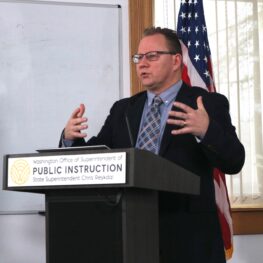
That's one of the reasons that Gov. Jay Inslee and state superintendent Randy Dorn arranged to visit Cascade Middle School in the Highline school district on Friday to talk about the future of science instruction from kindergarten through 12th grade.
They are expected to announce that Washington will become the eighth state in the country to adopt the "Next Generation Science Standards," which outline what students should know about the big ideas of science, key practices scientists and engineers use to solve problems and fundamental concepts that apply across all scientific fields.
Delaware, California, Kansas, Kentucky, Maryland, Rhode Island and Vermont also are on board with the new voluntary standards.
Washington was among 26 "lead state partners" that have been working since 2011 on the massive undertaking, which has involved thousands of education leaders, science teachers, scientists and researchers who study how children learn.