Being a parent is nonstop hard work, making it challenging to stay on top of news that impacts families in Washington state. This Hits Home is your weekly hit of news, commentary, and, occasionally, opinion. Want to have a say? Look for the “Take action” prompts. Here’s the update for the week of Aug. 31-Sept. 6
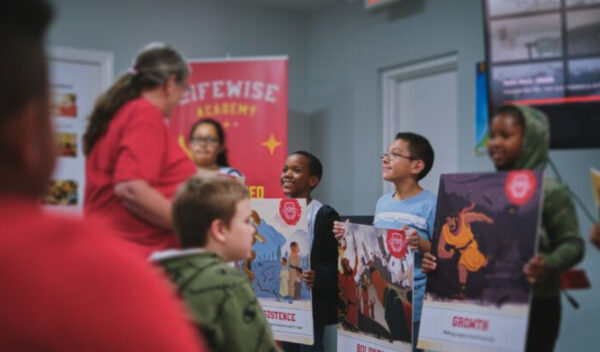
(Photo courtesy of LifeWise Academy)
Controversial Christian program is spreading in WA schools
A national program that pulls public school kids out of class for off-campus Bible instruction is expanding quickly in our state, according to a report from the Washington State Standard. According to LifeWise Academy, members of the public have expressed interest in starting a chapter of their religious program in roughly 83% of the state’s school districts.
The program is currently running in four western Washington school districts, including Everett and Gig Harbor, with active efforts underway in 26 more districts, and some level of interest expressed at 245 of the state’s roughly 295 districts, according to LifeWise. The Secular Education Association, a group formed specifically to oppose the program, lists a smaller number of places where the program is active— nine Washington schools.
LifeWise has also landed in court. The organization sued the Everett School District in December 2025, alleging the district’s policies violated its free speech and religious freedom rights, and in April a federal judge issued a preliminary injunction requiring Everett to let LifeWise participate in school resource fairs, post flyers on the same terms as secular groups, and teach students with parental permission. Supporters point to a 1952 Supreme Court ruling as the legal basis for programs like this; critics, such as the Secular Education Association, worry about kids being pulled from class, peer recruitment pressure, and the line between school and church. Read more.

We all know they didn’t strike
If you are a parent with kids in Seattle Public Schools, you don’t need to read more about the teachers’ strike that did not happen. You already know that the district and the Seattle Education Association, representing 6,000 SPS teachers and other educators, reached an 11th-hour deal that led the district to announce late last Tuesday night that school would indeed start as scheduled on Wednesday. But if you want to keep tracking that story, head on over to Claire Byron’s great coverage at The Seattle Times, which outlines how the deal finally got reached. Check out The Bulletin, a newsletter by Seattle school parents, for its take on the dealmaking.
(Photo by artisanalpv / CC BY-SA 2.0.
Let’s talk about where and how to park those Limes
In case you didn’t know this: Kids under age 18 are not allowed to ride Lime bikes or scooters, per Lime’s rule of engagement. Not that it stops tweens and teens from jumping on the bright green wheels, zipping through Seattle streets, and/or participating in organized “Lime Strikes,” where scooter riders swell the streets. Because while it may be against Lime’s policies, it is not illegal for kids to ride e-bikes under state and city laws. According to those laws:
- Kids ages 16 and 17 are welcome to ride Class 1, 2, and 3 e-bikes. Lime bikes fit here.
- Kids ages 12 to 15 can legally ride Class 1 and Class 2 e-bikes (which max out at 20 mph). They are legally prohibited from riding Class 3 e-bikes (which can reach 28 mph).
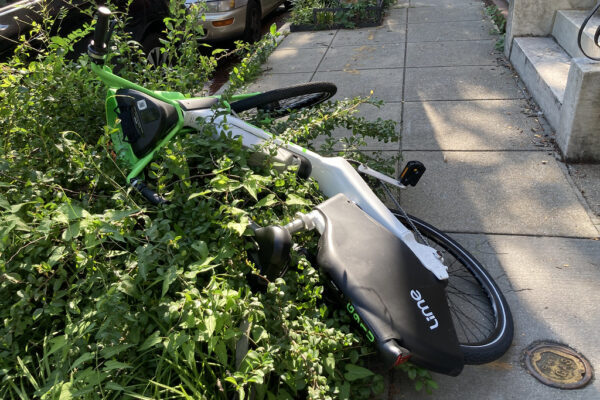
But this brief is not about riding Limes; it’s about parking them. The city’s hearing- and vision-impaired residents have a message for riders of all ages: Park Limes out of the walkway and off sidewalks.
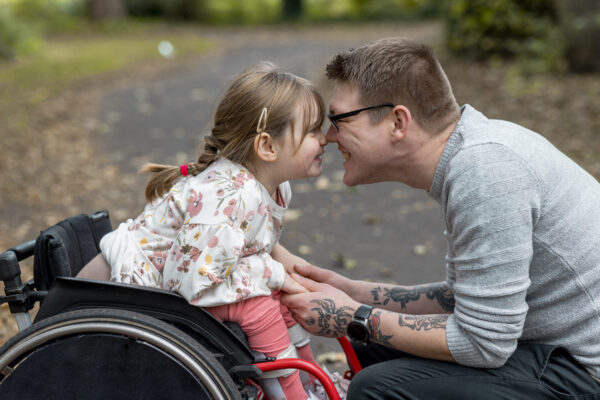
Why? Because members of the deaf and blind communities, as well as those in wheelchairs or other medically-needed transport, have reported that improperly parked scooters and bikes impair their ability to get around and can cause injury. With thousands of Limes across the city, that’s a high potential for harm.
So parents, share these rules with your rule-pushing tweens and teens: First, don’t do it. Respect Lime’s age limitation and tell your kids not to ride green.
But if they do ride Lime, follow the City of Seattle’s e-bike and scooter parking rules:
- Park the scooter or bike upright at a bike rack, bike corral, or in the area with trees, poles, and other fixtures toward the curb
- Leave at least six feet clear for pedestrians to pass
Do not park them at curb ramps, a corner/intersection, or in driveways; within designated no-parking zones that are highlighted on the map in the app you’re using; within bus stops; in City of Seattle parks; in front of building doors, benches, parking pay stations, fire hydrants, recycling/garbage bins, and dumpsters; on private property or in a place that’s hidden. Read more on this story at South Seattle Emerald.
(iStock)
Parent to Parent survives the budget knife — barely
Washington’s Parent to Parent program will continue, but with less funding. The program connects families living with disabilities with support and community. The state Department of Social and Health Services is cutting the program’s budget by 10% rather than eliminating it, bringing next year’s funding to about $877,000, according to Washington State Standard.
Parent to Parent pairs newer parents of children with developmental disabilities with experienced parents who can help them navigate services. It also runs “sibshops” for siblings. The program began in King County in 1980 and now serves families in all 39 Washington counties.
“I wish we hadn’t received a cut at all, but it certainly could have been worse,” statewide manager Tracie Hoppis told the Standards.
The program’s contract ran only through August even though funding was included in the state budget. A bipartisan group of 44 state lawmakers urged Gov. Bob Ferguson and DSHS Secretary Angela Ramirez to preserve it. Hoppis said some of the 10% reduction will affect multicultural coordinator positions. Advocates want lawmakers to restore the cut and specifically name Parent to Parent in the next state budget.

(Photo by Lauren Holloway / @_l.holloway_ / courtesy Art of Resistance & Resilience)
Vandalized Black Panther Party mural is back up at Franklin High
A mural honoring the 50th anniversary of the Seattle Chapter of the Black Panther Party is back on the fence outside Franklin High School after volunteers restored it. The mural was created by Franklin’s Art of Resistance & Resilience club and first installed in 2018. It was taken down for repairs last October after mural panels were vandalized. Fixing the art was a group effort, with current and former Franklin students, teaching artists, and community members pitching in. The project also received help from the Seattle Office of Arts & Culture, Seattle Public Schools, Artstation Mt. Baker, and proceeds from poster sales. Volunteers added a second mural below the restored work featuring a quote from Black Panther Party member Ericka Huggins: “We can together change the world. We are all threaded together like a huge tapestry of humanity, and we forget we are interconnected.” Read the full story and photo essay at South Seattle Emerald.

(Photo courtesy of Mary Bridge Children’s Hospital)
Two new pups helping hospitalized kids feel better
Mary Bridge Children’s Hospital has two adorable and well trained new employees, a little more furry than other hospital workers but every bit as devoted to health. Langley and Filmore, 2-year-old black Labrador retrievers, have joined the Tacoma hospital as facility dogs, helping kids feel safer and more comfortable during hospital stays, procedures and other medical care. The pair trained for two years through Canine Companions and learned more than 40 cues, from turning the pages of a book to playfully encouraging a child to take medicine.
Langley will work with children in the emergency department’s behavioral health pod, while Filmore will visit kids in inpatient units and specialty outpatient clinics. They join veteran facility dog Olaf, who has been on the job at Mary Bridge since 2019 and has helped during more than 5,000 patient and family visits. That makes three very good dogs now reporting for duty at the children’s hospital.
They are not the only dogs serving sick kids in Puget Sound. Over at Seattle Children’s Hospital, a golden retriever named Nash helps bring smiles to kids.

AAP doesn’t want its name in general election voter pamphlet, but it’ll be there
Voters’ pamphlets will be mailed to Washington voters beginning Oct. 1, and one is not appy about its inclusion in the guides. The American Academy of Pediatrics has objected to how its name is used in the argument for Initiative 26-638, which would bar transgender students from girls’ sports. According to The Seattle Times, the AAP asked Let’s Go Washington, the initiative sponsor, to remove the reference. The organization declined.
The disputed language cites AAP-recommended routine checkups while describing how a student’s sex could be verified. The Washington Secretary of State’s Office told the Times that it does not fact-check or edit committee arguments in the voters’ pamphlet. Neither the Washington chapter nor the national AAP made a request for removal, but one opponent of the initiative said AAP leaders believed the reference could mislead voters about the organization’s position.
The initiative’s voter pamphlet text says verification of a child’s biological sex could involve review of “reproductive anatomy, genetic makeup, or normal endogenously produced testosterone levels.”
Whether the medical organization wants it there or not, mention of the AAP will remain in the initiative’s write-up. Read the full story.
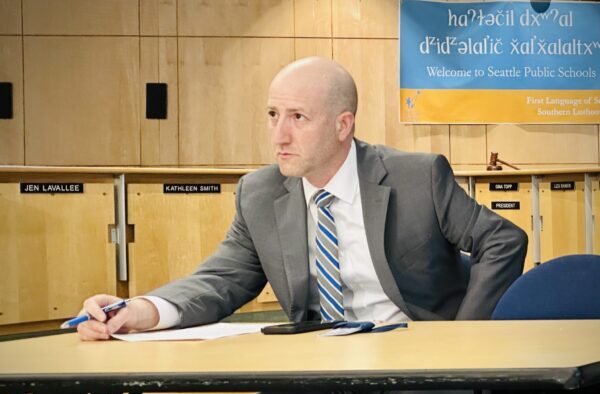
Seattle Public Schools Superintendent Ben Shuldiner at a press conference on Monday, Aug. 31 (Photo by C. Murfin)
That’s a GREAT question, Danny | Op-Ed
I sat in press conferences held by Seattle Public Schools Superintendent Ben Shuldiner last week and found myself blanching every time he used the “b” word to describe why contract negotiations with the teachers’ union were difficult. And yet, I wasn’t sure why. We’ve been talking about the district’s budget woes for so long now I can’t remember when we weren’t talking about them.
Which is why I was very interested in Seattle Times columnist Danny Westneat’s Sept. 2 question to Shuldiner: Really? We’re “broke?”
Shuldiner has been using that word and other pretty dire language to describe the district’s finances. “As everybody knows, we’re broke,” he said during recent teacher contract negotiations. “Unless we make big systemic changes, we’re insolvent.”
Westneat isn’t buying the idea that Seattle schools somehow arrived here because taxpayers haven’t stepped up.
And he brings receipts.
Just last year, he points out, Seattle voters approved a three-year, $747 million school operating levy and a $1.8 billion capital levy. Then, in November, voters approved the city’s $1.3 billion Families, Education, Preschool and Promise levy. Add them together, as Westneat does, and Seattle voters recently approved about $3.8 billion in multiyear education levies.
Yet: We’re broke?
Westneat digs deeper. In 2019, Seattle Public Schools spent $914 million educating 53,369 students, or about $17,000 per student. In 2025-26, he writes, the district spent $1.35 billion on 49,940 students — about $27,000 per student. That’s a 48% increase in spending and a 58% increase per student, compared with inflation of about 31% over the same period.
For the upcoming year, Westneat notes, the district trimmed spending by $14 million — about 1% of its $1.34 billion operating budget.
To be clear, Westneat isn’t arguing that Seattle teachers are paid too much or that voters are taxed too much. His beef is with the seemingly endless cycle: Taxpayers approve more money for schools, and almost immediately we’re back to budget crisis, threats of cuts and, this year, the possibility of a teacher strike.
As a parent who has voted yes on school levies more times than I can count, I think his question is spot on: If Seattle voters keep saying yes to funding education, why does it always feel like the district’s answer is, “We need more”?
Westneat proposes a sort of bargain with voters: After we approve new taxes, give us a cooling-off period. Make do for a while with what we just gave you.
I’d pay extra for that. Read the full column in The Seattle Times.
WA Head Start leader says “flexibility” means a lot less for kids
Advocates for the federally funded Head Start early education program recently began passing around a policy brief that argues that the federal government’s own numbers undercut its pitch for looser rules governing the program. Joel Ryan, executive director of the Washington Head Start and ECEAP, passed the brief to Seattle’s Child and other media outlets.
In a nutshell: The federal Department of Health and Human Services is calling its proposed Head Start changes “flexibility.” But, according to the Head Start advocacy brief, HHS’s own Regulatory Impact Analysis shows the roughly $2.2 billion in projected annual savings would be a direct result of doing less for kids and families. According to the brief, entitled “False Flexibility: What the Federal Government’s Own Analysis Reveals About the Proposed Head Start Rule,” the proposed changes to the program would lead to:
- bigger classrooms — with federal ratio limits gone, the average kids-per-teacher count could go up by 30% or more, alongside an assumed 13% cut to the teaching workforce
- shorter days and years
- fewer health and dental screenings and mental health consultations
- a new English-only requirement would impact nearly 19,000 classrooms and over 34,000 teachers at an estimated $47 million cost — with, notably, no identified educational upside.
- New documentation requirements that could make roughly 8% of currently enrolled kids ineligible for Head Start, disproportionately affecting families experiencing homelessness who may struggle to produce the paperwork.
- Shrinkage of administrative funding — the money programs use to actually manage federal grants — from 15% cap to just 5%.
Currently, Washington Head Start serves more than 15,000 children in the state, with a large number concentrated in King County.
“What makes this brief especially important is that these aren’t projections from opponents of the rule,” Ryan wrote in an email. “They come from HHS’s own Regulatory Impact Analysis. The Department is essentially counting reductions in services, staffing and quality as savings and then using those savings to argue that Head Start can serve more children without additional funding.” Read the full brief.
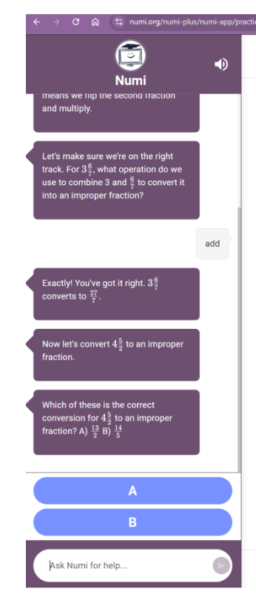
Right after a mistake, an AI tutor called “Numi” walks a student through a solution step-by-step
An AI tutor that slows kids down and helps them learn more fractions
A randomized experiment involving more than 6,000 Tennessee middle school students suggests that AI may help with math when it is paired with repeated practice, according to a report in The Hechinger Report. Students practiced fractions in four groups: with or without an AI tutor and with or without a requirement to answer questions on the same skill correctly three times in a row after making a mistake.
Students who received both AI tutoring and the repeated-practice requirement scored about 3 percentage points higher on a test a week later than students who received conventional computer-based instruction. Lead authors cautioned against treating the result as proof that AI will transform learning. The advantage was concentrated on easier questions similar to those students had practiced and did not extend to harder problems. At the time of publication, the study was a working paper and had not been peer-reviewed.
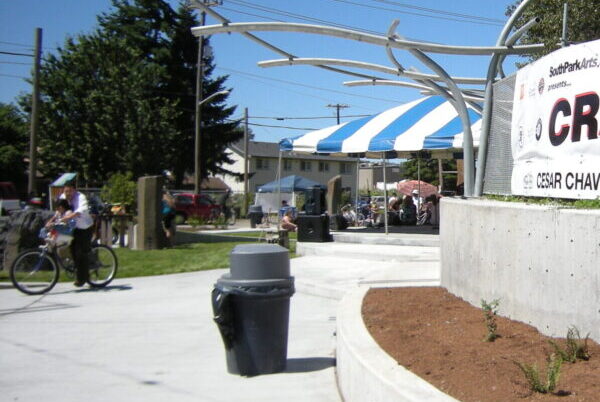
New Parque Libertad
(Photo by Joe Mabel)
South Park has a newly named park: Parque Libertad
The South Park park formerly known as César Chávez Park is now Parque Libertad, Seattle Parks and Recreation announced Sept. 2. The renaming process began after reports of sexual abuse allegations against the late labor leader. King County owns the land, and Seattle Parks operates the park.
The name emerged from a community submission process reviewed by the Parks Naming Committee. Interim Superintendent Michele Finnegan said “Libertad,” Spanish for “freedom,” reflects “the enduring pursuit of civil rights, equality and opportunity for all.” King County Councilmember Teresa Mosqueda, whose district includes South Park, said the new name emphasizes the freedom to be “safe, respected, seen, and included.”