Being a parent is nonstop hard work, making it challenging to stay on top of news that impacts families in Washington state. This Hits Home is your weekly hit of news, commentary, and, occasionally, opinion. Want to have a say? Look for the “Take action” prompts. Here’s the update for the week of June 15-21.

U.S. Rep. Pramila Jayapal speaks at the campaign kickoff event against two conservative-backed ballot initiatives in Seattle. (Photo by Jake Goldstein-Street/Washington State Standard)
Battle heats up over WA ballot measure to bar trans students from girls’ sports
Opponents of conservative-backed initiatives to undo changes to the rights of parents and public school students and restrict the participation of transgender girls in sports officially launched their campaign to defeat the ballot measures last week. The campaign to stop the initiatives has already brought in more than $1 million, with unions and the American Civil Liberties Union making big contributions.
The No Hate in WA State campaign argues the two Let’s Go Washington initiatives would (IL26-001 and IL26-638) invade children’s privacy, vilify transgender youth, and leave vulnerable kids unwilling to seek help when needed. A few hundred people attended the campaign kickoff Wednesday night at Seattle club Neumos, organizers said.
IL26-001 seeks to undo changes Democratic lawmakers made in 2025 to a Let’s Go Washington initiative on the rights of parents of public school students, which the Legislature had approved a year earlier. Chief among the changes in the 2025 law, which was recently upheld in court, was to remove parental access to medical records. IL26-638 would bar transgender K-12 students from competing in girls’ sports, requiring that a child’s sex assigned at birth be confirmed through routine athletic physicals. Read the full story from the Washington State Standard.

(Image: C. Murfin)
WA ranks highly on maternity health care, but still faces major challenges
Does it feel like ranking season to you? My inbox is full of “best of” surveys, analysies, and top tens. Usually, I scroll right by, but this one caught my eye, given the national divide on mothers’ rights and care.
Turns out, if you’re going to have a baby, the Pacific Northwest is a better place to be than most states. A new report by the national customer review organization Consumer Affairs places both Washington and Oregon among the top 10 best places to have a baby. Oregon took the #5 spot, while Washington snuck in at #10.
The report reviews several metrics related to maternal healthcare access. Washington scored high in the areas of postpartum care, family support, and healthy babies. Still, even while landing a top spot, Washington has several maternity care challenges:
- In Washington, 20.5% of counties meet the definition of “maternity care desert” — they lack essential maternity care resources, including maternity hospitals, birth centers, or obstetric providers.
- Only 83.1% of women in Washington receive adequate or intermediate prenatal care — below the national average of 83.9%. Adequate care is defined as beginning care within the first four months of pregnancy and attending at least 80% of the medically recommended visits. Intermediate care is defined as starting care by the fourth month, but attending only 50% to 79% of the recommended visits.
- Oregon outpaces our state in maternal care providers: it boasts 119 providers per 100,000 women. In Washington, that number drops to 86.
“The Evergreen State hovers around the middle of the pack for the metrics measuring maternal healthcare access, ranking 27th overall in this category,” according to report authors. “However, Washington makes up for it with outstanding postpartum and family support, scoring third best. Families can take advantage of the state’s paid leave program, which includes 12 weeks and a maximum weekly benefit of $1,647 in 2026.
“Washington is also a high performer (sixth best overall) for maternal and infant outcomes,” the report finds. “The state boasts an especially low rate of babies born with low birthweight, at just 7%. That’s the third-lowest rate nationally.” See ConsumerAffairs’ full report here: https://www.consumeraffairs.com/movers/the-best-states-to-have-a-baby.html

Dispatchers have the final say on the decision to send an ambulance. (Image: City of Seattle CARE)
Would you want a 911 call about your child routed to Texas?
Just read another head-scratching piece about Seattle’s 911 call center service in Geek Wire, then a longer, investigative report last week in The Seattle Times. The stories detail how the Seattle Fire Department has been using a Denmark-based AI system to listen to all 911 medical calls. The system then prompts city dispatchers to hold off on sending ambulances to some callers and instead to route those calls to a Texas call center staffed by nurses.
The AI system has been offering dispatchers prompts since 2023 without public knowledge, caller consent, or a formal review process. And that has some local experts raising the alarm:
“A person who is erroneously routed outside of the 911 environment has a right to know how it happened. I’m troubled on a number of levels,” University of Washington law professor Ryan Calo, co-director of the university’s Tech Policy Lab, told The Seattle Times last week.
The department’s partnership with the Danish company apparently bypassed Seattle’s surveillance ordinance, which requires any tech that listens in on the public to go through a public approval process.
Any city department interested in surveillance tech has to write a detailed report on how it could affect people’s privacy — especially for communities that are already over-policed or marginalized. That report has to include at least one public meeting where residents can weigh in. The Seattle City Council has to vote on whether or not to allow the technology.
Don’t miss investigative journalism at its best: Follow The Seattle Times series on Seattle’s emergency call system.

Proposed location for Lincoln High School athletic fields (Image: Seattle Public Schools)
A field for Lincoln High School, almost
Lincoln High School students may finally get a long-awaited sports field following a protracted, often tense process of securing a site for the project.
Last week, Seattle Public Schools Superintendent Ben Shuldiner announced his recommendation for the location of the school’s new athletic field: a gravel lot at N. 50th Street and Aurora Avenue N. The recommendation also includes a renovation of the track located at Lower Woodland Park’s field #7.
“After reviewing community input, working with Lincoln’s administration and athletics staff, and talking with a number of community groups, I am asking Seattle Parks and Recreation to partner with us on designing and building a full-size, multi-sport athletic field,” Shuldiner announced on the SPS website.
The community certainly did have input on where to build the field. SPS announced plans in 2024 to convert the grass field at Wallingford Playfield into a lighted synthetic turf football field for Lincoln students, the only public high school in the city without a dedicated football field. Voters gave the go-ahead to pay for it in a 2022 tax levy. But backlash to that announcement was swift, with playfield neighbors fighting tooth and nail to prevent the buildout.
SPS has submitted a letter to the director of Seattle Parks and Recreation to advance the plan.
“We’ll present to the Parks Board this summer,” Shuldiner said. “We anticipate the field being ready for fall 2029 and the track sooner than that.” Read the full story.
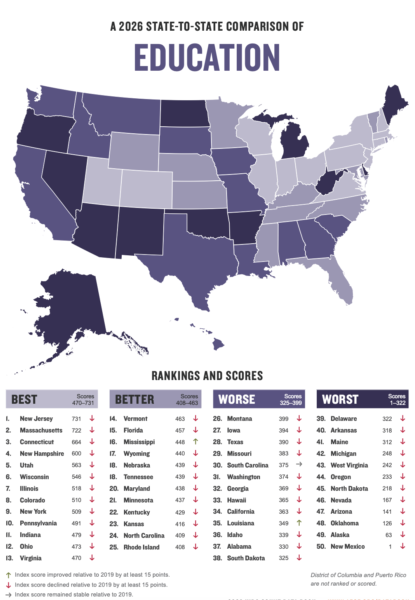
KIDS COUNT Spotlight: Big drop in WA education ranking
The recently released 2026 KIDS COUNT report, compiled by the Annie E. Casey Foundation, shows that Washington has dropped from 27th in the nation to 31st overall in education outcomes. The findings are based on data from 2024. Last year, the state fell one spot. A little over a decade ago, it ranked 20th.
Washington’s Office of Superintendent of Public Instruction (OSPI) remains skeptical of the research and contends that the state has “made progress in every area” covered in the report.
And yet, the education numbers in the newest Kids Count Data Book, now in its 37th year of publication, show a state in need of improvement: In Washington, the latest analysis shows that 70% of eighth graders were not proficient in math and 68% of fourth graders were not proficient in reading. Those numbers haven’t changed since last year’s report.
OSPI officials point out that national reports can overlook differences in individual states’ data collection, which can lead to unfair comparisons.
“Test scores in Washington have been trending upwards since they hit a low point during the pandemic,” Katy Payne, OSPI chief strategy officer, said in a Washington State Standard report. “A more sophisticated analysis of how our students are doing would measure our recovery since that drop, instead of comparing scores pre-pandemic to post-pandemic.”
Still, Payne added: “We do have room for improvement, of course, with 14 states statistically outperforming our students in 8th-grade math.” Read the full story from the Washington State Standard.

Emergency crews at Lake Sammamish (Image: Eastside Fire & Rescue)
Teen’s drowning at Lake Sammamish is a sad reminder: Life jackets save lives
A teen drowned last Sunday at Lake Sammamish State Park, the second drowning at the lake this month. According to posts from rescue services and news reports, the 15-year-old girl wandered outside the marked Sunset Beach swimming area, where her family could not see her. Although emergency crews from multiple jurisdictions arrived quickly, and the girl was located, they could not revive her.
The death is one more statistic in a sad trend: According to Public Health — Seattle & King County, drowning deaths are on the rise in our region.
“In 2025, there were 25 drowning deaths, part of a steady increase since 2018,” wrote PHSKC’s Fred Mariscal in the health department blog Public Health Insider earlier this month. “More than half happened in open-water rivers and lakes where conditions can change quickly, and hazards are often hidden. Many of these tragedies were preventable with life jackets, supervision, and safer choices around water.”
The biggest, most important choice? Require kids to wear a life jacket when entering any natural body of water. Seattle Children’s Drowning Prevention Network is offering a 20% discount on jackets at Big 5 stores. Or, check out state parks’ jacket loan programs.
The health department urges parents to check out these drowning-prevention resources to keep themselves and their kids safe around any body of water.
- King County Water Safety: Tips, lifeguarded beach schedules, swim lessons, and life‑jacket stations.
- Washington State Parks Life Jacket Loaner Map: Borrow a free life jacket.
- Seattle Children’s Drowning Prevention Network: Life jacket tips and 20% off coupon for life jackets at Big 5.

Mother black bear with cubs (Image by USFWS Headquarters / CC BY 2.0.)
More on safety: Beware bears and other wildlife after attack on teens
A group of teens ran into a black bear with her cubs last week while hiking the popular Mt. Si trail, northeast of North Bend in the Cascade foothills.
According to a statement from the Washington State Department of Fish and Wildlife (WDFW), the encounter happened around 1 p.m. on June 16. The three teen hikers were approximately 2.7 miles up the trail when the bear charged at the group and swiped at one of them. One boy was scratched by the animal. He was transported to a local hospital “with non-critical injuries related to the encounter,” according to an Eastside Fire & Rescue X post.
According to the WDFW statement: “A second group of hikers reported that they were followed closely by a black bear for several miles. The group stated they saw a second, smaller bear while they were exiting the trail. The trail was cleared and was closed while Fish and Wildlife Officers attempted to locate the animal. Officers concluded their search later that evening and did not locate either bear. Currently, no additional search efforts will be made.”
WDFW estimates that there are approximately 22,000 black bears in Washington. Since the 1970s there have been nearly 20 human-black bear contacts with injuries and one death (1974).
To avoid injury during a bear encounter, WDFW advises:
- If a bear walks toward you, identify yourself as a human by standing up, waving your hands above your head, and talking in a low voice.
- Back away, avoiding direct eye contact. Don’t run from a bear.
- Make noise and leash pets while hiking.
- Be aware of your surroundings to avoid startling a bear.
- Carry bear spray that is readily accessible and know how to use it. More information on how to use bear spray is available on WDFW’s blog.
For more information on living with black bears, go to the wildlife department’s bear information webpage. Read the full story.

Ingraham High Schools mascot Ram, and other students, may see a fence next year. (Image: Joe Mabel / CC BY-SA 4.0.)
On to school safety …
As Seattle Public Schools wrap up the school year, Superintendent Ben Shuldiner is already focused on ensuring staff feel safer when they return to campuses in the fall.
At a media roundtable Tuesday, Shuldiner said fencing and security cameras could go up at some schools this summer — security measures he said are long overdue.
Ingraham High School topped his list of concerns. On a recent visit to the campus, with its open layout of multiple buildings, Shuldiner said the school’s principal told him Ingraham’s design and lack of fencing have allowed strangers to wander in “at least five times a year.”
“Some schools have been asking for fencing for years,” Shuldiner said. “I just think that this district hasn’t prioritized safety, and so that’s something that I’m really thinking about.”
Student safety concerns met Shuldiner when he walked onto the job earlier this year: Two teenage boys were shot and killed at a bus stop near Rainier Beach High School in February. Both the Ingraham and Garfield communities have been hit by gun violence in recent years.
Shuldiner is opening the door to weapon detection systems as well — not as a mandate, but as an option for schools that ask. He pushed back on the idea, common in Seattle, that security measures make schools feel like prisons. “When you go through T-Mobile, you’ve got to go through weapons detectors,” he said. “There’s multiple points of entry, but somebody’s always there, and it’s a way to actually make folks feel safe.” He noted positive response from families after weapon detectors were used at graduation ceremonies at Ingraham and Nathan Hale last week. Read more on this story from KOUW.
Now about the money … SPS budget recommendation

Seattle Schools Superintendent Ben Shuldiner (Image: SPS)
As an article in The Seattle Medium pointed out last week, Seattle Public Schools is broke. And, refreshingly, Superintendent Ben Shuldiner isn’t softening that fact. At a press roundtable last week, Shuldiner said the district is “structurally insolvent” and, without a new budget approved by the school board this summer, would run out of money in roughly 10 months. The district cut about $50 million from an initial deficit of $87 to $100 million through central office and school reductions, but its rainy-day fund has drained to around $30 million — a fraction of the $135 million reserve a district this size should carry.
Shuldiner has come up with a 2026-27 budget recommendation he says will keep the district from financial rupture by tackling the deficit through a hiring freeze, central office reductions, and a potential mandatory sports “pay-to-play” fee. The plan avoids school closures and mergers for the 2026-27 academic year.
“If the board approves our new budget, we’ll have staved off insolvency for one more year,” Shuldiner said, “but like, it’s getting really bare bones, folks.”
The path beyond the next school year may include school mergers, but Shuldiner said that before any such decisions were made, he would fully engage principals, teachers, staff, and families — a deliberate departure from the top-down closure process that blew up under previous leadership. He argued consolidation could actually help students by eliminating the kind of multi-grade “triple split” classrooms that stretch teachers thin. Read the full story in The Seattle Medium.
MAKE YOUR VOICE HEARD: The SPS Board will hold a public hearing on the 2026-27 recommended budget on July 8 and the public can testify. The board vote on final budget adoption is expected to follow, likely in late July or August. Speak at the meeting or contact board members with your thoughts.

Marijuana (Image: Elsa Olofsson / CC BY 2.0.)
This is a thing: Pot parenting (otherwise known as ‘gardening’ moms)
OK, I’d be lying if I said I never ate an edible when my kids were young. I did. I’ll never run for president. But regularly, as in daily, weed ingestion? I’m not sure I could have functioned under that influence.
Apparently, many parents, especially moms, are doing just that, according to a fascinating article recently published in The Atlantic. Writer Sarah Levy explores the world of ‘gardening’ moms, many of whom say that frequent marijuana use is necessary to their sanity — and positive parenting.
“Mothers I spoke with insisted that they were not putting weed first,” Levy writes. “Rather, they said, lacking meaningful parenting help from other adults, they were prioritizing their family by using cannabis as a tool: to help them stay patient, to respond neutrally to their children, to be present without becoming overwhelmed—essentially, to be better moms.”
There are risks, of course; the potential for slowed reaction time among parents is key among them. Not to mention, the dangers of getting in a car after imbibing, and Levy points out the American Academy of Pediatrics recommendation that parents not use cannabis in the view of kids, and that all cannabis products be locked safely away from children.
Yet, parent gardeners say the focus should be on the benefits or getting parents the support they need to parent well.
So I ask you: Could cannabis improve one’s ability to parent well? Are you a ‘gardening’ mom or dad? Reach out to me ([email protected]) and share your story, on the record or off. Read the full story in The Atlantic.
The US Department of Education (Image: Douglas Rissing / iStock)
Trump proposal to move special education out of DOE will turn back progress | Op-Ed
By Carrie Gillispie, project director New America
The Trump administration’s decision to move special education out of ED to the Department of Health and Human Services (HHS) will turn back the clock on decades of progress and weaken protections for millions of students with disabilities.
Administering the Individuals with Disabilities Education Act (IDEA) demands deep, education-specific expertise, robust oversight, and consistent guidance to states and school districts. HHS is not structured to provide that support and is already struggling to serve people with disabilities in its own domains of health and human services due to the Trump administration’s severe staff reductions and program cuts.
Separating programs for students with disabilities from all other education programs harkens back to our nation’s ugly past of othering, institutionalizing, isolating, and segregating the more than 15 percent of youth with disabilities. Before the establishment of ED, only one in five children with disabilities in the United States attended school. Today, ED holds states accountable for providing education to all students with disabilities. For more than 50 years, students and parents have fought to gain the rights they deserve. Today’s announcement threatens to rewind our systems to when federal oversight was absent, and states and school districts failed to uphold the civil rights of students with disabilities.
Housing special education in a separate agency sends the message that these students are somehow apart from other students, rather than recognizing them as multifaceted learners who belong with their peers. To be sure, students with disabilities are not a monolith. Nearly 12 percent are English learners, and roughly half attend Title I schools, yet these programs will now be administered by different federal agencies. Timely access to services for babies, children, and young adults with disabilities is now mired in a labyrinth of red tape.
A key role of ED is to ensure that states use about $15 billion of federal funds appropriately so that funding gets to the students who are eligible for special education. Moving special education to HHS puts this accountability at risk. At the same time, moving ED’s Office for Civil Rights (OCR) to the U.S. Department of Justice (DOJ) removes a key family resource for addressing the record-high level of complaints of discrimination and abuse of youth with disabilities. Instead of discrimination cases being addressed by OCR staff with experience working toward school system improvement, DOJ staff will choose which cases to investigate while operating under dramatic staff reductions and policy changes likely to decrease investigations and enforcement.
When the leader of HHS makes alarming statements—such as claiming that children with autism “will never pay taxes, they’ll never hold a job, they’ll never play baseball, they’ll never write a poem, they’ll never go out on a date”—it demonstrates why specialized education expertise within the agency that serves all students is so critical. Serious professionals, like those fired from ED last year, know that only with well-funded, high-quality special education and protected civil rights can students with disabilities achieve their goals and flourish.
About the Disability Policy initiative: New America’s Disability Policy initiative envisions a country where every policy is inclusive, grounded in lived experience, informed by data, and designed to advance the four goals of the Americans with Disabilities Act: equal opportunity, economic self-sufficiency, independent living, and full participation.
* New America is a Washington D.C. think tank providing policy research, analysis, and commentary. Its Disability Policy initiative aims to “make every policy inclusive, grounded in lived experience, informed by data, and designed to advance the four goals of the Americans with Disabilities Act: equal opportunity, economic self-sufficiency, independent living, and full participation.”
TAKE ACTION: If you have an opinion about moving Special Education serves out of the U.S. Department of Education, make your voice heard. Contact your members of Congress.