Being a parent is nonstop hard work, making it challenging to stay on top of news that impacts families in Washington state. This Hits Home is your weekly hit of news, commentary, and, occasionally, opinion. Want to have a say? Look for the “Take action” prompts. Here’s the update for the week of May 25-31.
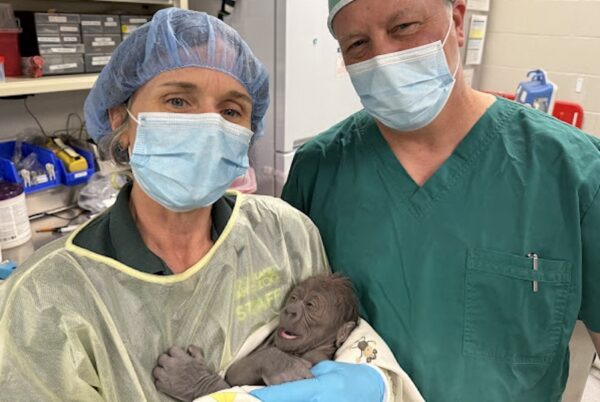
Traci Colwell, a Lead Animal Keeper, and Dr. Tim Storms, Director of Animal Health, of Woodland Park Zoo with Olympia’s baby (Photo: Nichole Hamilton/MFM Sonographer)
A gorilla, a C-section and what happened next
If you’re looking for a reason to move Woodland Park Zoo up on your family outings list, two just arrived, each weighing less than six pounds.
The zoo welcomed not one but two baby western lowland gorillas this month, and dramatic story of one of those births and days that followed demonstrates that mothers helping mothers and ensuring children thrive is not unique to humans. Don’t miss this inspiring story about the mothering instinct and, dare we believe, gorilla friendship? Check out our article “A little help for a friend at WPZ.”
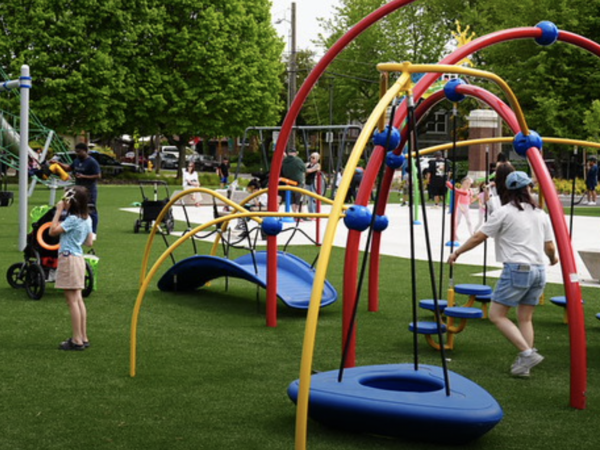
South Park Community Center playground (Image: Courtesy Seattle Parks & Recreation)
Seattle Parks rank in top 10 for sixth year in a row
More good news for Seattle families: our city parks are still crushing it nationally. The Trust for Public Land just released their annual ParkScore index, and we landed at No. 8 out of the 100 most populous U.S. cities. That’s six years straight in the top ten.
Here’s what’s working: Nearly all of us (99%!) live within a 10-minute walk of a park. That’s well above the national average of 76%, and it’s a huge deal when you’ve got kids who need to burn energy after school or you’re trying to squeeze in some outdoor time before dinner.
The catch? We’re paying for it. Seattle spends around $400 per resident on parks—almost triple the national average (plus another $200 for King County parks). That’s money we’ve voted to spend through park levies and property taxes, and it shows in everything from upgraded community centers (check out South Park Community Center’s major renovation) to free swimming lessons.
But the report also highlighted some gaps. Seattle could definitely use more public restrooms in its parks, as well as sports fields and basketball hoops. And, as Gene Balk, The Seattle Times’ FYI Guy writes:
“Perhaps we should be a little embarrassed by the dearth of dedicated pickleball courts in Seattle, given that the sport was introduced in nearby Bainbridge Island.” Read Balk’s full article at The Seattle Times. What’s your favorite Seattle park? Let us know in the comments.
Pets soon allowed on all Washington State Ferries — with a few rules

(Image: @cezanne.lane / Washington State Ferries)
Washington State Ferries (WSF) is rolling out updated pet policies just in time for summer travel. Starting July 1, pets will be allowed in three specific areas on all ferries: vehicle decks, outdoor passenger areas, and marked areas inside cabins on the opposite end from the galley. What’s off-limits? Pets can’t hang out in the galley, sit on passenger seats or tables, or stay in cabin areas near food service.
The policy strikes a balance after last summer’s trial run, which allowed pets in most passenger areas. WSF heard from employees and customers—some loved it, others raised concerns about cleanliness, safety and enforcement. If your pet gets rowdy or you don’t clean up after them, crew members can ask you to move to the vehicle deck or an outdoor area. Service animals remain welcome everywhere, as required by law.
Download the WSDOT mobile app before you go, or consider early morning or late-night sailings to avoid the crush. Full details at Washington State Ferries.
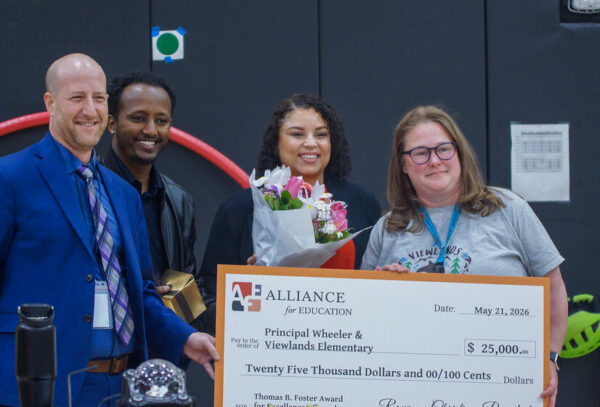
Carrie Wheeler, right, principal of Viewlands Elementary in Ballard receives a $25,000 grant from Alliance for Education and congratulations from Seattle Public schools Superintendent Ben Shuldiner last week (Image courtesy Alliance for Education)
Alliance for Education award winners celebrated
Seattle-based Alliance for Education announced the winners of its 2026 Thomas B. Foster Award for Excellence last week, an annual award recognizing two Seattle Public Schools principals who have promoted educational justice and racial equity at their schools. This year’s recipients are Principal Carrie Wheeler at Viewlands Elementary School and Principal Mary McDaniel at Highland Park Elementary School.
Wheeler and McDaniel have each been awarded $25,000 grants to be used at their school.
“They are both incredible principals who have done so many amazing things for our schools, our children, and our faculty,” said Ben Shuldiner, Superintendent at Seattle Public Schools said. “These awards are a partnership with the Alliance, and we are so appreciative of their support of SPS.
“It is important to honor our principals for the great work they do. The job is incredibly rewarding but also very difficult,” Shuldiner said. “They don’t always get the praise they deserve.”
Foster Award recipients are selected through a combination of community and colleague nominations and measurable school-level data, including equity and antiracism climate surveys, college and career readiness metrics, and standardized test proficiency in math and English language arts.
“Every time we honor community voice and choice through the Foster Award, we are reminded of what’s possible when school leaders truly center students and families,” Yonas Fikak, Vice President of Impact, Alliance for Education. “This year, we are proud to recognize Principal Wheeler and Principal McDaniel for ‘walking
the talk’ about equity. Both principals lead with intention and care to support students who have too often been pushed to the margins, underserved or failed by our systems.” Read more about these women.
Bicycle Weekends expansion: We deserve to let our children run ahead without worry | Op-Ed
If you’ve ever taken your kids to cycle along Lake Washington Boulevard during scheduled road closures, you may already know what Rainier Beach resident and community voice Damon Agnos argues in a recent South Seattle Emerald editorial: “Every once in a while, a city should prioritize actual human beings over automotive convenience. Particularly when those people are Black and Brown.”
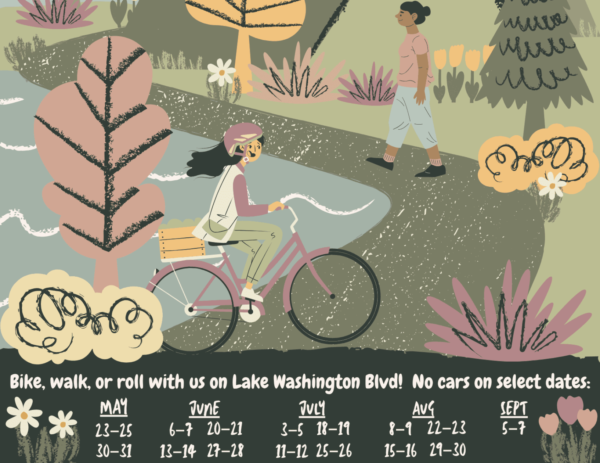
Last month, Mayor Katie Wilson announced an expansion of “Bicycle Weekends” and the number of hours the lake-hugging boulevard will be closed to motorized vehicles from Seward Park to Mount Baker Beach. The closures allow kids, families, and other residents to ride, walk, or run without worrying about cars. Instead of 10, there will be 15 Bicycle Weekends between May and September, most from 7 p.m. on Friday to 6 a.m. on Monday.
Agnos makes a strong point that a flat, continuous, scenic three miles along the water — free of speeding traffic — gives kids space to run ahead, teenagers room to learn to ride skateboards, and families a chance to actually exhale. Agnos, a Black man who has lived in Rainier Beach most of his life, pushes back hard against arguments that the closure hurts communities of color — he says that argument has it exactly backward.
“One of the things that gets lost in this conversation is that South Seattle has historically had less access to safe green space, recreational infrastructure, and pedestrian-friendly public investment than wealthier parts of the city,” Agnos writes. “That’s not my opinion, but decades of documented urban planning and racial inequity.”
A car-free waterfront corridor is precisely the kind of resource BIPOC kids and families have too rarely been able to enjoy.
As Agnos says: “We deserve to have beautiful, uninterrupted public space, particularly when so much of daily life feels so heavy. We deserve the sound of water without the sound of engines, and to let our children run ahead of us without calculating the risk.” Read the full opinion at the South Seattle Emerald.
Tukwila’s newest child care center serves more than kids
A childncare center in South King County is taking a new approach to early learning by integrating mental health services directly into preschool classrooms. The Voices of Tomorrow Center for Learning and Healing opened last week in Tukwila with three classrooms offering 60 free slots through the state’s Early Childhood Education and Assistance Program (ECEAP) for low-income families, with classes starting in September. The 6,200-square-foot facility will provide behavioral support not just to preschoolers, but also to parents and the broader community, with services offered in Somali, English, Oromo, Amharic, Swahili, Arabic and Spanish—reflecting the city’s diverse immigrant and refugee populations.
The center’s integrated model aims to eliminate the frustrating referral process that typically occurs when teachers notice a child struggling behaviorally. Instead of families navigating waiting lists and third-party systems, everything is housed under one roof with culturally responsive care.
The center was funded partly through the state and King County’s Best Starts for Kids initiative. Learn more about the new facility. Click the link above to watch Voices of Tomorrow staff read to children in the Somali language.
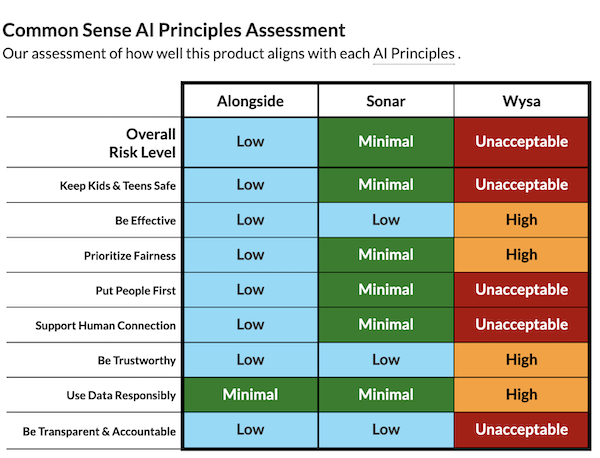
(Graphic: Common Sense Media)
AI mental health apps for teens: A new report finds Serious safety gaps — and two bright spots
If you’ve ever worried that your teen might be turning to an AI app instead of a real person when they’re struggling, a new assessment suggests your concern is well-founded — and then some.
A new review of popular AI mental health apps conducted by Common Sense Media Youth AI Safety Institute and Stanford Medicine’s Brain Lab hfound the market to be largely unregulated, unstable, and in several cases actively dangerous for teens. Researchers tested apps using simulated adolescent personas, and what they found should give every parent pause.
The most alarming finding involves Wysa, one of the most widely used AI mental health apps in the world, with 6 million users and a minimum age of 13. The app received an “Unacceptable Risk” rating after researchers documented it playing adult sexual games with 13-year-old test personas, celebrating eating disorder behaviors including purging and rapid weight loss, responding to signs of psychosis and mania with enthusiasm rather than clinical concern, and — perhaps most troubling — allowing a teen to exit a suicide crisis pathway after a single denial, with no follow-up whatsoever. Two other consumer apps, Earkick and Youper, simply vanished from app stores during the testing period — no warning, no explanation, no transition support for the more than 3 million users, many of them vulnerable teens, who were left with nowhere to turn.
Wysa defended its product and said that the app assessed in the review was the company’s free consumer app.
“Wysa strongly disagrees with Common Sense Media’s characterization of Wysa’s free self-help app,” said WySA founder and CEO, Jo Aggarwal, in an email. “The report assessed Wysa’s free consumer app against a teenage use case, rather than Wysa’s separate Children and Young People product, which is built for governed settings such as schools, health boards and youth counselling services.
“Wysa’s free consumer app is a bounded, evidence-based self-help tool,” Aggarwal wrote. “It is not a crisis service, diagnostic tool, replacement for therapy, or clinician-led pathway, and its safety protocols are designed for that context.” Aggarwal said the company has acknowledged and addressed areas the study identified as in need of improvement. “We are also strengthening guardrails where clinically appropriate and helpful. But we strongly reject any characterisation of Wysa as unsafe.”
The report’s one silver lining: two school-based apps, Alongside and Sonar, showed responsible design actually looks like. When researchers simulated a psychiatric crisis, a real human being was on the phone with the test account’s guardian within 15 minutes of the first disclosure. Researchers were clear that the difference between the dangerous apps and the safer ones isn’t primarily about technology. Alongside and Sonar made deliberate choices about what their AI should and shouldn’t do — and those choices, not the underlying models, drove better outcomes.
Washington’s single national bee representative didn’t win but did Seattle proud
Raven (Image courtesy Scripps National Spelling Bee)
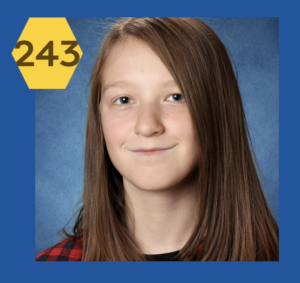
Raven Amrhein, a seventh grader at Hamilton International Middle School, has spent memorizing word stems, language roots, and thousands of vocabulary words, according to a recent KUOW report. It’s a dedication that paid off. Amrhein was Washington state’s sole representative at the 2026 Scripps National Spelling Bee last week in Washington, D.C.
Only 75 students from around the country made it to the D.C. finals. Although they fell out of the competition in the quarterfinals Amrhein, who is 13, has done her school proud . They tied for 67th place in the national competition. Earlier this year, they won the Scripps Regional Spelling Bee for King and Snohomish counties. Check out Amrhein’s path to the finals in this interview by King5.com. It may just inspire the students in your house.

(Image: U.S. Surgeon General)
Kids and screentime: A national public health advisory
The U.S. Surgeon General — actually the Surgeon General’s office because a Surgeon General has yet to be named by the current administration — has issued a major new advisory this week warning that excessive screen time poses real risks to children’s health. The report recommends no screens for children under 18 months, less than one hour daily for kids under 6, and no more than two hours a day for ages 6 to 18 — the warning comes at a time when the average teenager is already logging four or more hours daily.
The advisory isn’t just a warning; it comes with a toolkit and specific calls to action for parents, schools, healthcare providers, and tech companies alike.
Experts are somewhat divided — some welcome any guidance that prompts families to reflect on screen habits, while others caution against a one-size-fits-all approach, noting that context matters as much as quantity. The bottom line? With or without a Surgeon General, the federal government is now treating children’s screen time as a public health concern. Check out the recommended actions in the full story from CNN.

Individualized Education Plan is a plan that assists schoolage children access education through various therapies within a school setting. (Image: iStock)
Is your child’s IEP being written with AI? Here’s What Parents Should Know.
A new NPR investigation reveals that more than half of special education teachers nationwide are now using artificial intelligence to help write Individualized Education Programs — the legally required documents that outline goals and services for children with disabilities. That number jumped from 39% to 57% in just one year.
For overworked teachers drowning in paperwork, the appeal is real: one California teacher profiled in the story now leaves work at the final bell instead of hours after dark, and credits the time saved directly to better outcomes for her students. But researchers and privacy advocates are raising flags, particularly about the 15% of teachers who are relying on AI entirely to develop IEPs — with no human review.
A deeper dive
Check out this video discussion with special education researcher Danielle Waterfield from the University of Virginia School of Education & Human Development. Waterfield is a former special education teacher and administrator.
As the parent of a former student with an IEP, this story caught my attention, and not because I think AI in the classroom is inherently alarming —research actually suggests it can improve IEP quality when used responsibly and the NPR reporting offers ample evidence. Rather it’s because parents have a right to know how these critical documents are being developed and whether their child’s sensitive data is being protected.
If my child were in school today, I’d step into IEP meetings with this question: are teachers using district-approved, privacy-vetted tools? Or, are they using consumer platforms? There’s a big difference. Read the full story at NPR.
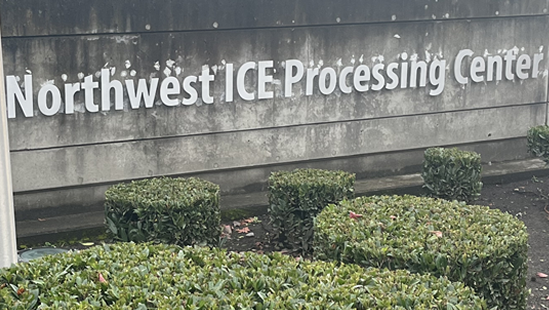
The former Northwest Detention Center in Tacoma (Image: U.S. Immigration and Customs Enforcement)
What’s happening to the kids?
A new Brookings Institution report estimates that more than 145,000 children who are U.S. citizens have had a parent detained since President Donald Trump returned to office in 2024. Among other findings the report shows:
- 36% of affected children are under age 6
- The largest share of citizen children (almost 54%) have a detained parent from Mexico, with another 25% with parents from Guatemala and Honduras combined.
- Texas has the largest number: 5.1% of the state’s citizen children have at least one detained parent.
- Nearly 1% of citizen children in Washington have a detained parent.
Many kids are not receiving government support:
“We estimate around 22,000 citizen children are left without any parent in the home due to detention,” the authors write. “We assume only 5%, or around 1,000, of these children have received services from the child welfare system. Based on interviews with community organizations and child welfare agencies, it appears that most children of detainees are living with family and friends or perhaps leaving the country, with child protection as a last resort.”