

Being a parent is nonstop hard work, making it challenging to stay on top of news that impacts families in Washington state. This Hits Home is your weekly hit of news, commentary, and, occasionally, opinion. Want to have a say? Look for the “Take action” prompts. Here’s the update for the week of April 13-19.
Gas Works Park ordered to remove or secure dangerous park elements

Gasworks Park (Seattle Municipal Archives / CC BY 2.0)
After months of gridlock over safety at Gas Works Park, Seattle officials appear to have found a way forward—one that could finally bring changes to the park’s iconic but dangerous towers.
According to numerous reports, the Seattle Department of Construction and Inspections has ordered the removal of hazardous features—including ladders, catwalks, and piping—from the structures, citing a long history of falls, injuries, and deaths. Parks officials have now been directed to secure permits and begin work, with a May deadline and potential daily fines for non-compliance.
The move follows a fatal 2025 fall involving a 15-year-old boy and years of failed attempts to make the site safer. Previous plans stalled when preservation rules protecting the historic industrial structures blocked changes. This time, the city is using a safety exemption in building code—effectively allowing officials to bypass the landmarks process and act more quickly to prevent future injuries. Read the full story in The Seattle Times.
Hundreds sign petition for memorial to slain teens
Memorial petition
Hundreds of south Seattle residents have signed a petition asking the City of Seattle and King County Metro to recognize the lives of Rainier Beach High School students Traveiah Houfmuse, 17, and Tyjon Malik Stewart, 18, who were shot and killed at a Metro bus stop on January 30. They want a memorial placed at the bus stop, located at Henderson Street and Rainier Avenue.
“This senseless act of violence has left an indelible mark on their families, friends, and the community at large,” the petition, which had nearly 850 signatures early last week, argues. “It is time for us to come together and create a lasting tribute in their memory … and to remind ourselves of the urgent need to address gun violence,” the petition urges.
“Transforming this bus stop into a permanent memorial will serve not only as a tribute to Traveiah and Tyjon, but as a powerful reminder of the aims we must pursue: reducing gun violence and increasing safety within our neighborhood. A memorial would offer family and community members a sacred space to mourn, reflect, and find solace.”
The suggested memorial would include the teens’ names, a bench, and messages of peace. Read the full story in South Seattle Emerald.
TAKE ACTION: Want to see a reminder that Seattle won’t tolerate gun violence and a memorial for kids who lost their lives? Sign the petition.
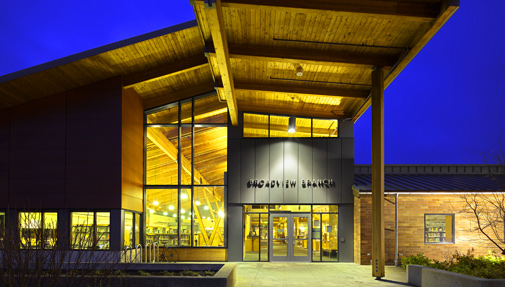
Seattle Public Library Broadview Branch (Image: SPL)
$480 million Seattle Library Levy WILL be on the August ballot
I guess the Seattle City Council did not listen to me when I urged members earlier this month to vote “no” to sending a $480 million library renewal to voters in August. The request, first proposed by Seattle Mayor Katie Wilson at $410 million before council members added costly amendments, is more than double the $219 million levy passed by voters in 2019.
On April 14, the council voted to put the proposal before voters.
TAKE ACTION: Check out South Seattle Emerald’s story on what the funds would cover or read up on where the proposed levy renewal dollars would go on Seattle Public Library’s levy page. Then be sure to voice your opinion by voting on August 4.

AI in the classroom (Image: Jefferson Lab / CC BY 2.0)
I spoke with teachers about AI. Here’s how the education system needs to adapt | Op-Ed
In a compelling opinion piece published by Washington State Standard, David Kimball, Tech Exchange editor for Washington Policy Center, Young Voices contributor, and fellow with America’s Future, offers policy recommendations we believe will help teachers help kids navigate the potential harm posed by the increased use of AI in education.
“The sudden and rapid propagation of artificial intelligence through large language models (such as ChatGPT) caught much of the education world off guard,” Kimball writes. “Over the past few months, during my study on the impact of AI, I spoke with dozens of teachers across Washington about how they’re approaching the new tech landscape. Most are adapting as best they can, but concern has grown as studies show a potential decline in critical thinking skills with AI use, compounding existing worries that electronics in classrooms are bigger distractions than aids to students.”
There’s no single panacea to addressing all concerns, Kimball stresses.
“The path forward will be forged with innovation and resolve to reevaluate how the education system operates,” he writes.
Kimball says there are some policy recommendations that can aid teachers in helping students navigate AI, chief among them prioritizing non-digital learning and ditching the Chromebooks.
“The public school system’s eager adoption of laptops en masse hasn’t paid off. The potential benefits of the machines may not outweigh their proclivity to distract. Based on the data and teacher frustrations, it would be prudent to reevaluate laptop policies, preferring traditional computer labs for digital-based work or individual laptop loans for at-home work. Read Kimball’s full opinion and recommendations.
‘Where’s the action?’ Seattle Schools superintendent pledges to streamline handling of sexual misconduct cases
Seattle Public Schools needs to move faster—and more clearly—when teachers are accused of sexual misconduct, Superintendent Ben Shuldiner recently told investigative reporters at KUOW. And, he believes, parents and students need to have a designated place to bring their concerns.
Shuldiner was interviewed for KUOW’s hit documentary podcast, “Adults in the Room.” Shuldiner told producer Isolde Raftery that SPS human services is reviewing a backlog of investigations and that he was “really pushing to say, ‘Where are we with this? What’s going on?’”
At the same time, district staff must be given due process.
“We’re trying to really look at every single person that’s under investigation. Some people are still on leave for two years,” Shuldiner told Raftery. “Like, where’s the action? Either find something or don’t, you’ve got to move forward. And I think that’s indicative of what you’re seeing from your lens — is a slowness, an inaction, maybe an obfuscation.”
Shuldiner said that the system has been too slow and, at times, unclear in how it responds to allegations, adding that the issue isn’t limited to individual cases—it’s structural. SPS, he said, lacks consistent processes to handle allegations in a way that prioritizes student safety while still ensuring due process for staff and that means gaps in accountability and no shared framework for identifying and responding to concerning behavior.
To address those gaps, Shuldiner wants a new department focused on student and family support, alongside clearer policies and updated training for staff. The goal, he said, is to create a system where families know where to turn and concerns are handled consistently and promptly. If it comes to fruition, Shuldiner’s proposed Department of Student and Family Support rollout would begin by the 2026–27 school year. To hear the Shuldiner interview, listen to the seventh episode of Adults in the Room.
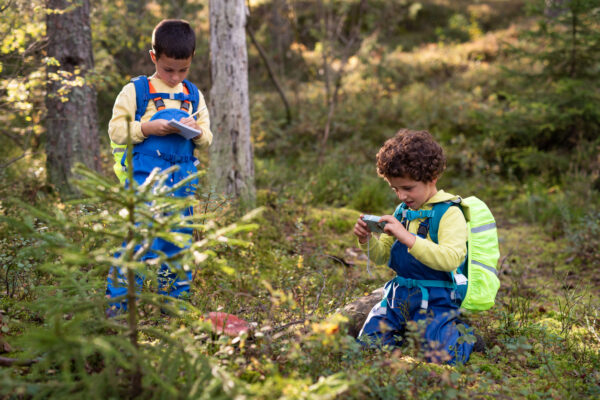
Kids of all ages can help collect pictures of wild plants, bugs and more (Image: Isbjorn / iStock)
Hey families! Take the City Nature Challenge
Here’s something you and your kids can do together for the environment—and have a great time doing it—with no weeding, digging, or garbage collecting (although those are all great ways to help the planet). City Nature Challenge 2026, a four-day collaborative wildlife information gathering event, kicks off April 24.
All you need to do is download the free iNaturalist app on your phone. Then head out with your kids to make observations of local wild animals, plants, and other living beings you encounter in the Seattle-Tacoma metropolitan area, which includes King, Pierce, and Snohomish counties. The idea is to make as many observations of wild nature as possible over the weekend. Data—collected right outside your window or in your backyard or neighborhood—will be used to better understand urban biodiversity and advance conservation research. One caveat: Wild is the operative word in this challenge. No photos of pets or other domestic animals.
Prefer a group for community connection? Join one of several challenge events.
Last year’s Seattle-Tacoma City Nature Challenge logged 19,628 observations of 2,138 species by 1,233 observers. After your family’s observations are uploaded, challenge yourselves to join the effort to identify what was found. That effort will take place from April 28 to May 10. Get more on the story.
Alliance for Education announces 2026 Public Education Advocacy Award
Former Seattle School Board member Jill Geary has been named as the recipient of the 2026
Alliance for Education Public Education Advocacy Award. The award recognizes individuals and organizations who have demonstrated “exemplary leadership and unwavering dedication to public education in Seattle” and a commitment to “advancing educational justice and racial equity for students in Seattle Public Schools (SPS).”
Geary, a family and special education law attorney, an administrative law judge, and an education policy leader, has centered much of her work on equity, collaboration, and public schools as a foundation for thriving communities. She served on the school board from 2015 to 2019 and is known for helping to strengthen SPS special education services.

(Image: Fat Camera / iStock)
Cut to pre-K program leaves WA school officials, parents, and educators frustrated
A statewide early learning program aimed at helping young children get ready for kindergarten is preparing to lose nearly 2,000 seats since lawmakers approved a 25% funding cut this year. The decision to cut $27 million from Transition to Preschool programs was finalized when Gov. Bob Ferguson signed the 2025-27 supplemental biennial budget and drew sharp criticism from Washington Schools Superintendent Chris Reykdal last week. Parents and local school leaders also voiced consternation, saying the program fills a key gap for families. Reykdal called the reduction one of the most damaging and “ill-advised” cuts he has seen in decades, arguing it undercuts long-standing efforts to expand access to early learning for young children across the state. Read the full story by the Washington State Standard.
In almost the same breath, Ferguson announced Washington will spend $55.8 million into early learning facilities to create 2,000 new child care spaces across the state. The competitive grant awards will support renovation projects in over 50 jurisdictions, according to the governor’s office.The 74 recipients include local governments, school districts, commercial properties and in-home child care facilities. Read that full story here.

“Grrr!” (Image: Luis Marina / CC BY 2.0.)
In praise of difficult kids
We all knew that kid in school. Maybe you now have one in your family. A child who their school or teacher has deemed “difficult.” A child who “talks too much” in class or argues for or against things seemingly just to be contrary. Who knows, maybe they’re difficult at home too.
I’ve met a lot of difficult kids. My son had “difficult” stamped all over him. Which is why I was heartened by educator Russel Shaw’s fresh take on this group of kids last week at The Atlantic. While such children can be exhausting, Shaw says, they also ‘possess a moral fire that deserves cultivating.’
Shaw offers three truly useful ways to do just that, including this simple tactic: “Let them be right sometimes.” He offers hope to parents and educators that difficult kids, while challenging, can grow up to be terrific adults.
“Properly guided, a child doesn’t just push back,” Shaw says his experiences have shown him. “They push forward.” Read or listen to the full piece in The Atlantic .

2026 RSV season longer than usual, infant immunizations available through April 30
The Washington State Department of Health has extended the window for infant RSV immunizations through April 30, citing continued high levels of the virus across the state. RSV protection is typically offered October through March, but health officials say this year’s later and prolonged season means some babies are still at risk.
State Health Officer Tao Sheng Kwan-Gett said the goal is to prevent serious illness while transmission remains elevated. RSV is a common respiratory virus that often looks like a cold but can lead to hospitalization and even death—especially in infants, who account for the highest number of severe cases. This season, hospitalizations among babies under 1 peaked in January and remain higher than usual.
The shift follows an unusual pattern: RSV activity in Washington didn’t pick up until December—more than a month later than is typical—and has stayed elevated into late winter, mirroring national trends. Health officials recommend immunization for all infants younger than 8 months during their first RSV season, as well as for certain higher-risk toddlers up to 19 months, including those with underlying conditions or from communities at higher risk of severe disease. For more information on RSV, check out the Your Local Epidemiologist blog.

Harborview Medical Center (Image: Toolhool / CC BY 2.0)
Harborview program shown to improve outcomes for kids with brain injuries
A program developed at Harborview Medical Center and studied by researchers at the University of Washington School of Medicine is showing it can improve care for children with severe brain injuries—even in hospitals far from Seattle.
The program, called PEGASUS, is designed to solve a common problem in medicine: doctors know what works, but it can take years for those best practices to show up consistently in real-world care. Instead of introducing new treatments, PEGASUS focuses on helping hospital teams actually follow existing, evidence-based guidelines—especially in the first critical hours after a child arrives in intensive care.
In a new international study across 16 hospitals in South America, researchers found that when PEGASUS was used, hospitals improved how closely they followed those life-saving guidelines—by about 8% for children with severe brain injuries and no other major trauma. That may sound small, but in emergency care, even modest gains can translate into better survival and recovery. Read the full story from the UW Newsroom.
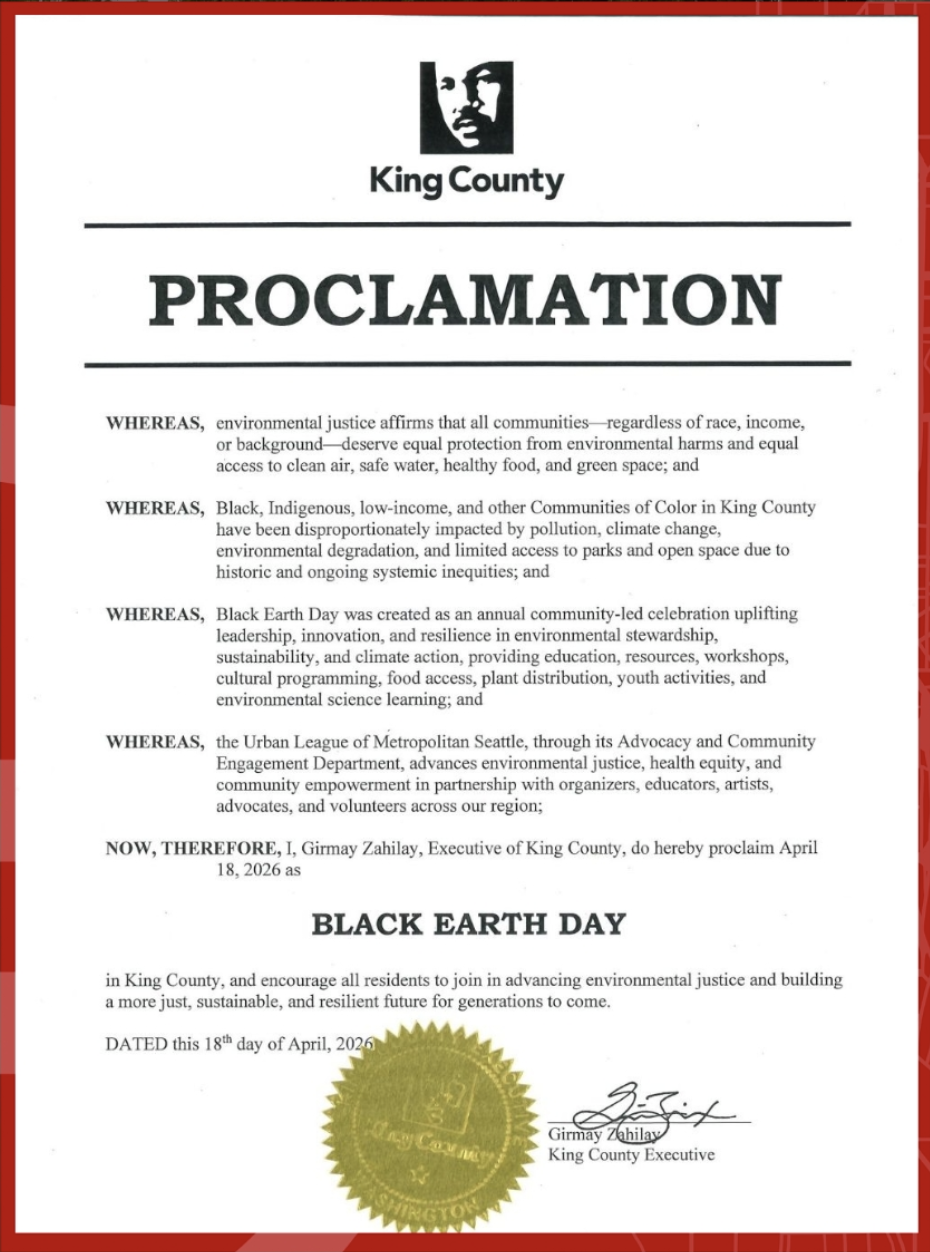
King County Black Earth Day is officially recognized

Black Earth Day (Artwork by Charde Brown
This weekend, residents across the county celebrated Black and Indigenous contributions to environmental justice during an annual celebration launched by the Urban League of Metropolitan Seattle’s Advocacy and Community Engagement Department (ACE) in 2022. This year’s celebration was elevated, however, when King County Executive Girmay Zahilay officially proclaimed April 18, 2026, as countywide Black Earth Day to “encourage all residents to join in advancing environmental justice and building a more just, sustainable, and resilient future for generations to come.”
“Black Earth Day is a growing tradition in our city that uplifts Black and Indigenous environmental heroes of the past and present by educating the community about our collective ability to create a healthy planet,” wrote the Urban League on Instagram. Read South Seattle Emerald’s great coverage of the day.
No matter your stance on MAHA, moms will make or break RFK, Jr. | Commentary
Dr. Rachael Bedard’s opinion column in The New York Times takes a close look at the role mothers are playing in the growing Health Secretary Robert F. Kennedy, Jr.’ “Make America Healthy Again” movement, noting how many were first drawn in by concerns that feel immediate and personal: rising rates of childhood illness, ultra-processed food, and what their kids are exposed to every day. For them, the movement isn’t about politics — it’s about trying to make sense of a health system that feels fragmented and, at times, unresponsive to family concerns. Increasingly, it’s these mothers — organized, vocal, and deeply motivated — who are helping carry that message into the mainstream.
But that influence cuts both ways. Bedard, a Times opinion columnist, geriatrician, and palliative care doctor, says the same coalition of moms that gives the movement its momentum is now wrestling with tension. As the MAHA agenda has expanded into vaccine skepticism and broader distrust of public health institutions, Kennedy risks losing the very group he needs to sustain it. That’s because many original MAHA parents are not looking to reject science — they’re looking for clarity, consistency, and solutions they can trust. The question now, writes Bedard, is whether the movement can hold onto that base, or whether those same mothers will begin to pull away. Read the full article in the New York Times.


