On Monday, September 21, Superintendent Ben Shuldiner announced two major shifts in Seattle Public Schools’ K-2 student technology.
The first is phasing out 1:1 devices. Right now, every SPS K-2 student has an iPad assigned for the year. By January 4, 2027, all K-2 classrooms will shift to a model where iPads are available to sign out or borrow but will not be the exclusive designated device for each student.
SPS K-2 classrooms will also limit student screen time to 30 minutes or less per day, and, said Shuldiner, “days where hopefully they have zero screen time.” This shift is also meant to occur by January 2027.
Shuldiner assured families who may not have access to a device at home that the district is “always willing to work with them,” but said the district needs more stringent and intentional use of technology.
“It’s not just about limiting to 30 minutes. It’s that if we’re ever going to use technology, there needs to be a high bar for using it. Meaning, it’s not just to watch cartoons,” he said. “It’s not just to watch some video.”
The district isn’t getting rid of classroom technology altogether. Its new K–5 curriculum, for example, includes some days with up to 20 minutes of technology use, and devices will continue to be used for purposes such as assessments. But Shuldiner said the district wants a much higher bar for putting young students in front of screens. Though Shuldiner said this is “just the beginning of a conversation” on more intentional tech use, the district is referring to the changes as a “shift,” and not an official policy—yet.
Dr. Mike Starosky, Assistant Superintendent of Academics, explained the January 2027 timeline, saying: “For many of our educators, this will not be a big change for them at all. They could implement it this afternoon. But for some of our schools, this will take a little bit more time, which is why we’re having a gradual release into this through the new year.”
Common sense reforms
Shuldiner hopes these reforms will be seen as common sense.
“There’s no reason why a Kindergarten kid needs to have an iPad every day in their hand,” he said. “Just doesn’t make any sense to me. People learned way before iPads were invented, and certainly little kids should be more engaged in social-emotional learning with their peers.”
This “overreliance” on technology is a relic of the COVID era, said Shuldiner. Prior to COVID, few K-2 students were issued 1:1 devices. Now that kids have returned to the classroom, Shuldiner said, 1:1 devices for young children are “vestiges of something that made sense five years ago still hanging around.”
It also made sense to start with grades K-2 since they are the only students issued iPads, not laptops.
Starosky said that the “Zero to 30 is an applicable, easily understood mantra … and our goal is simple: to use technology in ways that strengthen learning, not distract from it.”
Effective advocacy for intentional technology
Shuldiner credits a vocal and persistent community of parents and educators with bringing the technology discussion forward.
“We have a wonderful community of elementary school and K-8 team that have been really wanting this,” he said. “I’m reminded of an old saying from the French Revolution which is, ‘I am their leader; I must follow them.’”
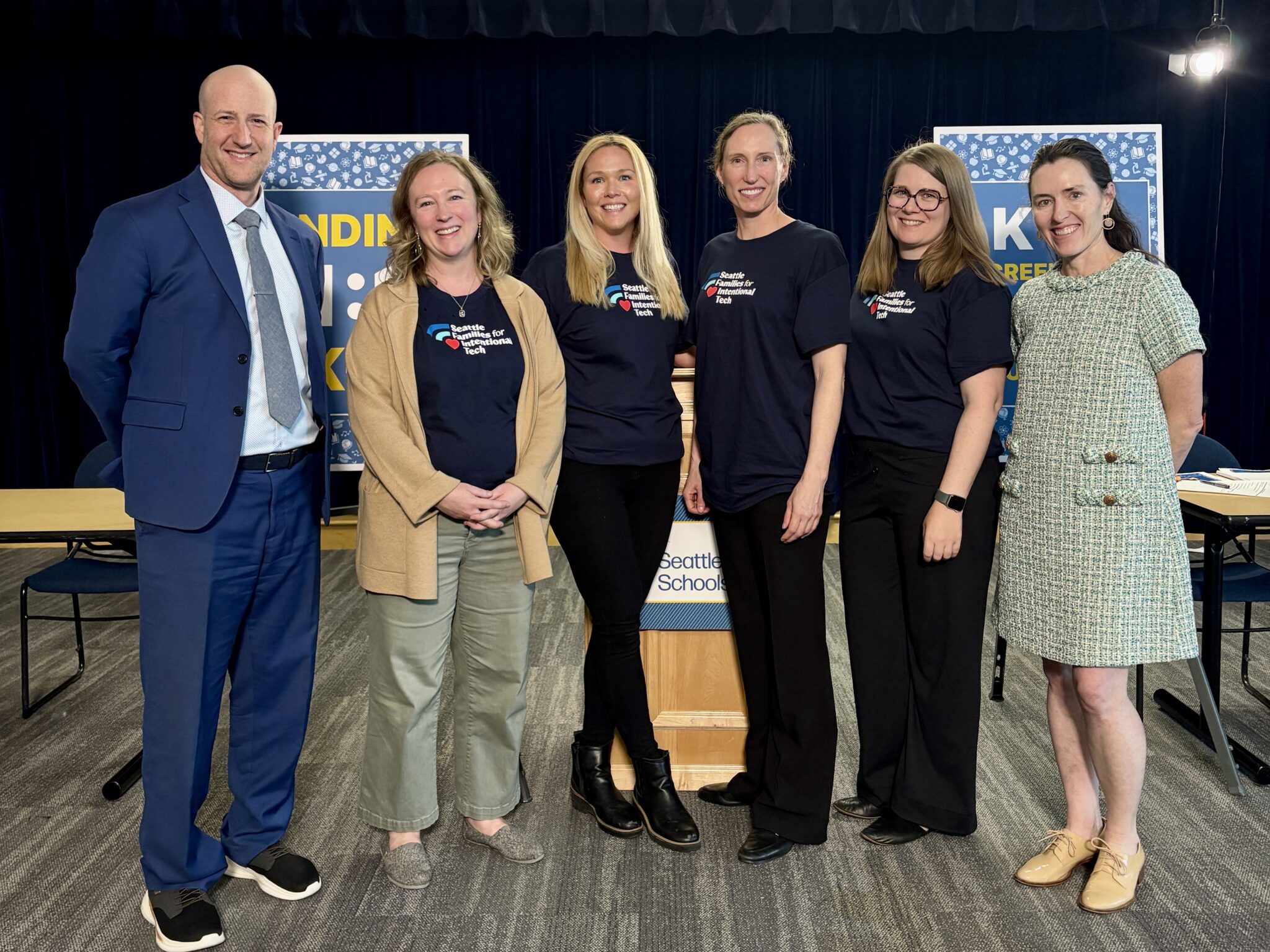
Charlotte Taylor, who has three children in SPS, spoke on behalf of the organization Seattle Families for Intentional Technology (SFIT), an advocacy group partnering with SPS to craft more thoughtful policy around classroom technology. SFIT is also the official Seattle chapter for the national organization Schools Beyond Screens.
In addition to the new guideline, SFIT seeks to set screen-time limits across all grades, restrict recreational gaming, and pause student use of generative AI while the district examines safety, privacy and effects on critical thinking.
These reforms, said Taylor, will help “seventh-graders pay attention to their science teacher instead of playing games on their laptops,” and “ensure that our fourth graders have the stamina to read whole chapter books.”
Looking forward
The shift could also save the district money on technology, although Shuldiner said he did not yet have firm figures. He stressed that SPS technology funding comes largely from voter-approved capital levy dollars separate from the district’s operating funds, meaning savings can’t simply be redirected to hiring teachers.
“We’d probably be saving a couple of hundred, a couple of million over the next couple of years,” Shuldiner said.
Success will initially be an eye-test: fewer students on iPads in class, more positive communication from families. But eventually, said Shuldiner, SPS will look at engagement, attendance, happiness, and proficiency.