With six weeks left in the 2025-2026 school year, Seattle Public Schools announced a new policy officially limiting student use of smartphones at school. Enacted on May 4, the decision unifies policy across the district, replacing a patchwork of individual school rules. That the district finally came up with a ban was not surprising — it’s been discussed for years. Coming at the very end of the school year, the timing was a surprise to most.
According to the policy, K-8 students must keep smartphones “Off and Away for the Day.” That means students are not permitted to use or access smartphones at all during the school day. For SPS high schools, the policy is “No Cell Bell to Bell,” which gives students “limited access during lunch and passing periods, supporting responsible device use and digital citizenship while keeping phones out of the classroom.”
A month after Seattle’s ban kicked in, Governor Bob Ferguson, together with state Superintendent for Public Instruction Chris Reykdal, announced a legislative goal 2027: to ban smartphones bell-to-bell in all Washington public schools.
Both efforts come on the heels of a sea change year in American education in which at least 44 states and countless individual schools and districts have enacted policies restricting smartphones in the classroom.
They’re just kind of…gone
Gigi Vann, 15, is a rising sophomore at Ballard High School. She got her first smartphone at age 12, nearly the last of her friends to do so. Many of those friends had smartphones in elementary school. Despite research showing risks associated with giving children smartphones, most American children receive their first smartphone between the ages of 11 and 13, according to a study published earlier this year in the journal Pediatrics.
As a freshman, Vann witnessed the outsized role smartphones played at school.
Some teachers were strict about phones even before the official rule; some were not. In more permissive classrooms, students brought their phones into class and placed them in their laps.
“Then they put their head on the desk and stare down at it, and then they’re just kind of gone. They’re not really there,” Vann said.
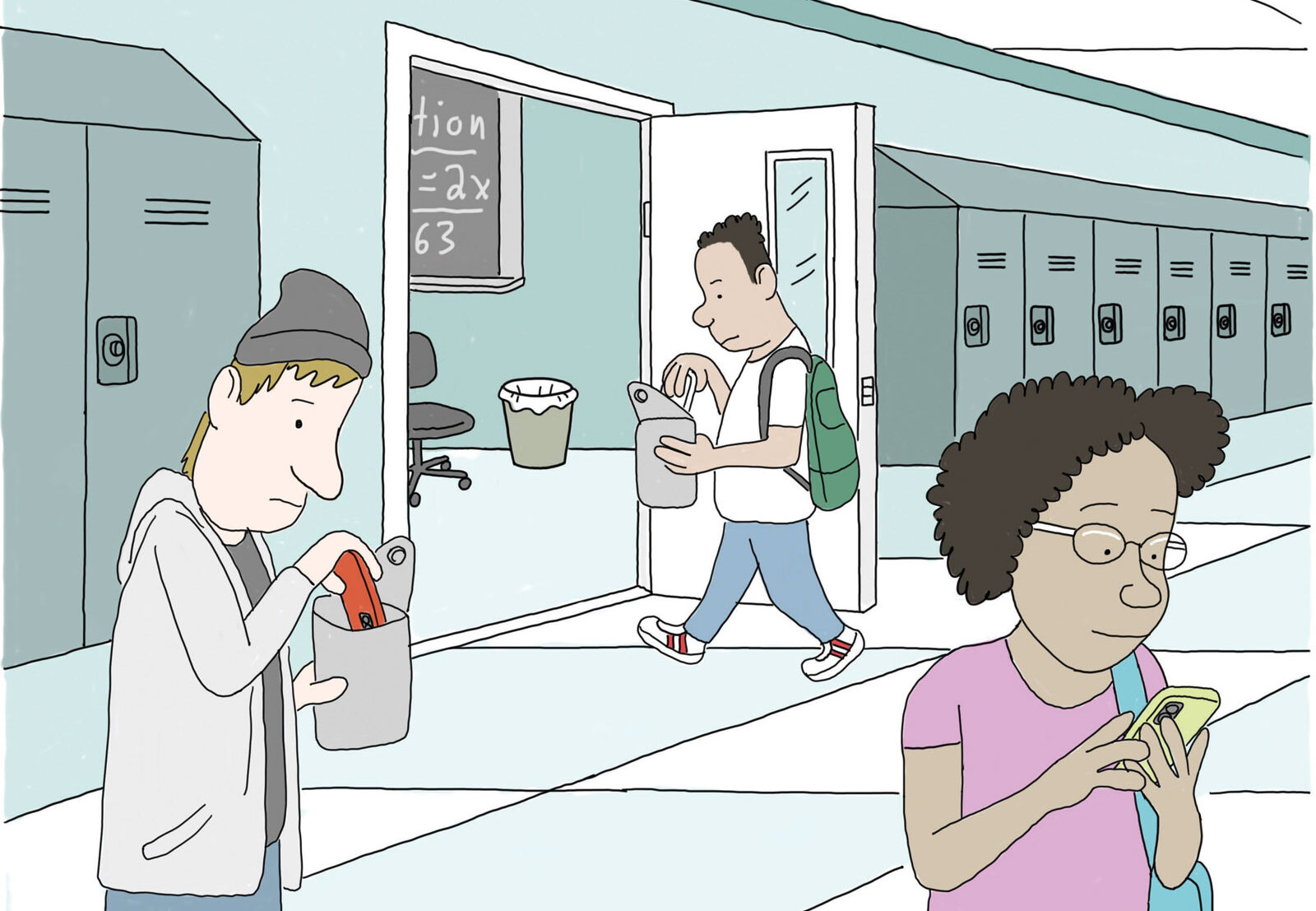
Teachers who were strict before the policy utilized a variety of ways to keep kids’ phones out of their hands during class. Vann said that some teachers gathered phones into a bin or a homemade slotted wooden box, and some collected phones to take attendance.
The teen added that the first week after SPS announced the policy teachers were strict about no phones and “some kids were anxious or angry about it.”
But then, attitudes regressed.
“Teachers who were already strict about phones stayed strict, but lots of teachers just let it slide,” Vann said. “It fully depends on the teachers to enforce it.”
Mixed feelings from parents
Sarah Jackson, 45, is Gigi Vann’s mother. She’s diligent about managing her children’s smartphones—Gigi has a twin brother—but finds the burden on parents onerous. She manually sets the “downtime” setting on her kids’ iPhones every morning before they leave for school.
Six weeks after the SPS policy went into effect, Sarah said, “My sense is that nothing has changed. I think if things had changed considerably we would have heard more about it from the kids.”
Parents of younger students are cautiously optimistic.
“I’m really excited and hopeful about this policy,” said Meaghan Kaul, who has a fourth grader at Gatewood Elementary. She explained that even when parents withhold smartphones, they can’t control what their children see at school on other children’s phones.
“Having no cell phone policy undermines parents’ own policies around smartphones,” Kaul said. “Phones are addictive.” Kids, said Kaul, have enough on their plates without a lot of unsupervised internet access: “The Internet is full of misinformation,” she said.
We figured, “Why wait?
About 75% of Washington state school districts had some smartphone policy for the 2025 – 2026 school year. Alhough SPS’s finally enacting a new policy didn’t come as a surprise—SPS floated a policy in November 2025, before Superintendent Ben Shuldiner was hired—the timing did.
“We knew and we know that cell phones are a huge distraction,” said Superintendent Shuldiner. “So, we figured, why wait? We want to make sure that we’re not letting the perfect be the enemy of the good.”
Enacting the policy at the end of the school year gave SPS leadership time to hear from constituents, like principals, parents, and teachers, “to see if we were on the right track,” Shuldiner said of the May policy start.
“What we heard over and over again from principals and teachers was, ‘Thanks so much for creating one process, one system, one kind of rule,’” Shuldiner said of responses after one month of the K-8 policy. “It’s pretty simple. Off and away for the day. It seems to be doing very, very well.”
Shuldiner says having the Governor’s support for the policies is helpful, but “the devil is in the details.” Right now it is unclear if or how a state mandate would conflict with the SPS policy, but Shuldiner, with an eye toward the district’s $104 million deficit, said he will be wary of any “unfunded mandates.”
The High School smartphone policy is more complicated, said Shuldiner, because “kids are in Running Start, or CTE programs, or they have to leave campus and drive somewhere.” That’s why for the upper grades, SPS chose not to enact a full school-day ban. In effect, high schoolers can use their phones anytime they’re not in class.
Phones distract in the classroom and dominate the hallways
How the policies for K-8 versus grades 9 to 12 differ remains a point of debate, since both teachers and students agree to the fact that life outside the classroom is equally as formative as inside the classroom.
As an activities coordinator at his alma mater, Garfield High School, Jamie Rees observes multiple classrooms throughout the school day. “It is vital,” said Rees, “that we build environments where young people can learn and experience themselves outside the influence of [smartphones].”
Rees started as a language arts teacher at Garfield in 2020 and previously taught high school in Baltimore. In his experience, kids often “reach for the phone anytime they encounter a challenging emotion, or when something requires depth or persistence of engagement.”
At Ballard High School, phones dominate interactions outside the classroom.
“Maybe if we didn’t have phones we would talk,” Vann suggested. “But right now if you don’t know each other people don’t really talk. We just default to our phones.”
Current high schoolers spent some of their most formative social years in restrictive COVID lockdowns communicating with each other through laptops and smartphones. Seattle City Councilmember Eddie Lin, whose son is a rising senior at Franklin High School, watched the rapid transition to tech-based socializing.
Given that loss of in-person contact and its lingering effects, he said, “Anything we can do to encourage face-to-face interaction is a good thing.”
The challenge with managing smartphones is the same one both inside and outside of the classroom: it requires collective action.
“It’s very difficult for one kid not to be able to use their phone when that’s how everyone is communicating,” explained Jackson. On the flip side, research shows that a single beep or buzz in a classroom or outside from a smartphone can distract, or draw the attention of, multiple students.
A game of digital Whack-a-Mole?
In the wake of growing smartphone restrictions, parents and teachers across the country have reported a new challenge: non-instructional activity, like chatting and gaming, shifting from smartphones to kids’ school-issued devices. For example, students have used Google docs as a de-facto chatroom and found Internet-based games that escaped school content blocks. At SPS, students as young as nine-years-old spend hours of class time in front of a screen.
“This goes to a much larger conversation about the inordinate amount of screen time that our children have,” Shuldiner said. “We are working diligently to reduce the number of minutes per day when children are using computers or on a screen.”
Several states and large public school districts have already passed screen time limits for the school day, including Los Angeles Unified School District. SPS does not currently have a policy limiting screen time, but Shuldiner emphasized that in the coming year, the district will be looking at curriculum as a way to curb time spent on devices.
Over the last school year, Shuldiner has expressed surprise at witnessing classrooms with very low instructional minutes. Rather than 30 instructional minutes in the first three hours of the day, for example, he wants to see the curriculum push that to hours. The new ELA curriculum approved by the School Board, for example, allows for only 20 minutes of screen time.
Once the tighter curriculum is widely adopted, screen time will drop. “Kids won’t have time to be on chat,” said Shuldiner, “because they’re going to be making soda volcanos in science class.”
Neither the SPS policy nor the proposal by Governor Fergusen outlines how exactly these policies will be enforced, and without clear, enforceable consequences, the burden of policing will rest, again, on teachers and parents.
Right now, most K-8 schools have tiered consequences for phone violations. “There’s so much time, energy, and emotional degradation to have to say ‘no, put this away,’ again and again, and teachers just get steamrolled,” said Rees.
Seeing improvement
In general, teachers have been the most positive about bans in schools that have them. A survey of nearly 5,000 students, 220 teachers, and 480 parents led by UW researcher and assistant psychology Professor Lucía Magis-Weinberg found that kids were less positive. While some student respondents said they did better academically without phone access, few students reported feeling any emotional or mental-health benefits. As many as 15% of students reported feeling less emotionally regulated and more stressed without phone access as well as feeling a loss of agency and personal authenticity.
Schools that have implemented Yondr pouches, like Seattle’s Robert Eagle Staff Middle School and Hamilton International Middle School, saw a variety of student improvements. A month after launching the Yondr pouch requirement in 2024, the principal at Robert Eagle Staff told Cascade PBS the change was “transformative.” Teachers at the school raved about better attention in class and school staff said they saw kids actually engaging at lunch rather than staring at devices. Yondr pouches are successful because they mute phones and remove potential distractions, thus enabling more collective buy-in: students don’t experience “fear of missing out” or FOMO because no one else has a smartphone, and they aren’t reminded of their phones constantly through notifications.
But even with a school discount, Yondr pouches cost between $15 – $20 per student. For a district with nearly 50,000 students the cost could be upward of $1 million.
When it comes to cost, Rees said the district needs to ask itself: “Is it an expenditure—or an investment?”