“Look, Listen and Learn” (LL+L) opens with a catchy theme song and two enthusiastic co-hosts: Auntie Lena and Possum, an inquisitive marsupial puppet. Together they laugh, talk, and entertain young viewers. Sometimes they discuss tough topics, like changing schools or teasing, offering evidence-based coping strategies for kids and parents to use in real life. There are read-alongs, artmaking, music, and recipes for kids to try at home. Most importantly, in accordance with its mission, almost everyone who appears on “Look, Listen and Learn” is a person of color.
Community pride and inspiration
Like “Mr. Rogers’ Neighborhood” and the stoops of “Sesame Street,” “Look, Listen and Learn” is a kids’ show that shows young viewers they are part of a community full of fascinating and inspiring people.
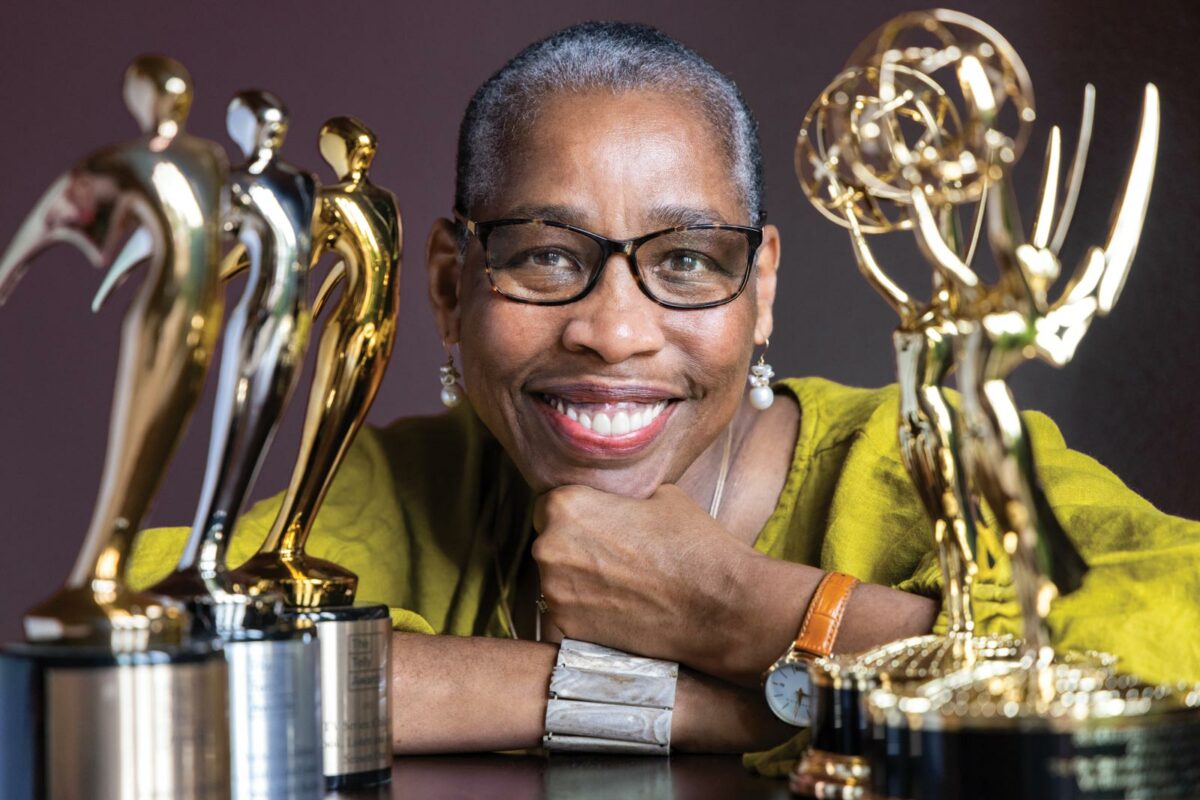
As Auntie Lena, Executive Producer Val Thomas-Matson draws from her own experience growing up in the Central District and Rainier Valley. Both of her parents worked to support four kids, two of whom were terminally ill with sickle cell anemia. Even amid that heartbreak, Thomas-Matson felt the warmth of her community.
Back then, Thomas-Matson says, the Central District was “a whole world of Black people doing both ordinary and exceptional things — things white folks said we couldn’t do, like becoming the first Black State Supreme Court Justice or a world-famous opera singer.”
A village raised Thomas-Matson. But today she worries that the kind of inspiration afforded by a tight community is fading.
“Fewer of those villages exist today,” she says. “Families who can provide for their children can do well, but those who are poor, melanated, or disadvantaged don’t have those opportunities, and are often dismissed.”
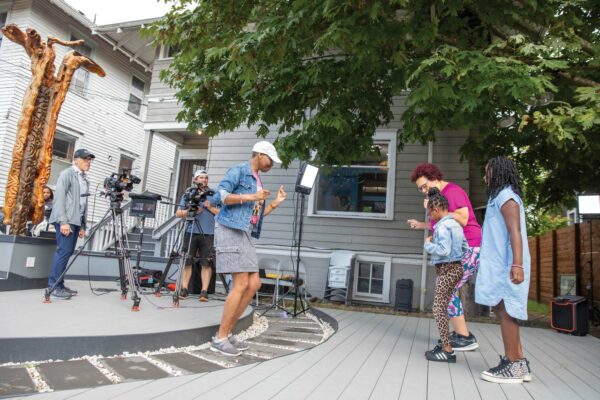
The magic of “Look, Listen and Learn” starts long before the cameras roll. (Image: Joshua Huston / Seattle’s Child)
A show informed by research
Research plays a huge role in “Look, Listen and Learn.” For example, puppets like Zane Exactly’s Possum have proven effective in helping kids work out difficult subjects, according to a 2025 study published in The Arts in Psychotherapy.
Show producers point out that children of color watch more media than white children, making positive BIPOC representation even more powerful.
Victoria Mendez, associate producer, grew up watching PBS Kids shows like “WordGirl” and “Martha Speaks.” By the early 2000s, children’s television started featuring more female leads.
“But,” says Mendez, “it’s important to see culturally different characters. Our show is entirely focused on kids of color.”
That’s not lip service. In addition to an all-BIPOC cast, the show’s tiny production team consists mostly of people of color.
Media research shows the biggest gaps in popular media aren’t in front of the camera, but behind it. From small TV shows to blockbuster movies, women, BIPOC, and queer folks are vastly underrepresented in production. That’s partly why Communications Lead Amari Cash stays involved — despite having another full-time job.
“I’d drop everything for ‘Look, Listen and Learn,’” she says.
An uncertain future
This year, “Look, Listen and Learn” won its first Emmy award — the latest in a string of honors that includes three Telly Awards.
Unfortunately, says Cash, “Awards don’t always translate to funding.” Like so much public television, the show is grappling for financial support.
“Look, Listen and Learn” show’s commitment to free, high-quality educational programming aimed at kids of color is also, frustratingly, making it harder for them to get grants. Fearing reprisal from the current presidential administration, big corporations that offered grants to shows aimed at diversity, equity, and inclusion are pulling back, says Cash.
In July, Congress clawed back $1.1 billion in federal funding for public media. Then in August, the Corporation for Public Broadcasting, the nearly 60-year-old public media grant writing entity, announced it would close at the end of this year after lawmakers left it out of the federal spending bill. Member stations all over the country are in the heartbreaking process of cutting staff and shutting down productions.
“It’s devastating,” said Mendez. “But we are using this as fuel to remind people how important free educational television is.”
She’s not the only one fired up. YouTube CEO Neal Mohan has led the company in an algorithm shift, prioritizing free, educational kids’ shows. After Mohan adjusted YouTube’s algorithm, viewership for LL+L exploded.
“We were seeing 500, maybe 1,000 monthly views per episode,” said Cash.
Hopefully, recent successes will help close funding gaps. Right now, “Look, Listen and Learn” has five full seasons available on demand.
“Look, Listen and Learn” airs on Seattle Channel (channel 21) on Saturdays and Sundays at 8:30 a.m. and 2:30 p.m. It’s available on YouTube at the LL+L channel.