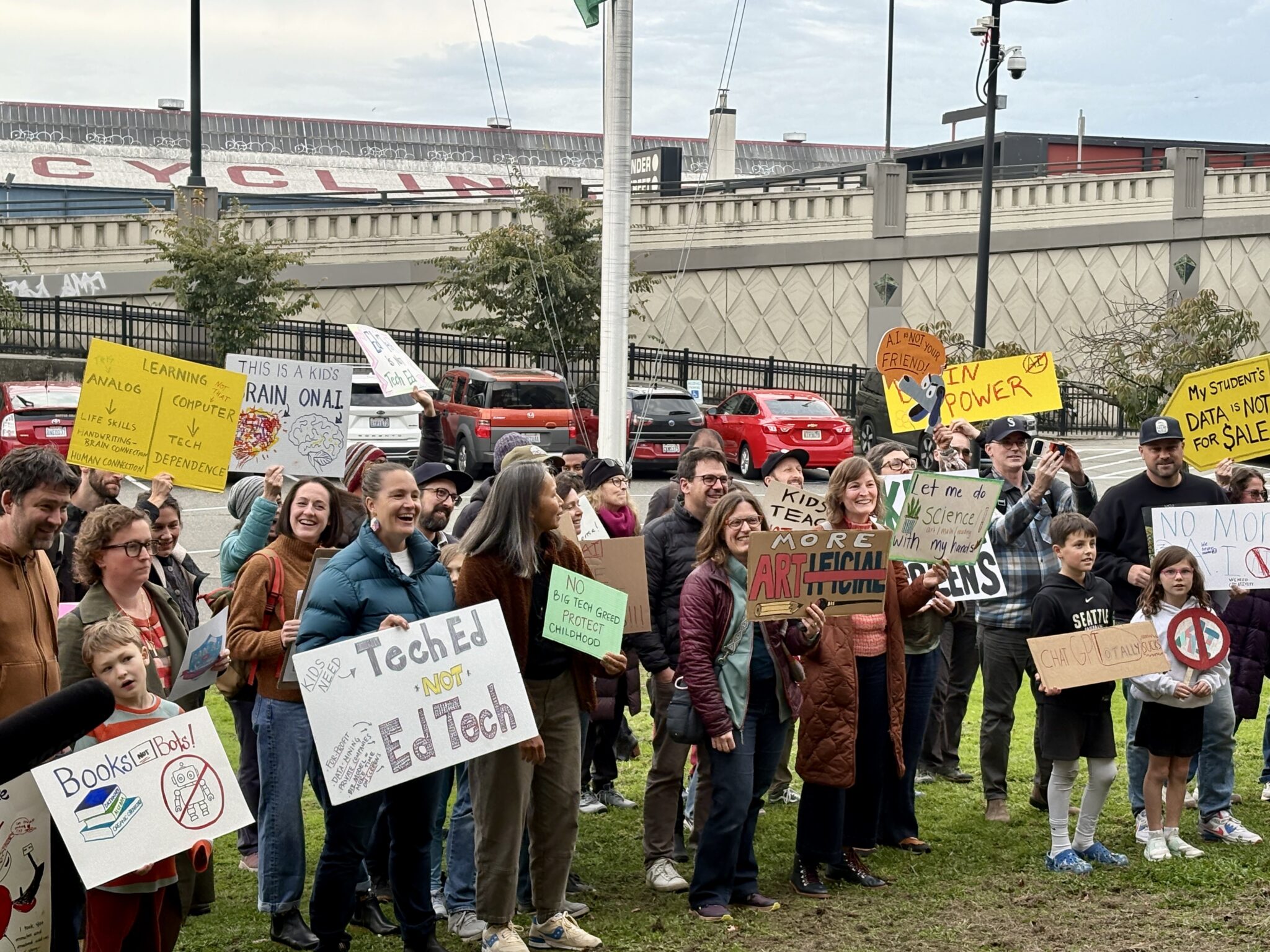
Families and advocates rallied outside the John Stanford Center for Educational Excellence this week to urge district leaders to adopt better policies around educational technology and artificial intelligence in the classroom. Seattle Families for Intentional Tech (SFIT) hosted the Nov. 4 rally ahead of a special meeting of the Seattle School Board focused on SPS educational technology.
The rally was attended by Emily Cherkin, a former teacher, and now a leading national advocate for education technology reform. Cherkin, who spoke to parents gathered, has written a book on tech intentionality and testified before Congress earlier this year on the impacts of tech in education on children.
Parents at the rally said the district has begun pushing back on students opting out of school-issued devices.
Corinne Reschenthaler is an SPS parent who said she decided to opt out of the school-issued device this year. When she reached out to her school’s principal to put a plan in place, Reschenthaler said she was told the district would not allow the opt out.
Reschenthaler said she likes her children’s school.
“I want to make Seattle Public Schools work for my family,” she said. However, Reschenthaler believes SPS is going too slowly on technology reform. That, along with the news that she could not opt her student out of the district’s education technology, has her questioning whether SPS is best for her kids.
“I worry it won’t work,” Reschenthaler said.
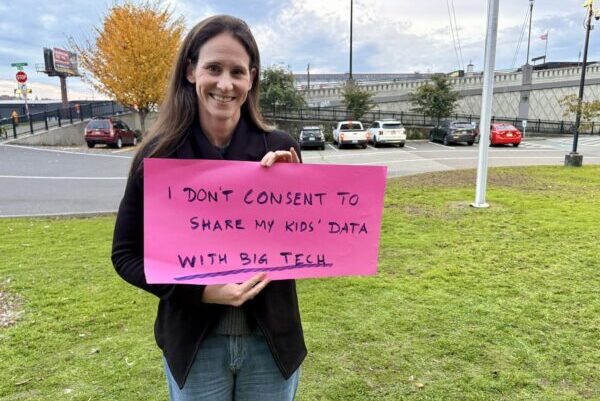
An SPS parent makes her message clear (Photo by Elizabeth Hunter)
Rallying parents also expressed fear and frustration that their children—some as young as second grade—are learning about artificial intelligence at school. If tech reforms are rolling out too slowly, concerned parents said, AI was rolling out too quickly.
“I would like for technology to be driven by educators, rather than business deals,” said Thomas Coffee, an SPS parent and former Google employee.
At the Special Board Meeting following the rally, SPS announced new recommendations and restrictions for school technology.
“We are changing and adjusting our prior guidance about technology usage,” said Mike Starosky, SPS assistant superintendent for academics. By January 2027, SPS will no longer assign one device to each child (1:1) for grades K–5.
“Students will still have access to computers but will not be issued a computer,” Starosky said.
SPS leaders also recommended a 1-hour screen-time limit for grades 3–5 and said it will block YouTube from students. Kids’ access to the platform on all school devices has frustrated parents and teachers. SPS will also prohibit Minecraft and Google Gemini on student devices.
Regarding AI use in the classroom, SPS leaders were less keen on reform, emphasizing “AI literacy” and safety instead of a ban.
“We cannot pretend that this technology doesn’t exist,” said Superintendent Ben Shuldiner.
Conversely, School Board Director Evan Briggs expressed skepticism about the district’s focus on AI literacy.
“I am still struggling with why we have bought into this,” Briggs said. “It’s unproven, it’s untested…It’s new, it’s unregulated.”
Instead of teaching kids how to use AI, Briggs said, “I think a lot of families would love to see them protected from it.
“We should absolutely talk to them about the scariness of AI,” the director added, “but we don’t need to have those tools in the classroom while we’re doing it.”