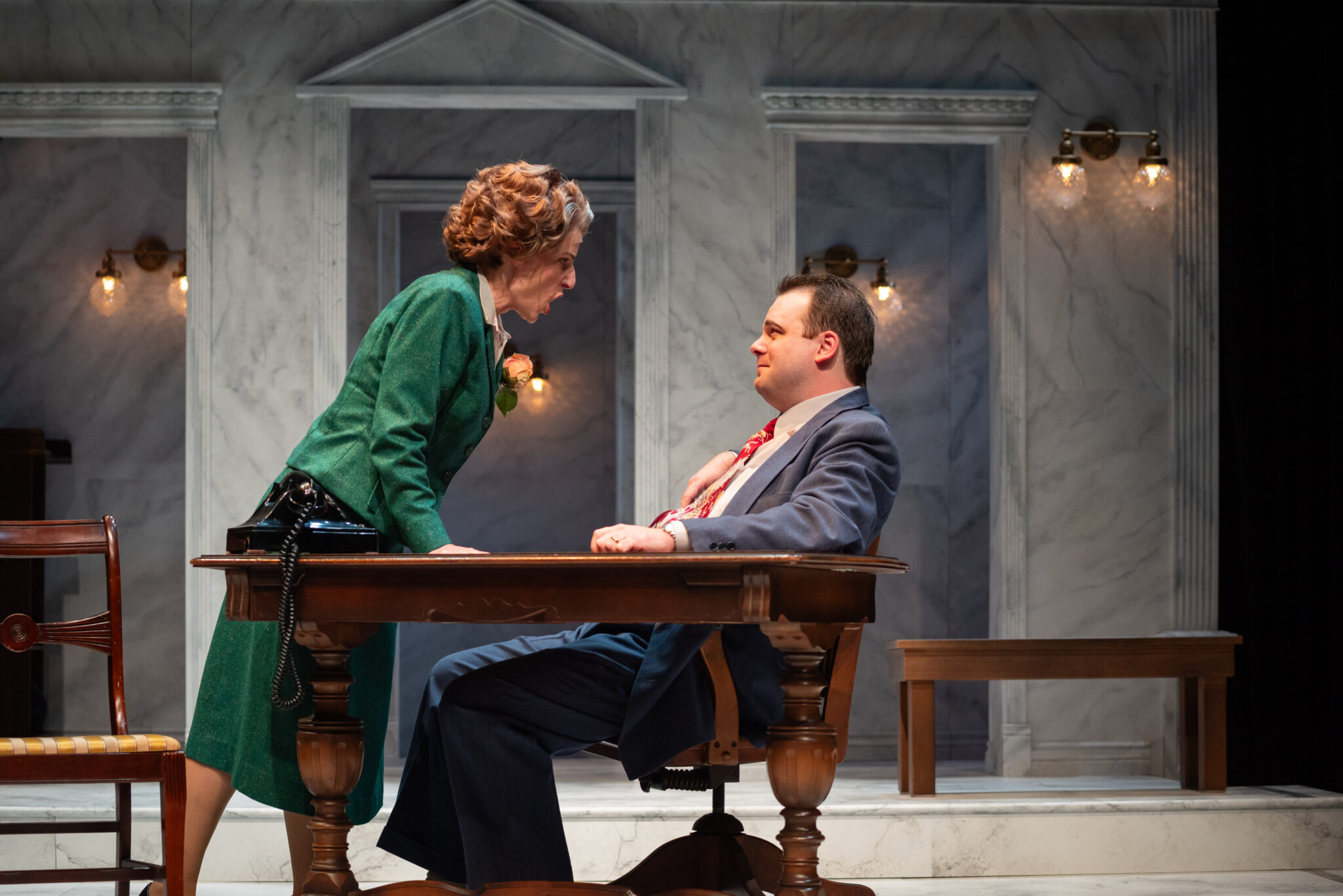
Bottom line: There wasn’t a single young person in the audience when I reviewed Joe DiPietro’s play Conscience, now playing at Taproot Theatre. There should have been. The theatre should be packed with high schoolers, especially those who have completed 10th or 11th grade U.S. history courses where the Cold War and McCarthyism are taught. Why? Because this is a play about Sen. Margaret Chase Smith, the one person in Congress who stood up to Joseph McCarthy even though they were in the same party. The one person who said no to fanaticism and to remaining silent when Americans were being accused by McCarthy, without a shred of evidence, of being communists.
And because the show begs the questions, which young adults-soon-to-be-voters should be asking: Who in Congress is standing up to the fanaticism, racism, misogyny and bigotry today? When, where and to whom should I speak up rather than remain silent—in my school, in my friendships, in my life?
The Story
Conscience that takes audiences back to 1950, when fear of communism was sweeping Washington and Wisconsin Sen. Joseph McCarthy was gaining national attention with explosive accusations that communists had infiltrated the federal government.
At the center of the four-character play is someone who, sadly, a lot of people today have never heard of: Margaret Chase Smith, the Maine Republican who became the first woman to serve in both the U.S. House and Senate.
Smith and McCarthy weren’t always enemies. She initially took his concerns about communist influence in government seriously and considered him a friend. But as McCarthy’s accusations mounted, Smith began asking for evidence. When he failed to provide it, she faced a question that drives DiPietro’s play: What do you do when someone on your own side crosses a line, and speaking up could cost you?
Why take your teen
It’s a question that could have been pulled from today’s headlines, and one good reason to invite your teen to join you at Taproot Theatre’s production of Conscience. The company’s simple yet stellar production offers ample fodder for conversation on, well, exercising your conscience.
The answer for Smith came on June 1, 1950.
That’s when she walked onto the Senate floor and delivered what became known as her “Declaration of Conscience.” She never mentioned McCarthy by name. No need. Smith condemned a political climate driven by fear, accusations and character assassination and urged fellow Republicans not to seek political advantage through what she called the “Four Horsemen of Calumny—Fear, Ignorance, Bigotry, and Smear.”
Six Republican senators joined her. McCarthy didn’t take it well. He mocked Smith and her six colleagues as “Snow White and the Six Dwarfs,” and Smith paid a political price for challenging him. But she continued opposing McCarthy and, four years later, voted with the Senate majority to formally condemn him.
Parallels a young adult will get
For younger viewers, the most interesting thing about Conscience may not be McCarthyism itself but echoes of it in school hallways and communities.
Strip away the Senate chamber, communism and 1950s Washington, and the dilemma at the center of the play is pretty familiar: What happens when everybody knows something isn’t right but nobody wants to be the person who says it?
Smith watches colleagues calculate the consequences of challenging a powerful member of their own party. That dynamic doesn’t require a civics class to understand. Teenagers encounter versions of it in classrooms, friend groups, sports teams and group chats: Who speaks up? Who goes along? Who stays silent? And what does silence cost?
That also gives parents and teens plenty to talk about afterward. Is courage still courage if there is nothing to lose? When does loyalty become complicity? Is publicly challenging your own group harder than challenging an opponent? And does one person’s decision to speak actually change anything?
Smith’s story complicates the last question. Her speech did not stop McCarthy. His influence continued for years. But she spoke anyway.
Then and now
It’s difficult to stage Conscience in 2026 without contemporary American politics hovering somewhere outside the theater.
The historical parallels worth considering aren’t simply whether Joseph McCarthy resembles President Donald Trump, members of the current administration or anyone in Congress. The more interesting questions involve political behavior: What happens when accusations travel faster than evidence? What happens when elected officials fear the consequences of challenging a powerful figure within their own party? What happens to institutions when personal loyalty begins competing with independent judgment?
There are important differences, too. McCarthy was a senator using congressional investigations and publicity to build influence; Trump is a president exercising executive authority at a speed and breadth heretofore never experienced. Treating the two as interchangeable would obscure both the history and the present.
There is, however, a striking historical thread connecting their worlds. Roy Cohn, who became chief counsel to McCarthy’s Senate investigations, later became Trump’s attorney and mentor in New York. Cohn isn’t a character in Conscience, but knowing that history adds another layer to a play about political power, accusation and the people who decide whether to challenge it. I’d recommend sharing this tidbit with your younger co-viewer.
Whether this production wants audiences to make that connection is another question—and one worth watching for.
For parents considering bringing a teenager, I’d pay attention not simply to whether Conscience feels “relevant,” but whether it gives young audiences something harder to come by: a chance to watch someone decide, in real time, what her conscience requires of her when doing nothing would be considerably easier.
Trigger warning
There are difficult and offensive words and action in this show, including disparaging remarks about people who are Jewish, homosexuals and/or female. Such language was, sadly, common at the moment in history where this story takes place. Part of the strength of the script is how the character of Sen. Smith addresses each as she follows her conscience. Warn your teen before you attend.
Outstanding cast
A show with just one set and four actors is a big ask for young people. The performances in the Taproot production make it easier, with big play and wonderful era-specific mannerisms. Jonathan Swindle is perfectly unlikeable in the role of McCarthy—a bombastic, fanny-patting oaf. Swindle makes us hate him, even while we’re mesmerized. Alyssa Keene, in the role of Sen. Smith, is electrifying and incredibly believable. All on stage pull their weight to give this show its weight.
If you go:
- What: Conscience at Taproot Theatre, 204 N 85th St, Seattle
- When: Through Oct. 17; Closed Captioned: Wednesday, October 14 at 2 p.m.
- Age recommendation: OK for ages 14 and up, but really, I’d hold it for a date and post-show discussion with your 15 to 18-year-old.
- Cost: $28-$77; Pay What You Can on Wednesday, September 23 at 7:30 p.m.
- Tickets: Purchase online