Being a parent is nonstop hard work, making it challenging to stay on top of news that impacts families in Washington state. Below are highlights and commentary on key policy updates and headlines from the week of Dec. 22-28.
Proof that you’re spending more
I was not surprised last week when the U.S. Commerce Department announced that spending in the U.S. increased markedly (4.3%) in the third quarter of 2025. (The department was a little late releasing the third quarter report due to that month-plus-long government shutdown.)
I doubt any parent in need of milk for their kids is surprised either. GDP includes domestically produced food, with values adjusted for inflation. That includes milk. If you have any doubt that milk prices have climbed in recent years, check out reporting from The Seattle Times, which found that, in Seattle, the price of a gallon of whole milk hit $4.99 in May. In May 2020, that same gallon cost $3.32.
If you’ve already planted a garden to save on food and are now thinking about a cow … the answer is YES, you can keep a cow in Seattle. But only if you have a lot that’s at least 20,000 square feet (about 0.46 acres).
Must-Read: Do you love them the same?
It’s a second-time parent’s nagging question: Will I love my new baby as much as my first? Or the new baby more than my first? In other words, will I have a favorite? It’s certainly possible. According to an article posted by The New York Times last week, about two-thirds of parents had a preferred child. Parents often have favorites. So, if you’ve got more than one child, there’s a chance you feel it, even if you can’t admit it.
It’s also true that favoring one child over another, even subtly, can have negative consequences for that other child. Research shows the non-favored child may experience poorer mental health, less academic success than siblings, and have difficulty with relationships within a family.
What’s a parent to do? Talking about this taboo subject is a good place to start, experts say. Next, avoid showing favoritism if possible. But if you do give more time, attention, and/or physical stuff to one child, be very intentional about explaining the discrepancy to your other kids.
This read, and the research and expert comment it offers, sure made me sit down and think. And call both my kids and talk to each for exactly 23 minutes.
Gov. Ferguson & taxing the high-earners
He let the wealth tax train roll by last year to the consternation of many Democratic state lawmakers, but last week, Gov. Bob Ferguson boarded a different rail: He wants lawmakers to pass a millionaire’s tax during the upcoming legislative session. That session kicks off on Jan. 12.
What’s the difference? A wealth tax is a broad umbrella term. It generally means a tax on a person’s net worth (assets like stocks, bonds, real estate, etc.), often assessed annually. Washington has not enacted a true wealth tax, and such proposals raise constitutional questions under the state’s ban on income taxes.
Millionaire’s tax usually refers to a much narrower policy: a tax aimed at very high-income or very high-asset households, often structured as a capital gains tax surcharge or similar mechanism to avoid calling it a general income tax. In this case, Ferguson wants to impose a tax on incomes exceeding $1 million.
The governor made that announcement after unveiling his supplemental operating budget proposal that amends the 2025–27 biennial state budget. The proposal includes another $800 million in cuts. While a millionaire’s tax would not likely kick in until the next biennial budget, Ferguson said it would balance the scales for non-millionaire families and state residents who currently pay more than their “fair share” of taxes.
Expect a court challenge, and likely a ballot item, if the tax is approved in 2026. Read the full story at KUOW.
Take action: What do you think about further taxing those who earn more than $1 million annually? Make your voice heard: Contact members of the Washington State House of Representatives and Washington State Senate. Contact Gov. Bob Ferguson’s office.
WA superintendent pans governor’s ‘austerity approach’
Washington’s K-12 schools superintendent, Chris Reykdal, and Gov. Ferguson are in alignment on the idea of a tax on high-income earners. But Reykdal is not at all happy about the governor’s proposed 2025-27 supplemental budget. Last week, he criticized the governor’s “austerity approach,” which he says will harm education and other public services. That’s because Ferguson’s new proposal does include new taxes but instead reaches balance by cutting or shifting existing funds.
“This budget, like others before it, closes the holes in Washington’s budget on the backs of public services,” Reykdal said in a statement last week. Not only are our investments below the national average, we are also going in the wrong direction.”
He wants the state to “double down” on its investments in education, rather than cutting when school districts are already in financial distress.
“Washington state is home to some of the highest earners in the country,” Reykdal said. “The recent tax cuts by the Trump Administration are going to cut taxes for millionaires and billionaires by at least $10 billion per year in our state alone. So, this year, and the year after that, I will be proposing transformative ways to fully fund our K–12 schools, and I will be including tax considerations in my proposals. We have the second-most regressive tax structure in the nation, and we are overdue for a real shift toward progressive revenue.”
As for shifting existing money around, as is done in Ferguson’s new budget proposal, Reykdal says you just can’t rob Peter to pay Paul:
“This is a false narrative, he said. “The idea that we either need to cut from one direct service that our communities rely on in order to fund another public service is wrong.” Check out coverage on this issue by The Seattle Times.
Take action: Have a thought about cutting $800 million from already-strapped state-funded schools and other programs? Make your voice heard: Contact members of the Washington State House of Representatives and Washington State Senate. Contact Gov. Bob Ferguson’s office.
Seattle Children’s nurses vote to authorize strike
Seattle Children’s Hospital has not experienced a nurses’ strike in its 118-year history. That could change in 2026.
While the hospital’s 2,100 nurses are not yet on picket lines, they voted last week to authorize a strike if their negotiating team from the Washington State Nurses Association (WSNA) does not reach an agreement with the hospital. The two sides have been at the bargaining table for months but have yet to settle nurses’ requests regarding meal and rest breaks, sick leave, pay, and more, according to the WSNA.
Nurses recently ran a full-page ad in The Seattle Times stating: “We don’t want a labor dispute. We don’t want to strike. We want a fair contract that protects nurses’ legal rights, ensures patient safety, compensates nurses injured by workplace violence, and maintains the union strength that has made this institution exceptional.”
The hospital, which announced in September plans to lay off 150 staff, said on its nursing update webpage that it is trying to balance nurse requests and patient needs while experiencing continued financial strain from expected federal and state funding cuts. Seattle Children’s estimates that it will lose tens of millions of dollars in 2026 and possibly hundreds of millions over the next five years.
“Total compensation for nurses must be balanced with preserving Seattle Children’s ability to care for all children in the region, regardless of their families’ ability to pay,” the hospital wrote.
Limiting immigration enforcement at schools
In the Trump administration’s continued war on immigrants, Washington has been hit hard. As many as 2,000 people have been picked up by U.S. Immigration and Customs Enforcement (ICE) agents in the state since President Donald Trump entered office in January. Sen. Drew Hansen, D-Bainbridge Island, hopes to make it a little harder for them by keeping immigration officials out of schools (including early learning facilities, schools, colleges, and universities) unless they have a court-approved warrant, order, or subpoena.
It’s not a new idea. The bill would codify and build on the state attorney general’s office’s existing policies on how schools and other public facilities should handle ICE agents. The difference? Those policies cover public areas. Hansen’s bill would bar agents without court orders from entering nonpublic areas, including those of child care providers and private health care facilities.
Take action: Have an opinion about keeping immigration out of places where kids learn and are cared for? Make your voice heard: Contact members of the Washington State House of Representatives and Washington State Senate. Contact Gov. Bob Ferguson’s office.
The Fun (and a Little Scary) Read: Rats in potties
Ok, I’ll just admit for the record here, that a rat or snake rising up from the toilet bowl and biting my bottom was a major fear of mine as a child. It didn’t help that my family thought this was hilarious and fed my paranoia liberally. My whole family did, including one Halloween night when my dad put a rubber rat in the potty, and I had nightmares for the whole week.
“Oh, honey, we’re just kidding you. It’s an old wives’ tale,” my mom would laugh when I dragged her to the bathroom in the middle of the night.
Well, I sit here today, vindicated!
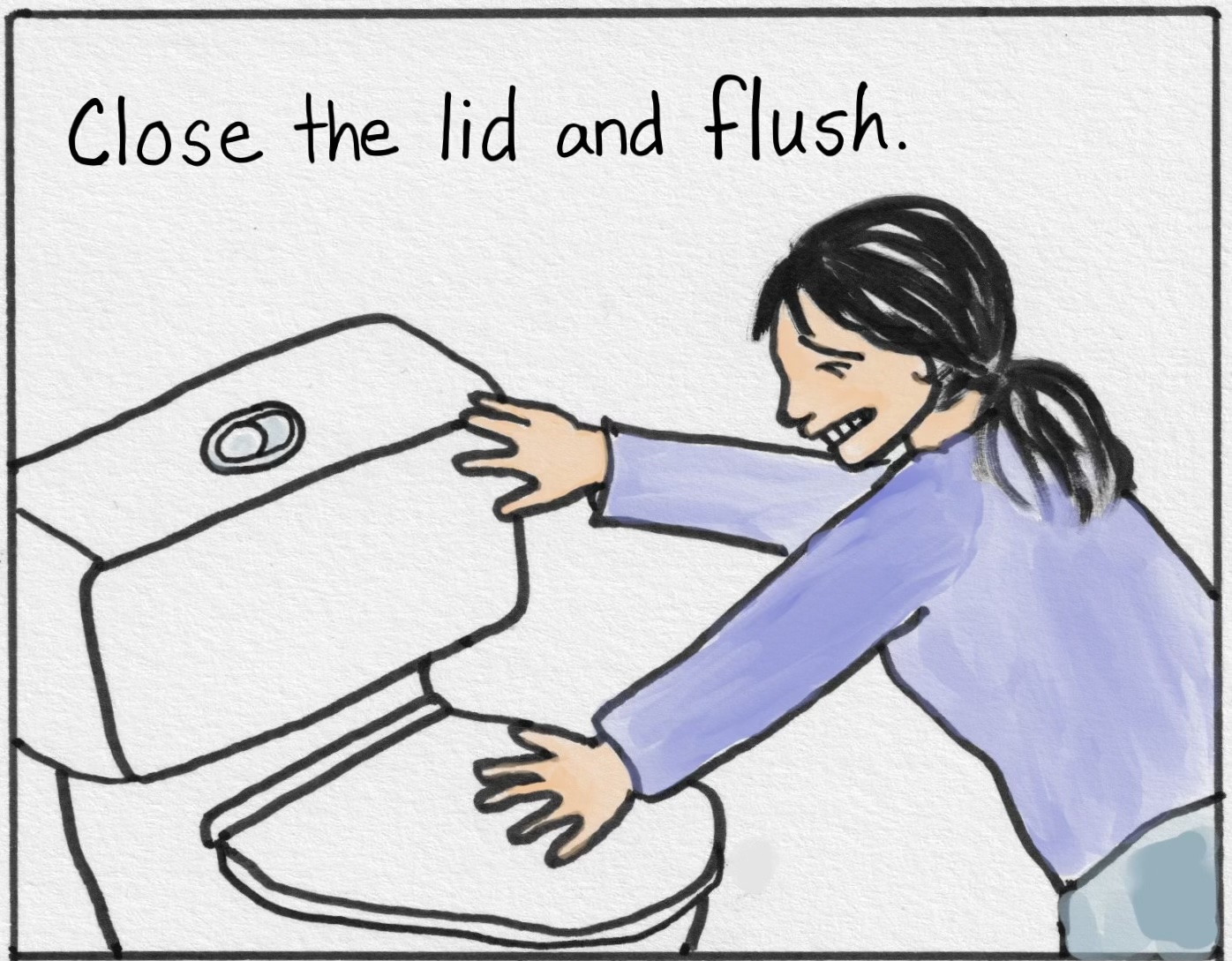
Earlier this month, Public Health—Seattle & King County posted a warning on Facebook: “Heavy rain and floodwaters may sweep rodents into the sewer systems. If a rat visits your toilet, take a deep breath and follow these tips.”
The steps were outlined in an easy-to-understand cartoon strip:
- Stay calm
- Slam that lid down.
- Run to the kitchen, grab the dish soap, open the lid quickly, squeeze some in, and slam that lid down again.
- FLUSH.
KUOW took these tips and found a real person who found a real rat in her toilet. A good read!