Being a parent is nonstop hard work, which makes it hard to stay on top of local news that affects families. This Hits Home is your weekly round-up of news, commentary, and, occasionally, opinion from our writers here at Seattle’s Child and news sources like The Seattle Times, Washington State Standard, KUOW, Cascade PBS and others. Want to have a say? Look for the “Take action” prompts. Here’s the update for the week of Sept. Oct. 5-11.
Two Seattle high schools will have weapons detectors
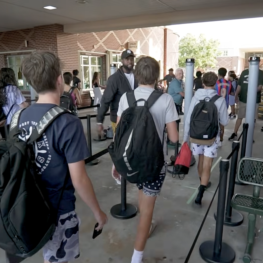
Students at Rainier Beach and Nathan Hale high schools will be the first in Seattle Public Schools to participate in a pilot program using weapons detectors. The Seattle School Board unanimously supported the plan Wednesday, Oct. 7, after both schools requested the equipment. Nathan Hale hopes to begin its pilot in December, with students helping assess the detectors’ accuracy and whether they slow down the morning rush into school. The district has used similar equipment at graduations and sporting events, but not for daily school entry. Costs and other details are still being worked out. Superintendent Ben Shuldiner says the district won’t introduce the equipment at other schools unless they request it. Read more at KUOW
Looks like Seattle schools bus drivers won’t strike
If you rely on Seattle Public Schools buses, you can breathe easy. Teamsters Local 174 and Zūm Transportation reached a tentative contract agreement with the district last week, heading off a possible drivers’ strike. The deal covers 300 drivers who provide about 80% of the district’s yellow school bus transportation. Retirement benefits were a sticking point, but neither side has released the agreement’s terms. Drivers vote Oct. 10 on whether to approve the tentative agreement. Until then, the contract isn’t final. Learn more from KOMO.
Hey, working teens! Washington minimum wage is going up again
Washington’s minimum wage will increase by 60 cents next year, reaching $17.73 an hour on Jan. 1. For someone working 40 hours a week at minimum wage, that’s an additional $24 before taxes. Workers ages 14 and 15 can be paid 85% of the adult rate, or $15.07 an hour in 2027. State law requires the increase to account for inflation. Seattle’s minimum wage is higher and will rise to $22.14 an hour next year. Several other cities and counties, including SeaTac, Tukwila and Renton, also set their own minimum wages above the state rate. Read more at Washington State Standard.
Ferguson wants all day no phones—not even at lunch
No checking phones between classes. No scrolling at lunch. No smartwatches buzzing during lessons. That’s what Gov. Bob Ferguson has in mind for Washington public schools beginning in September 2027. His proposed Phone-Free Schools Act would require students to store personal phones and other smart devices during the entire school day. Schools could choose how to handle storage, and exceptions would be available for certain medical needs and students with qualifying education plans.
Several major King County school districts, including Seattle, Bellevue, Lake Washington, Renton and Kent, restrict cellphone use during classes but do not impose an all-day ban on high school students. Gov. Bob Ferguson’s proposal would set a stricter statewide standard, prohibiting personal device use during lunch, between classes, and during instruction.
Students wouldn’t face suspension for violating the rules during at least the first year. Ferguson plans to introduce the legislation ahead of the January session. If lawmakers approve it, the rules would be stricter than Seattle Public Schools’ current policy, which allows high school students to use phones during lunch and between classes. Read more at KOMO News.
Parent and others say affordability is central in Nov. 3 election
“I’m super concerned about the affordability crisis that Americans across the country are dealing with,” Seattle parent and education advocate Erin MacDougall told Cascade PBS recently. “I think here in Washington we have a particularly high cost of living and a very regressive tax system, and people are feeling really hard times, just to access groceries and health care costs.” MacDougall is not alone in believing the country and state affordability crisis is the biggest issue for voters in the Nov. 3 elections. Check out the coverage.
DON’T MISS: For a broader discussion on what is motivating voters today, listen to the recent live recording of the NPR Politics podcast in Seattle.
How will Washingtonians vote transgender sports initiative? Data conflicts
How will Washingtonians vote on Initiative 638, which would prohibit transgender girls from participating on girls’ school sports teams? A poll commissioned by the group supporting the initiative suggested 56% support in August.
But that poll’s data and methodology have not been released publicly, making the findings difficult to evaluate. And in a report this week, KUOW spoke with a researcher whose polling suggested support for the measure declined when respondents learned more about its sex-verification requirements. Under I-638, students seeking to participate on girls’ teams could be required to undergo a physical examination, chromosome test or hormone test to establish their gender. Trans girls would be banned from girls’ sports. Voters will decide the measure on November 3. Read more at KUOW.
Seattle University won’t ask diversity question on applications
Students applying to Seattle University this year won’t be asked to write about a personal experience involving equity, inclusion or belonging. The university has dropped the optional essay question from its undergraduate admissions application. A university spokesperson confirmed the change to KUOW but didn’t explain why the university removed the question. Seattle University isn’t alone: The University of Washington eliminated a diversity-related admissions prompt last year. Colleges nationwide have been reconsidering admissions practices following the U.S. Supreme Court’s 2023 ruling against race-conscious admissions. Read more at KUOW.
Rainier Beach safe-passage program gets funding through June
The people helping Rainier Beach students get to and from school safely will remain on the job through June 2027. Seattle has committed $350,000 to continue Community Passageways’ neighborhood safety work, including routes near Rainier Beach High School and South Shore PK-8. The funding follows months of concern over cuts to the organization’s violence-prevention programs. At a Sept. 30 community meeting, parents also pressed Seattle Public Schools officials about emergency procedures, including what happens when students are outside during a lockdown and where families should go to reunite with their children. District officials said schools must have reunification plans. Read more at South Seattle Emerald.
Consent: Cornell rape allegations have kids and parents talking
What are we teaching our sons and daughters about sexual consent before they leave home for college? Allegations involving seven fraternity members at Cornell University have brought that question into sharp focus. Again. The Cornell story is the most recent in a long string of cases over the years about non-consensual sex on college campuses. In the Cornell case, a former student alleges in a civil lawsuit that she was drugged and sexually assaulted at a fraternity house in 2024. The university investigated and disciplined students, but prosecutors initially declined to bring criminal charges. New York Attorney General Letitia James has since been appointed to oversee a renewed investigation. Criminal court has not established the allegations. The case raises difficult questions for parents about consent, intoxication, sexual pressure, and what young people should do when someone cannot freely agree to sexual activity.
The story has a lot of parents sitting down with teens to deepen the conversation about the critical importance of understanding, giving and hearing sexual consent. Read more at The New York Times.
(Photo courtesy Elizabeth Hunter)
Why I won’t track my kids | Op-Ed
By Elizabeth Hunter
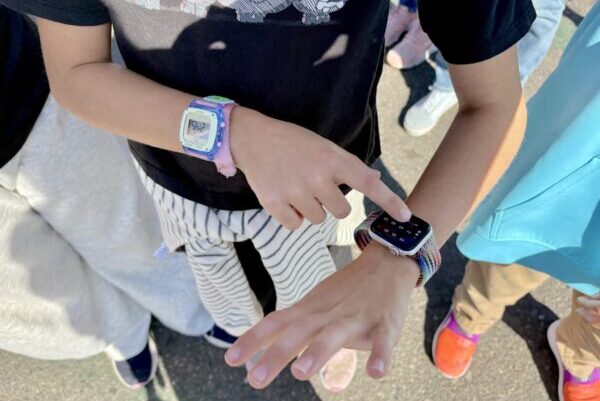
In a few short years, it has become commonplace for parents to use wearable GPS technology to track their children, sometimes well into adulthood. Smartphones, smartwatches, and AirTags are just a few products in the surveillance arsenal used by, according to a recent survey, more than 80% of American parents.
I won’t track my children, and here’s why: I do not want to surveil my children; I want to trust them. And I trust them a lot more than I trust Big Tech.
Trust develops when an act of belief is rewarded. When I tell my children to be home from the park at 5 p.m., I assume they will go to the park, play, and come home by 5 p.m. Every time they come home on time, my trust in them grows, and I feel comfortable letting them range further.
Developing trust requires, among other things, a willingness to take risks. In fact, James Gruenig, a professor emeritus at the University of Maryland who has studied the mechanisms of trust, has emphasized that “openness to risk is the important element of trust.” Tracking devices dilute the risk and sacrifice trust.
In the years since I started letting my children navigate their world independently, they have rarely broken my trust. I cannot say the same for the big tech companies behind these tracking devices.
Child tracking devices are supercharged data harvesters. Doctor’s appointments, tutoring classes, therapy sessions—any place your child ever visits—are logged, analyzed, and then likely sold.
Watchdog organizations like Consumer Reports have found, disturbingly, that most tracking devices are tracking more than your child’s location. These tracking companies collect and store messages, voice notes, and detailed movement patterns. Consumer Reports also gave most tracking devices “mixed reviews” on privacy and security.
In a now-viral story published on August 6, WIRED exposed how easily bad actors can hijack a cheap tracking watch and surreptitiously track a child’s movements, record sound, and snap photos. Cheap convenience comes at a cost.
The cost I am more concerned with day to day isn’t creepy foreign hackers; it’s the depreciation of privacy. Wearable technology, GPS, and apps like “FindMy” are conditioning our youth to think broadcasting their location—to friends, partners, Big Tech, ex-boyfriends—is no big deal. It is a big deal. I don’t want my children to grow up believing anyone is entitled to know their location at all times, especially without explicit consent.
That’s why, as parents, we build trust. There is risk in allowing them out into the world on their own, but that risk comes with lifelong rewards: trust, freedom, privacy, agency, and self-confidence, to name a few.
For parents like me who are wary of surveillance but want to communicate with kids on the go, may I suggest a flip phone? This summer, as my daughter and her friends ventured beyond our neighborhood, we lent her a Jitterbug flip phone. No GPS, no Internet, no social media, just a pay phone in the pocket. In the end, they only used it once. The rest of the time, she and her friends just… figured it out.
**This article is an opinion piece (Op-Ed) and reflects the views of the author. We encourage thoughtful debate and welcome a range of viewpoints. Readers who wish to submit their own Op-Ed for consideration may do so by emailing [email protected].