Lawmakers in Olympia are up against their first deadline this week — Weds, Feb. 4 is the last day for bills to be voted out of committees in their house of origin if they have no fiscal impact on the state.
One bill, House Bill 2112, is among those. While it won’t cost the state anything, not passing it would be a big loss for Washington families.
The proposal, sponsored by Representative Mari Leavitt (D-University Place) and currently awaiting a vote in the House Consumer Protection & Business Committee, would require websites to verify a user is age 18 or older if one-third of the site content is sexual material harmful to minors. And it’s supported across the aisle, by Democrats and Republicans.
The impacts of exposure
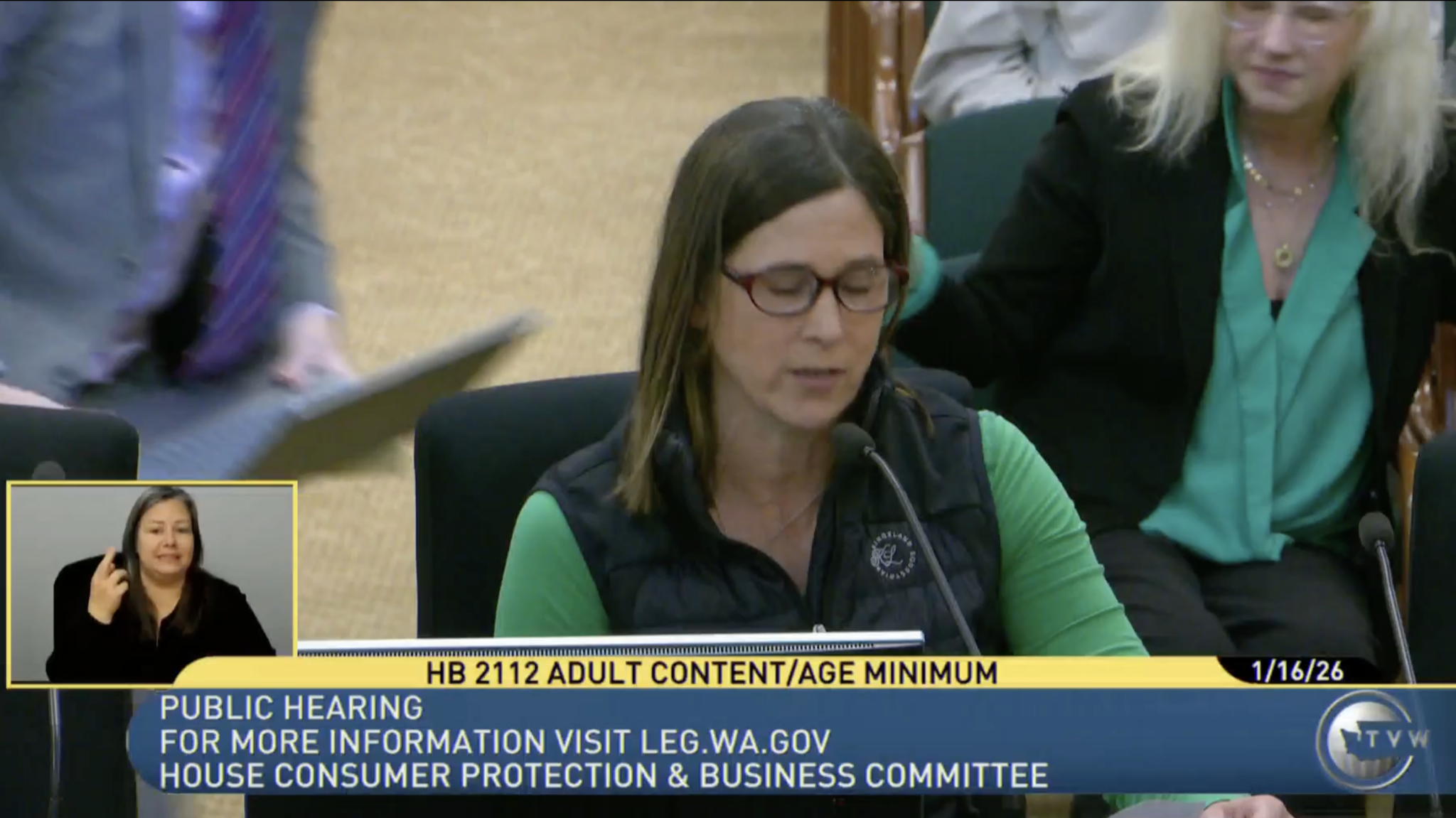
During a public hearing earlier this month, it was easy to see why House Bill 2112 has broad support, with the first testimony from Heather Grassman, a Sammaish mother of twins whose family epitomizes the worst outcome of kids’ access to internet porn and other “dark web” content.
“On Jan. 15, 2025, at 8:30 a.m., my beloved son Reilly, 17 years old…ended his life after experiencing a deep depression directly related to the time he spent in the dark places of the internet that we could not protect him from,” Grassman told lawmakers. “After he died, we found messages on his cell phone in his own words about how it contributed to his depression.”
Grassman said that the Bill’s passage is “essential” because parents are “out-matched” by the companies generating sexually explicit content.
“My tech-savvy husband and I tried to keep our boys safe online [with] firewalls, external router protection, parental controls, and monitoring their screen time,” she said. “That same tech provides all the information kids need if they want to work around or bypass these barriers. It just doesn’t make sense. We have laws to protect our kids from sex and violence in movies and print, and yet they have unlimited access to these things and more in a device that they can carry in their pocket.”
If HB 2112 makes it out of committee and is passed into law by the legislature this year, Washington would be one of 26 states with internet content age-verification laws.
In other testimony, Rachel Robison described her first exposure to pornography and her subsequent online addiction to explicit content by age 13. That exposure led to attempted suicide, abusive relationships, and the need for ongoing trauma therapy, Robison said. Robinson has testified and told her story across the country in an effort to get age-verification laws passed.
“I was 7 years old [when]I was exposed to porn by another 7-year-old on a play date,” she told those gathered at a National Center on Sexual Exploitation (NCOSE) briefing on a similar proposal in Texas. “My sweet world was opened to a world of brutality and sexual violence.”
She told Washington lawmakers: “If the website had required actual age verification, all these things would have been prevented.”
Privacy objections
Although TechNet, the technology industry trade association, does not broadly support age verification, TechNet is not opposing HB 2112.
Opposition to the bill, however, came from surprising quarters: the ACLU, the Northwest Progressive Institute, and LGBTQ advocates spoke out against it. Such groups cited privacy as a major concern.
The Free Speech Coalition and representatives from the adult industry also opposed it, some stressing that passage of such laws would dramatically reduce traffic to compliant sites, meaning users (adults and children) would simply move to non-compliant sites hosted in other countries.
If approved by the legislature and signed by Gov. Bob Ferguson, HB 2112 would create the “Keep Our Children Safe Act,” allowing Washington’s Attorney General to sue explicit internet content companies that fail to enforce age-verification protocols. If found guilty, companies would be fined $10,000 per day until verification is instituted. Companies would also be fined $10,000 per instance for failing to delete verification-identifying information after an age check. Companies would be fined up to $250,000 if one or more minors accessed material restricted under the act.
Kids over companies?
Parents at the committee hearing bought none of those opposition perspectives. Tech companies must be held accountable for protecting kids from explicit content, they say, and it’s the state’s job to ensure they do.
“We place the responsibility on parents, most of whom do not have the tools to accomplish this, no matter how hard they try,” Grassman said. “We can’t expect our children to understand the potential harm, something that has been clearly established, for which there is no debate. Our story is real-life proof of that.”
As of Jan. 30, the bill remains in committee, with no executive session scheduled, during which it could be voted out of committee. Click below to watch video testimony on the bill from its Jan. 16 hearing.
Take action: Do you have an opinion on HB 2112? No matter how you feel, your voice matters. Contact members of the House Consumer Protection & Business Committee and your Washington State Senate representative.
More news from the Washington Legislature 2026:
Follow the weekly This Hits Home: News that impacts Washington families column posting at seattleschild.com every Sunday at 7:30 p.m. PST.