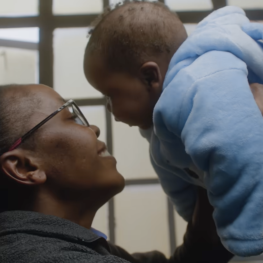
In her 2016 film Screenagers, Executive Producer Delaney Ruston’s primary concern was how smartphones affected kids, starting with her own daughter, Tessa. The film’ s success inspired the nationwide Away for the Day campaign for phone-free classrooms and has fueled two more films in the last 11 years. In the most recent installment, Screenagers: Generation AI, Ruston’s daughter is a young adult.
Which means it’s now Tessa’s turn to be concerned: As a teacher in training, she’s worried about how Artificial Intelligence (AI) is affecting kids’ academic and social lives.
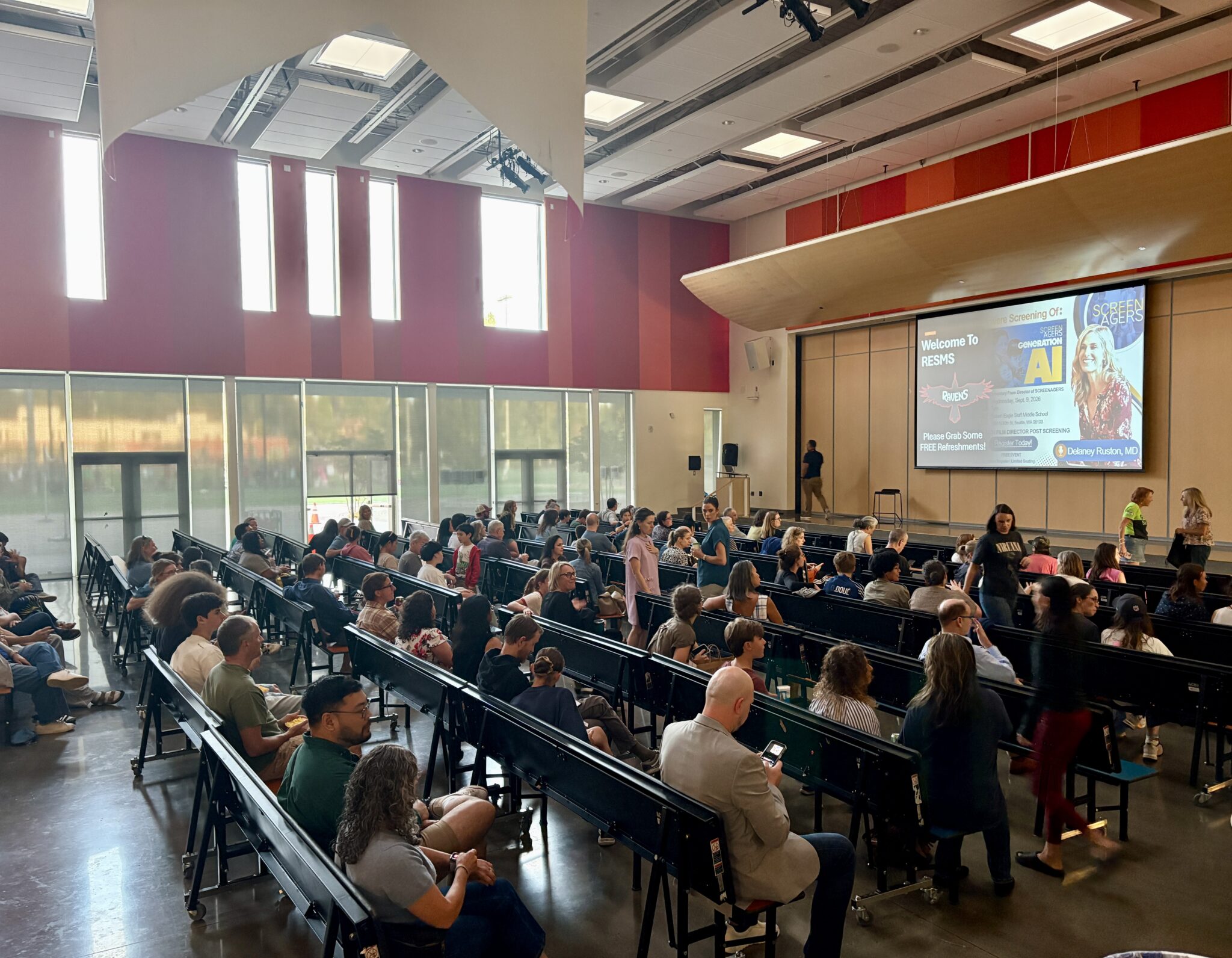
Screenagers Generation AI premiered to a packed cafetorium at Robert Eagle Staff Middle School in Seattle earlier this month, the same day an AI researcher publicly resigned from the AI company Anthropic, warning that AI could harm humanity if it continues to evolve unregulated. In the last two weeks, several other AI pioneers and industry watchdogs like The New York Times’ Ezra Klein have followed suit with truly scary reporting on the apocalyptic possibilities of unleashed AI. According to Ruston, these voices are echoing what young people already feel.
Power through community viewing
“Tessa loves kids, and her age group of young adults in their early to mid-twenties are very upset about AI,” said Ruston. Though she never intended to take on the subject of AI, Ruston’s previous work is proof positive of the powerful community film screenings to create social change.
Lisa Tabb, Screenagers: Generation AI co-executive producer, explained: “All of our films are shown in community settings. This way we can work together, create rules and boundaries in our own homes, and advocate for the policies we want to see at our kids’ schools. Collective action is how we’ll solve this and make life as parents so much easier.”
They began filming Screenagers: Generation AI in January 2026.
“AI is just an incredibly mammoth industry,” said Ruston. “But knowing that we had to work quickly—because AI changes quickly—helped me get over my fears.”
Filmgoers at this month’s premiere were faced with a more immediate existential question: what happens when AI infiltrates children’s social and academic lives?
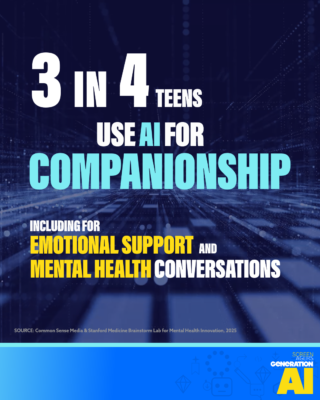
(From Screenagers: Generation AI)
Broken hearts become agents for change
The film explores the massive and mundane ways AI impacts kids’ lives. Elliston Berry, for example, was 14 when she discovered her photos on social media had been edited with AI to make her appear nude. Sam Nelson, 19, and Sewell Setzer III, 14, lost their lives because they relied on AI chatbots for deadly information.
These heartbreaking experiences galvanized families into action. Berry helped establish the bipartisan Take It Down Act, which criminalizes non‑consensual deepfake pornography and requires platforms to remove reported harmful images within 48 hours.
The families of Sam Nelson and Sewell Setzer III are suing the tech companies behind the chatbots that provided information to their children, alleging that the chatbots are designed to be manipulative and addictive.
As Robbie Mornay, director of AI Programs for Common Sense Media, says in Screenagers: Generation AI: “Parents and the public may assume that each version of an AI tool is safer than the last, and I think this is one of the most fundamental misconceptions that exists.”
In the film, Zak Stein, who founded the AI Psychological Research Coalition, explained: “The first wave of social media hacked our attentional system. It hijacked our ability to pay attention. This next wave of AI is hacking our attachment system.”
This quote stuck with Zachary Stowell, Principal at Robert Eagle Staff Middle School.
“The concept that these companies were focusing on your attention then, and your attachment now was so telling,” Stowell said after the screening at his school. “As a principal, I try to find palatable concepts that my students can understand, and I think this will hit for them.”
The film makes it clear that putting guardrails on this industry will require public demand.
Stowell was shocked by AI companies’ lack of accountability: “It is so irresponsible, and yet again we put profits over our kiddos’ wellness,” he said.
(From Screenagers: Generation AI)
Process matters more than answers
Generation AI also shows how AI affects kids’ daily lives. Interviews reveal students using AI for personal advice and homework answers—even during class time. These shortcuts, however small, come at a cost.
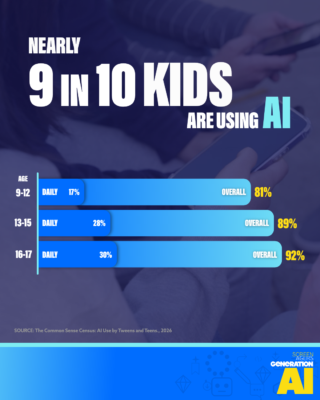
Experts warn that repeated use of AI for schoolwork or social interactions can have negative consequences for childhood development. And yet a 2026 survey from Common Sense Media found that 86% of kids between nine and 17 years old already use AI, from search engine summaries to complex chatbot relationships, and there are few, if any, guardrails in place for children.
“My concern about kids going to robots for all kinds of communications is that they will get caught in this trap of perfectionism, this idea that the robot has all of the right answers,” says Stanford psychologist Dr. Anna Lembke in the new film. “They no longer trust their own inner judgment, their own voice.”
In friendship, research suggests that face-to-face interaction can provide emotional and social benefits that text communication does not always replicate, even when talking in person feels more uncomfortable. In school, research on “productive failure” similarly suggests that struggling with a problem, trying different approaches and sometimes getting it wrong before receiving instruction can produce deeper conceptual understanding and a greater ability to apply that learning to new problems than simply being shown how to get the right answer.
Advice for parents
After the film screening at Robert Eagle Staff, Ruston answered questions and offered concerned viewers some advice:
- Start talking to kids now, and often, about AI. “Short conversations on a regular basis” can have a big influence, said Ruston.
- Develop a family AI plan that considers “SAM” — how does our family use or not use AI in our Social lives, Academic lives, and Mental lives?
SPS parent and attendee Ashley Worobec called Screenagers: Generation AI “critical viewing not only for parents, but for the people deciding how this technology shows up in our schools.”
One of those people is Superintendent Ben Shuldiner, who hasn’t yet seen Screenagers: Generation AI, but has been putting a lot of thought into students’ use of technology.
“Seattle Public Schools is keenly aware of the impact of technology on our students,” Shuldiner said. “We are working diligently with both internal and external groups, including families and advocates, to determine the best course of action to both limit the abundance and over-reliance on screen time and access to inappropriate technologies, as well as making sure that we teach our students how to use technology thoughtfully and positively.”
Bring Screenagers: Generation AI to your school
Want to get the conversation about kids and AI going at your school? Screenagers: Generation AI is available for school and community screenings and is recommended for students in grade 6 and up. Visit the Screenagers Host a Screening page and submit a screening inquiry. Schools can request a preview of the film before committing to a license. Schools and PTSAs can arrange a one-time community screening or sign up for a school membership that allows repeated screenings and provides access to classroom materials and shorter versions of Screenagers films.
Make it a community conversation: Consider inviting students and parents to watch together, then follow the film with a discussion about how families and schools want kids to use AI. Screening hosts receive discussion and promotional materials to help organize the event.