Ever wonder what it takes to raise a baby shark? Kids visiting the Seattle Aquarium’s Discovery Lab can find out for themselves with the lab’s introduction to “shark nannying.”
The Aquarium introduced four hands-on activities at the Discovery Lab earlier this year, giving children and adults new ways to explore marine life and conservation. Six additional activities are in development, with plans to introduce them before the end of 2026.
Located on the Ocean Pavilion’s second floor, the lab invites visitors to experiment, play and learn alongside Aquarium educators. Activities are designed to help visitors young and old understand marine animals and the work being done to protect them.
“We’ve seen a very high level of engagement,” Nicole Killebrew, the Aquarium’s manager of Visitor Engagement, said in a posting on the Aquarium’s Stories page in October. “Folks are inclined to stop and ask what’s going on.”
And it’s not just children who are getting hooked.
“One of the biggest joys has been how much our adult visitors have enjoyed these programs, as well as the kids,” said Jessica Colla, a marine science interpreter at the Discovery Lab, in the Stories post. “Many of my interactions start by talking to the children, and then I realize their parents are just as curious.”
Colla recalled one family that spent more than an hour trying activities and learning about marine research. Their child enjoyed the experience so much that they wanted to return someday as an Aquarium volunteer.
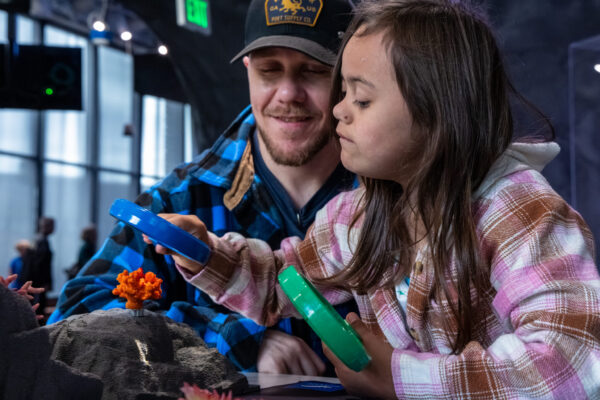
Exploring coral in the Seattle Aquarium Discovery Lab (Photo by Djordje Zlatanovic / Seattle Aquarium)
Four activities to try now
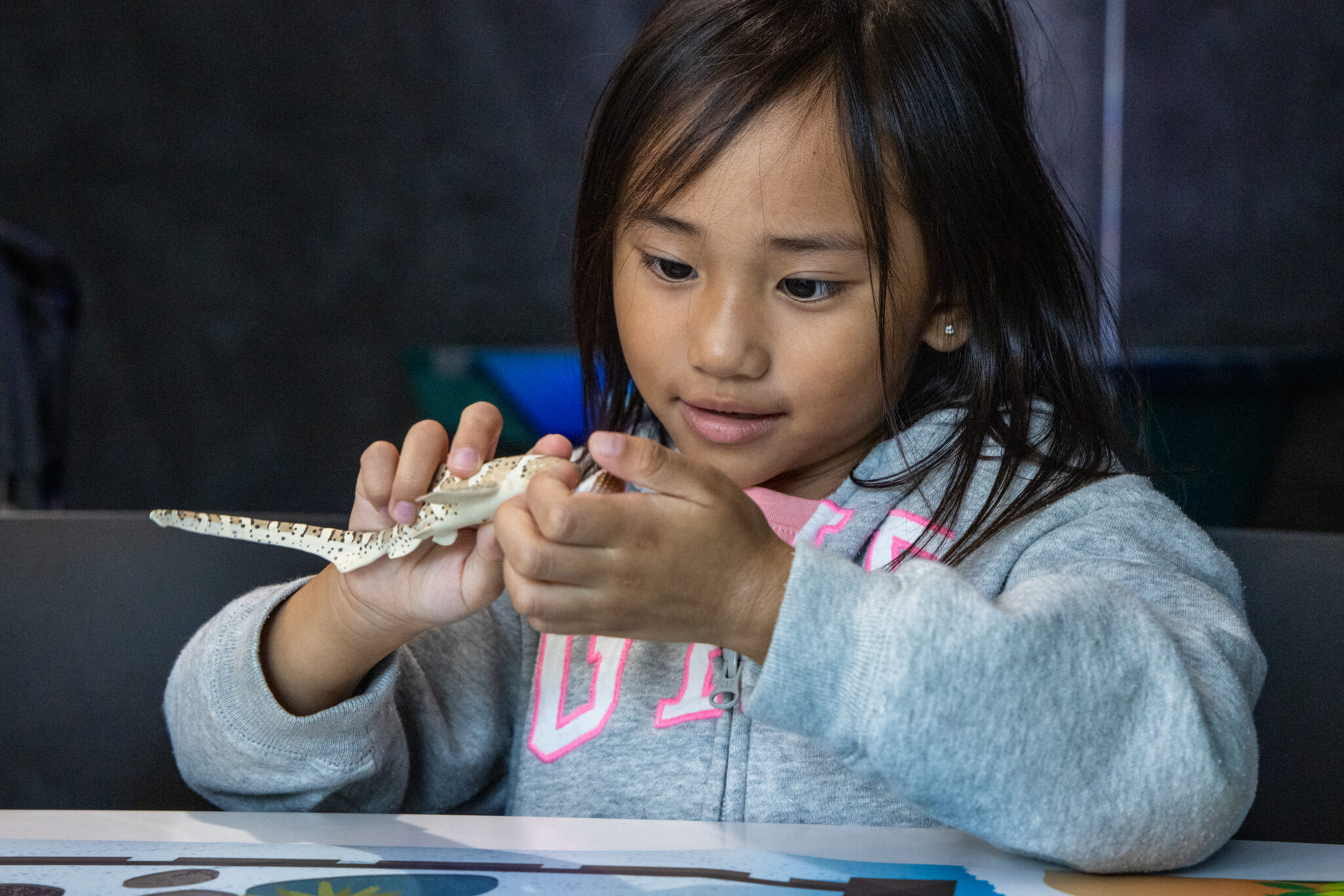
Become a shark nanny. Kids can step into the role of caretakers for endangered Indo-Pacific leopard sharks, beginning with the earliest stage of a shark’s life. The activity includes a real egg casing from Oatmeal, a leopard shark born at the Aquarium who now lives in the Ocean Pavilion’s largest habitat, The Reef.
Young visitors help their pretend shark pups grow by collecting clams and snails for them to hunt in a model sea pen. They can also learn how scientists prepare sharks for release into the wild and practice tagging a plush shark.
The activity introduces children to the STaR project, an international conservation effort co-founded by the Aquarium to help rebuild wild populations of Indo-Pacific leopard sharks. STaR stands for Stegastoma tigrinum Augmentation and Recovery, a reference to the species’ scientific name.
In the Stories post, marine science interpretive diver Sam McNeely, who helped create the shark nanny activity, said two kids who recently completed the session were so enthusiastic about nannying that they gave their pretend pups names.
“They named them after themselves,” McNeely said. “This gave them a sense of belonging and purpose in caring for their shark and the recovery of the species, just like it does for the real shark nannies.”
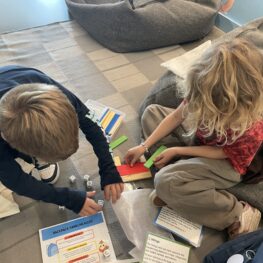
Build a coral reef. Could a flat coral survive a powerful storm? What about a tall, branching coral when ocean conditions change? In this interactive card game, players select different coral shapes and decide where to place them in a three-dimensional reef.
Then comes the challenge: The game introduces changing environmental conditions, and players discover whether their chosen corals can withstand them. A plankton feeding frenzy might favor one coral type, while a storm could challenge another.
The activity demonstrates why coral reefs contain so many different shapes and structures, and how those differences help marine animals survive. It also introduces the importance of reefs, which support an estimated quarter of known marine life despite covering less than 1% of the ocean floor.
Discover how reef animals eat. Seahorses suck up their meals, blueband gobies sift through sand, and moray eels use specialized jaws to catch prey. Children can investigate these unusual feeding techniques using stuffed animals and real anatomical specimens.
Available for examination are a moray eel jaw and examples of feeding structures from other marine creatures. Kids can look closely at porcupinefish teeth or a sea urchin’s mouth and consider what those features reveal about an animal’s diet.
Educators can adapt the experience to visitors’ interests, whether a child wants to investigate a favorite stuffed sea creature or discover an unfamiliar animal.
Create an ocean habitat. Give a child a whiteboard, 52 specially designed magnets and the freedom to build an underwater world, and the results can be surprisingly elaborate. In the ocean habitat-building activity, you can arrange fish, corals, mangrove trees, shrimp, people and other elements into their own tropical ecosystem. As participants add or remove pieces, educators help them consider how the different parts of a habitat depend on one another — and how human activity can affect the balance. The activity gives children an opportunity to see how an ecosystem works as a connected whole, from its smallest creatures to its largest plants and animals.
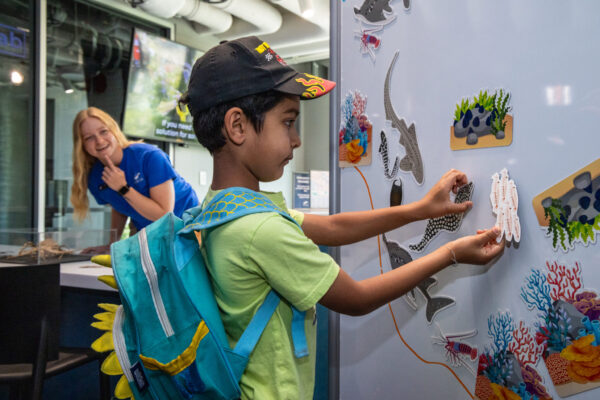
Using a whiteboard to learn about and create animal habitat (Photo by Djordje Zlatanovic / Seattle Aquarium)
Six more activities coming soon
The Aquarium’s Visitor Engagement team is developing six additional games and puzzles designed to introduce visitors to ocean science and conservation. The planned activities include:
- Ocean research tools: A card game introduces equipment scientists use to study the ocean, from underwater robots and water-sampling bottles to satellites. Props will help children explore how researchers collect information about marine environments.
- Mangrove Plinko: A mangrove-themed version of the familiar game demonstrates how coastal forests protect wildlife and human communities. Players will learn about the role mangrove roots and trees play in coastal ecosystems.
- Kelp versus mangroves: A matching puzzle compares the benefits of Pacific Northwest kelp forests with those of Indo-Pacific mangrove forests, showing how these different habitats support marine life.
- Jelly discoveries: A magnet game and puzzle introduce the anatomy and life cycles of lagoon, upside-down and moon jellies, inviting visitors to investigate how these unusual animals develop and survive.
- Sharks and rays: A card game explores the adaptations that help different sharks and rays find food, reproduce and survive in their habitats.
- Ocean currents: Players follow the journeys of a sea turtle, a research vessel and a piece of marine debris in a board game that demonstrates how ocean currents connect distant parts of the world.
The Aquarium expects the expanded programming to be in place by the end of 2026, although it has not announced specific launch dates for the six activities. Visitors should check with Aquarium staff to learn which activities are available.
If you go
Where: Discovery Lab, second floor of the Seattle Aquarium’s Ocean Pavilion, Seattle waterfront.
When: Activities generally take place daily between 10 a.m. and 4:30 p.m., depending on staffing. There’s no fixed schedule, and offerings vary from day to day. Ask Aquarium staff what’s available during your visit.
Cost: Included with Aquarium admission, which covers the Ocean Pavilion and Piers 59 and 60. Children ages 3 and younger enter free; children ages 4–12 receive reduced admission. Additional discounted admission programs are available.